T1#consumer
Nintendo Famicom Released
Metadata
- Date
- Decade
- 1980s
- Tier
- T1
- Sources
- 08
- Connections
- 01
- Tags
- #consumer
The Family Computer went on sale in Japan on Friday 15 July 1983 at ¥14,800. Its North American counterpart, the Nintendo Entertainment System (NES), did not reach stores across North America until 27 September 1986—more than three years later. "When did the Famicom come out?" and "When did the NES come out?" have different answers.
| Region | Product | Date | Source |
|---|---|---|---|
| Japan | Family Computer (HVC-001) | 15 July 1983 | Nintendo's Famicom timeline; Nintendo IR |
| North America (test market) | NES | October 1985 (New York) | Video Game History Foundation |
| North America (test market) | NES | February 1986 (Los Angeles) | Centre for Computing History |
| North America (nationwide) | NES | 27 September 1986 | Centre for Computing History; English Wikipedia |
Nintendo's own investor-relations table of sales by region records the machine as "released on July 15, 1983" with the region given as Japan, using the Japanese date.
What was in the box: model HVC-001
According to the specifications Nintendo publishes, the console had a single "8-bit N-CH custom" CPU and two 2K×8-bit static RAM chips. It measured 150 mm wide, 220 mm deep and 60 mm tall, weighed about 620 g including both controllers, drew roughly 4 W, and ran from a dedicated AC adapter rated DC 10 V, 850 mA.
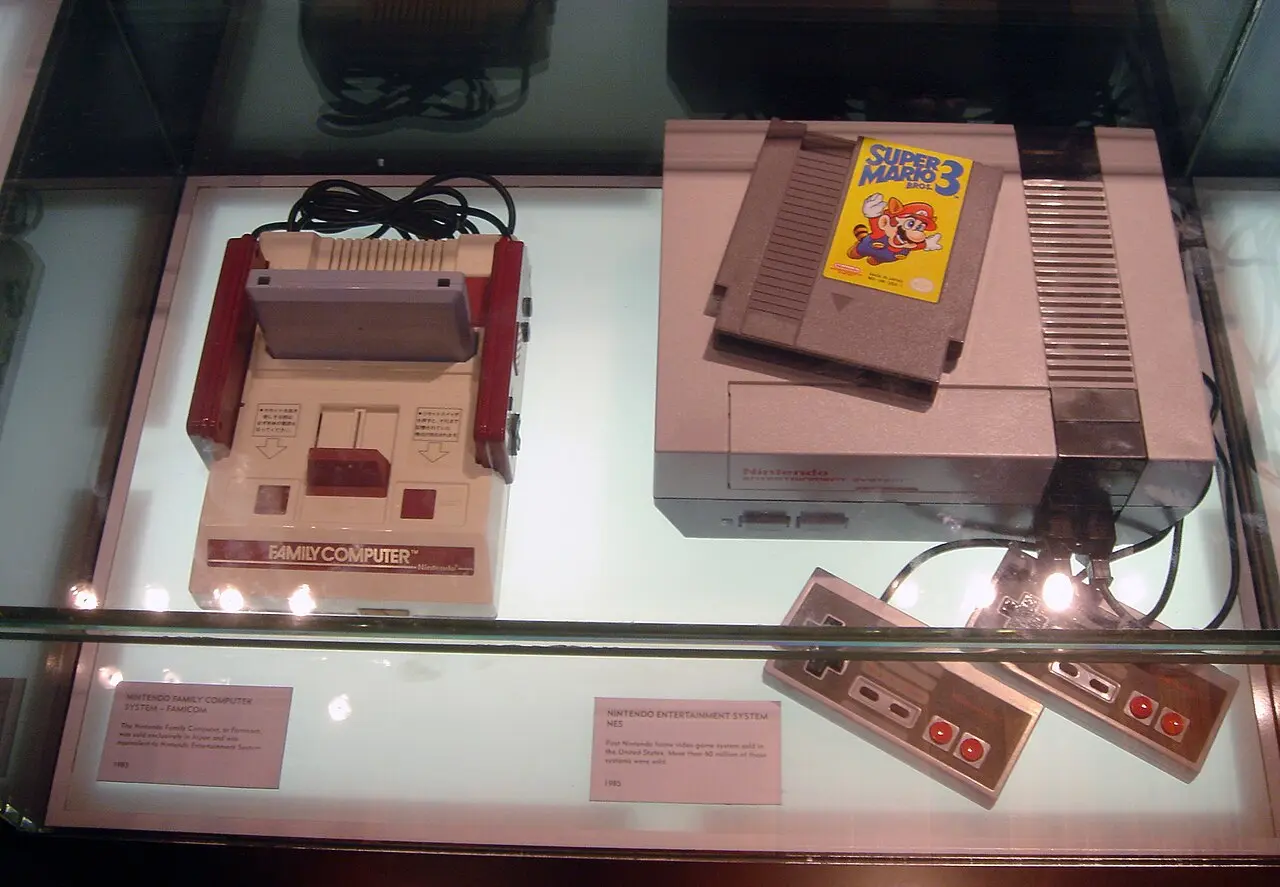
The two controllers were hard-wired to the console, and they were not identical. Controller I carried SELECT and START; Controller II replaced them with a microphone and a volume slider. The box also held an RF switch and a 75 Ω/300 Ω converter for feeding the picture into a television's aerial socket—a reminder that the machine was designed as a home appliance that borrowed whatever TV the family already had.
Nine games in the first year
The three launch titles were Donkey Kong, Donkey Kong Jr. and Popeye. Nintendo's timeline notes that all three were already running in arcades, and that the selling point was being able to play arcade-style games at home. Mario Bros. followed in September, bringing the 1983 total to nine titles.
At launch, then, the Famicom was sold as an arcade you could keep in the living room, and Nintendo's own arcade catalogue supplied the first shelf of software.
Two later dates that changed the machine
Two dates after launch changed what the Famicom was:
- 13 September 1985 — Super Mario Bros. goes on sale
- 21 February 1986 — the Disk System, a peripheral using rewritable disk cards, goes on sale
The first was a large game built for the home console rather than ported from an arcade; the second bolted a medium other than the cartridge onto the console. Nintendo's timeline says console production, and the in-house rewriting of disk cards, continued until 2003, twenty years after launch. English Wikipedia gives 25 September 2003 as the day the last unit was manufactured.
The NES: same insides, different product
The NES was more than a renamed Famicom. The Video Game History Foundation describes the final NES sold in an October 1985 test market limited to New York as having "a new toy-like console design". English Wikipedia records that the "Deluxe Set" of that period sold for US$179.99 and bundled two controllers, the Zapper light gun, the R.O.B. robot and two games.
North America's home video-game market had collapsed shortly before—the so-called video game crash of 1983—and, according to English Wikipedia, Nintendo of America struggled simply to persuade retailers to stock the unit. After watching New York, Nintendo expanded to Los Angeles in February 1986 and to all of North America on 27 September 1986. When North American readers look up "the NES release date", they will meet either that last date or the first test-market month of October 1985.
Still selling in the 2000s
Nintendo's IR table of sales by region begins with the fiscal year ended March 1998, and it still has a line for Famicom hardware sold in Japan. Across the seven fiscal years from March 1998 to March 2004, it shows 30,000 to 60,000 units a year (rounded to the nearest ten thousand), about 330,000 in all. Nearly twenty years after launch, new Famicoms were still selling in Japan by the tens of thousands each year. The figures for the Americas over the same period are close to zero: the NES had long since finished.
In 2016 Nintendo announced a re-creation, the Nintendo Classic Mini Family Computer, with 30 built-in games at ¥5,980 before tax. That news release is one of the documents in which Nintendo itself restates the 15 July 1983 launch date.
How many were sold
Nintendo's IR figures for worldwide consolidated sales put the Famicom and the NES on a single line: 61.91 million consoles and 500.01 million games (table as of 30 June 2026). The table does not split Japan from the rest of the world, so it cannot answer how many Famicoms were sold in Japan alone. In a 2016 news release, Nintendo described the Famicom as a home console that had sold more than 60 million units worldwide.
What came next
Nintendo followed the Famicom with a 16-bit machine and then with the 3D-first Nintendo 64. In the decade after the Famicom, the CD-ROM-based original PlayStation redrew the map of home consoles. The company itself is covered on the Nintendo page.
Questions this page answers
- When was the Famicom released?
- In Japan, the Famicom went on sale on Friday 15 July 1983 at ¥14,800. Its North American version, the NES, has different dates: a New York test market in October 1985 and a full North American release on 27 September 1986.
- Were the Famicom and the NES released on the same date?
- No. The Famicom went on sale in Japan on 15 July 1983. The NES was test-marketed in New York in October 1985, reached Los Angeles in February 1986, and had its full North American release on 27 September 1986.
- What were the Famicom's launch titles?
- Three games, all ports of Nintendo arcade titles: Donkey Kong, Donkey Kong Jr. and Popeye. Nine titles in all were released in 1983.
- How many Famicom consoles were sold?
- Nintendo's IR figures count the Famicom and NES together: 61.91 million consoles and 500.01 million games worldwide. The table does not split them by region.
Sources
Primary手のひらサイズのファミコンに30タイトルを収録「ニンテンドークラシックミニ ファミリーコンピュータ」11月10日、メーカー希望小売価格5,980円にて発売 — 任天堂ニュースリリース
Cites the Japanese launch of 15 July 1983
Primaryファミコン年表 — 任天堂
Launch date, the three launch titles, nine titles in 1983, and the dates of Super Mario Bros. and the Disk System
Primaryファミコンとは? — 任天堂
Specifications for model HVC-001
PrimaryDedicated Video Game Sales Units — Nintendo IR
As of 30 June 2026
PrimaryConsolidated Sales Transition by Region (XLSX) — Nintendo IR
Lists the NES/Famicom as "released on July 15, 1983" with the region given as Japan
SecondaryThe NES Launch Collection — Video Game History Foundation
The October 1985 New York test market
Last updated: