T1#consumer
Game Boy — The Monochrome Handheld
Metadata
- Date
- Decade
- 1980s
- Tier
- T1
- Sources
- 06
- Connections
- 01
- Tags
- #consumer
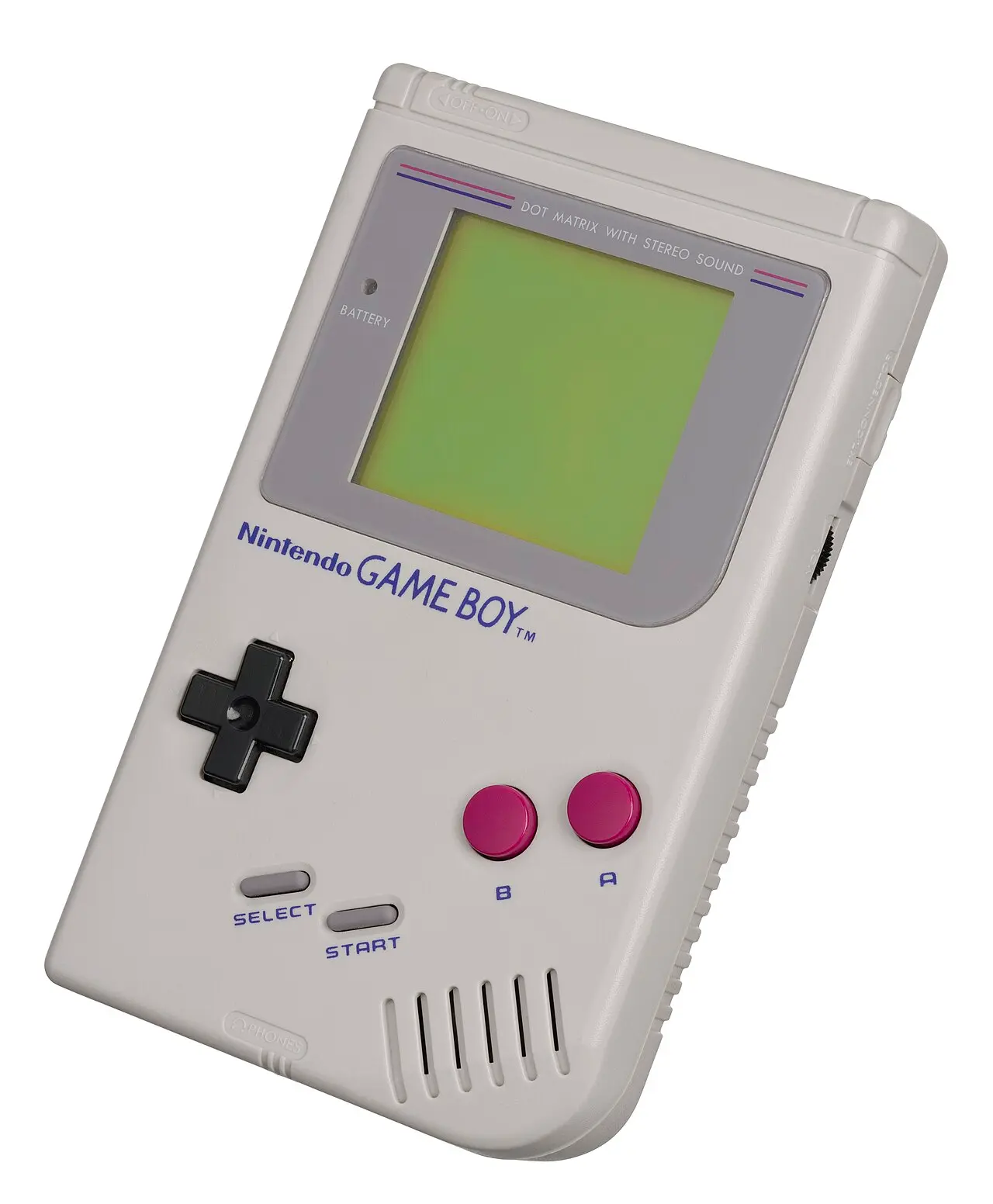
The Game Boy was released in North America on 31 July 1989. Japan had it first: Nintendo launched it there on 21 April 1989, a little over three months earlier, at ¥12,500. Nintendo's IR data likewise records the Game Boy's first release as 21 April 1989, in Japan.
| Region | Release date | Price | Source |
|---|---|---|---|
| Japan | 21 April 1989 | ¥12,500 | Nintendo IR (date); Blue Backs (price) |
| North America | 31 July 1989 | $89.99 | iMore (date); English Wikipedia (price) |
| Europe | 28 September 1990 | — | English Wikipedia |
Four launch games, and Tetris in June
Four games went on sale in Japan with the console: Super Mario Land, Alleyway (a block-breaker), Baseball and Yakuman (mahjong).
Tetris, the game most people now associate with the Game Boy, was not among them. According to Famitsu it came out in Japan on 14 June 1989, with a two-player mode over the link cable that Famitsu credits with making head-to-head play a standard of puzzle games. According to Kodansha's Blue Backs site, Tetris was the best-selling Game Boy game in Japan, at 4.24 million copies.
Elsewhere it was different. According to English Wikipedia, Tetris was bundled with the Game Boy in every region except Japan, so North American buyers could play it the day they opened the box.
Built from modest parts
The Game Boy was not designed around the newest components. According to English Wikipedia, development was led by Gunpei Yokoi and Satoru Okada of Nintendo R&D1: Yokoi favoured using mature technology cheaply, while Okada pushed for interchangeable cartridges and the link cable that would later make Pokémon trading possible.
| Item | Detail | Source |
|---|---|---|
| Screen | Monochrome LCD, 160 × 144 pixels, four shades; adjustable contrast | Famitsu; English Wikipedia |
| Screen size | 2.6 inches | iMore |
| CPU | Sharp SM83, about 4.2 MHz | English Wikipedia |
| Memory | 8 KB of RAM | iMore |
| Power | Four AA batteries, up to about 30 hours | English Wikipedia |
| Link | A cable connects two units | Famitsu; English Wikipedia |
At ¥12,500, it cost half the price of the Super Famicom that followed the next year.
A million by summer
According to Blue Backs, the Game Boy sold explosively from the start, passing one million units by the summer of 1989, with shops running out of stock.
Famitsu notes that the Game Boy stayed on the market for about 13 years before handing over to the Game Boy Advance, and names Pokémon among the series that kept it going. Nintendo IR gives the Game Boy Advance's release date as 21 March 2001.
118.69 million, including the Game Boy Color
Nintendo IR publishes these lifetime figures under "Game Boy". Famitsu presents them as figures for the Game Boy family, and iMore says they combine the Game Boy and its successor, the Game Boy Color. They are not the total for the original monochrome machine alone.
| Region | Hardware | Software |
|---|---|---|
| Japan | 32.47 million | 157.06 million |
| The Americas | 44.06 million | 190.61 million |
| Other | 42.16 million | 153.44 million |
| Total | 118.69 million | 501.11 million |
According to English Wikipedia, the monochrome models alone had sold 64.42 million units by late 1998.
A peak ten years on
Nintendo IR's regional data gives yearly figures starting with the fiscal year that began in April 1997 (the year to March 1998). Worldwide hardware sales of the Game Boy, Color included, were as follows; the source rounds to the nearest ten thousand.
| Fiscal year | Period | Hardware (worldwide) |
|---|---|---|
| FY3/1998 | April 1997 – March 1998 | 10.37 million |
| FY3/1999 | April 1998 – March 1999 | 12.99 million |
| FY3/2000 | April 1999 – March 2000 | 17.45 million |
| FY3/2001 | April 2000 – March 2001 | 18.86 million |
| FY3/2002 | April 2001 – March 2002 | 4.70 million |
The best year on record is FY3/2001, at 18.86 million—more than eleven years after the 1989 launch. These years include the Game Boy Color, so they do not trace the monochrome machine alone. The fall to 4.70 million in FY3/2002 came in the first year after the Game Boy Advance launched on 21 March 2001. Software also peaked within the published range in FY3/2001, at 76.19 million.
By region, nearly three-quarters of the hardware sold outside Japan. Where the Famicom reached North America as the NES more than two years after its Japanese launch, the Game Boy arrived there a little over three months behind Japan—a product meant for the world from the start.
What came after
Nintendo's handhelds went on through the Game Boy Advance of 2001 to the Nintendo DS of 2004, with two screens and a touch panel. The Nintendo Switch of 2017 then erased the line between home and handheld consoles.
For the home-console line, see the Famicom and Super Famicom; for the company, Nintendo; for the wider story, the game consoles timeline.
Questions this page answers
- When was the Game Boy released?
- In North America it was released on 31 July 1989. Japan had it first, on 21 April 1989, at ¥12,500.
- What games launched with the Game Boy?
- In Japan, four: Super Mario Land, Alleyway, Baseball and Yakuman. Tetris followed there on 14 June 1989. Outside Japan, Tetris was bundled with the console.
- How many Game Boys were sold?
- According to Nintendo IR, 118.69 million consoles and 501.11 million games worldwide, a figure that includes the Game Boy Color.
- What powered the original Game Boy?
- Four AA batteries, good for up to about 30 hours of play according to English Wikipedia. The screen was a monochrome LCD with adjustable contrast.
Sources
PrimaryConsolidated Sales Transition by Region (XLSX) — Nintendo IR
Release date of 21 April 1989 (Japan) and sales by region
Four launch titles; monochrome LCD; Tetris (14 June); 118.69 million for the Game Boy family
Secondary4月21日 任天堂が「ゲームボーイ」を発売(1989年) — ブルーバックス(講談社)
Launch price of ¥12,500; one million passed that summer
SecondaryOriginal Game Boy gets torn down by iFixit on 30th anniversary — iMore
North American release on 31 July 1989
TertiaryGame Boy — Wikipedia
Last updated: