T1#consumer
Nintendo Wii — Motion Control in the Living Room
Metadata
- Date
- Decade
- 2000s
- Tier
- T1
- Sources
- 06
- Connections
- 01
- Tags
- #consumer
The Wii launched in North America on 19 November 2006, priced at US$249.99 with Wii Sports in the box. North America was the first region in the world to get it: Japan followed thirteen days later, on 2 December 2006 at ¥25,000, then Australia on 7 December and Europe on 8 December 2006. Unusually for a Nintendo home console, it reached the Americas before Japan.
| Region | Release date | Price | Source |
|---|---|---|---|
| Americas | 19 November 2006 | US$249.99 (Wii Sports included) | Nintendo IR; Nintendo of America fact sheet |
| Japan | 2 December 2006 | ¥25,000 | GAME Watch, 14 September 2006 |
| Australia | 7 December 2006 | — | English Wikipedia |
| Europe | 8 December 2006 | — | English Wikipedia |
Nintendo's IR table of sales by region likewise records the Wii as "released on November 19, 2006", with the region given as The Americas. Nintendo's own records use the American date, not the Japanese one, as the reference.
Both launches were announced on 14 September 2006: the Japanese date and price at Nintendo's "Wii Preview" event in Japan, and the American date and price in a Nintendo of America fact sheet. The US$249.99 included Wii Sports, five sports on one disc. According to English Wikipedia, the Japanese package did not include Wii Sports. GAME Watch reported that Wii Preview also presented 105 Wii titles in all, including those from third-party publishers.
From "Revolution" to Wii
According to English Wikipedia, the console was code-named "Revolution" internally and first shown publicly at E3 in 2005. Inside were an IBM "Broadway" CPU and an ATI "Hollywood" GPU, a configuration that did not try to match PlayStation 3 or Xbox 360 on raw performance. The same article explains that under president Satoru Iwata, Nintendo put expanding the population of people who play games ahead of the processing-power race.
The Wii Remote: point and swing
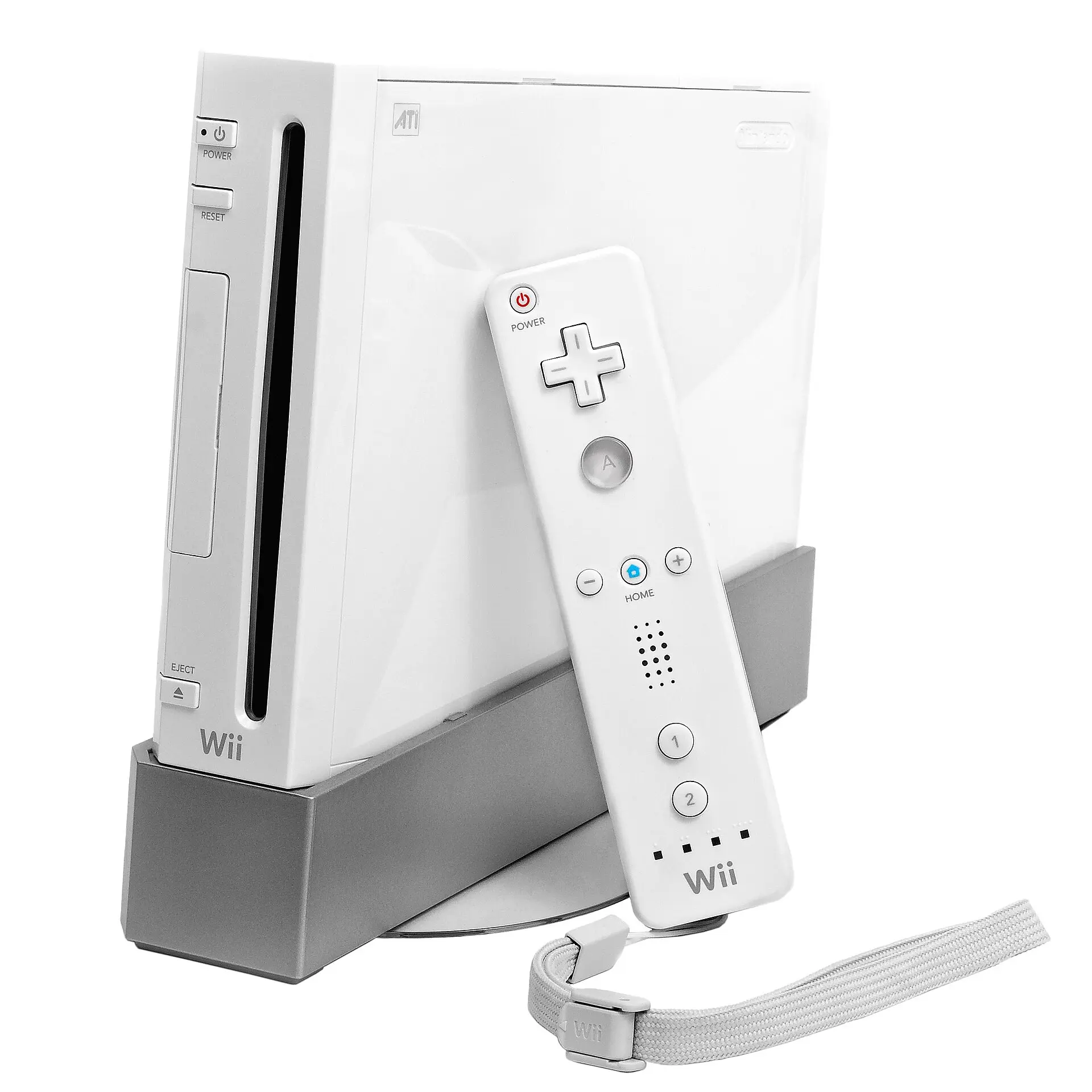
Control centred on the Wii Remote, which Nintendo of America's fact sheet described as resembling a television remote control. According to English Wikipedia, an accelerometer inside senses swings and tilts, while infrared sensing uses the Sensor Bar placed near the television to work out position. Swinging the remote like a tennis racket, or pointing it at a spot on the screen, became the input itself instead of pressing a button.
The fact sheet adds that the Nunchuk—a second controller connected to the Wii Remote and held in the other hand—also contained a three-axis motion sensor, so the movement of both hands could be used as input.
5.84 million in five months
On 26 April 2007, in its results for the fiscal year ended March 2007, Nintendo reported that Wii hardware had "got off to a favorable start with sales of 5.84 million units within the first five months after launch." The same document singled out The Legend of Zelda: Twilight Princess, which used the Wii Remote as a sword or a bow, and Wii Sports, five games simulating real sports, as having sold extremely well, and said the Wii was attracting expanded audience demographics as well as conventional gamers.
In that document Nintendo positioned the Wii as "a machine that puts smiles on surrounding people's faces", and said it would push further with its "Channel" concept—weather forecasts, news, web browsing—so that each member of a family would have a reason to switch the console on every day.
Where it sold
Nintendo's IR table of sales by region (cumulative to the fiscal year ended March 2026) splits the Wii's sales like this:
| Region | Consoles | Games |
|---|---|---|
| Japan | 12.75 million | 75.94 million |
| The Americas | 48.64 million | 502.53 million |
| Other | 40.23 million | 343.38 million |
| Total | 101.63 million | 921.85 million |
Nearly half the consoles were sold in the Americas, while Japan accounted for only about an eighth. Per console, buyers in the Americas bought about 10.3 games, against about 6.0 in Japan. Even the 5.84 million of the first fiscal year (launch to the end of March 2007) broke down as 2.00 million in Japan, 2.37 million in the Americas and 1.47 million elsewhere: the region that got the Wii first was its largest market from the start. Software in that first fiscal year totalled 28.84 million: 6.12 million in Japan, 14.49 million in the Americas and 8.23 million elsewhere—about three games per console even in Japan, within four months of launch.
How many were sold
Nintendo's IR figures for worldwide consolidated sales give the Wii 101.63 million consoles and 921.85 million games (table as of 30 June 2026). Among Nintendo's home consoles in that table, only the later Nintendo Switch, at 156.59 million, sold more; the Famicom (61.91 million together with the NES) and the Nintendo 64 (32.93 million) sold fewer.
According to English Wikipedia, production in Japan ended on 20 October 2013, and the Wii Shop Channel, where software was sold, closed in January 2019.
Nintendo's hardware line as a whole is traced on the Nintendo page.
Questions this page answers
- When was the Wii released?
- In North America the Wii launched on 19 November 2006 at US$249.99, the first region to get it. Japan followed on 2 December 2006 at ¥25,000, Australia on 7 December and Europe on 8 December.
- Did the Wii come with Wii Sports?
- In North America, yes: the US$249.99 package included Wii Sports. The Japanese package did not.
- How many Wii consoles were sold?
- Nintendo's IR figures give 101.63 million consoles and 921.85 million games worldwide. In the first five months after launch, 5.84 million consoles were sold.
Sources
PrimaryDedicated Video Game Sales Units — Nintendo IR (life-to-date hardware and software units)
As of 30 June 2026
SecondaryWii用ソフト スクリーンショット集 — GAME Watch、2006年9月14日
The Japanese date of 2 December and price of ¥25,000, announced at Wii Preview
SecondaryWii — Hardware — Nintendo World Report (Nintendo of America fact sheet, September 14, 2006)
The Americas date, US$249.99 and the bundled Wii Sports
TertiaryWii — Wikipedia
Last updated: