T1#consumer#launch#japan#storage
The MiniDisc — Sony's Recordable Disc Meant to Succeed the Cassette
Metadata
- Date
- Decade
- 1990s
- Tier
- T1
- Sources
- 06
- Connections
- 01
- Tags
- #consumer#launch#japan#storage
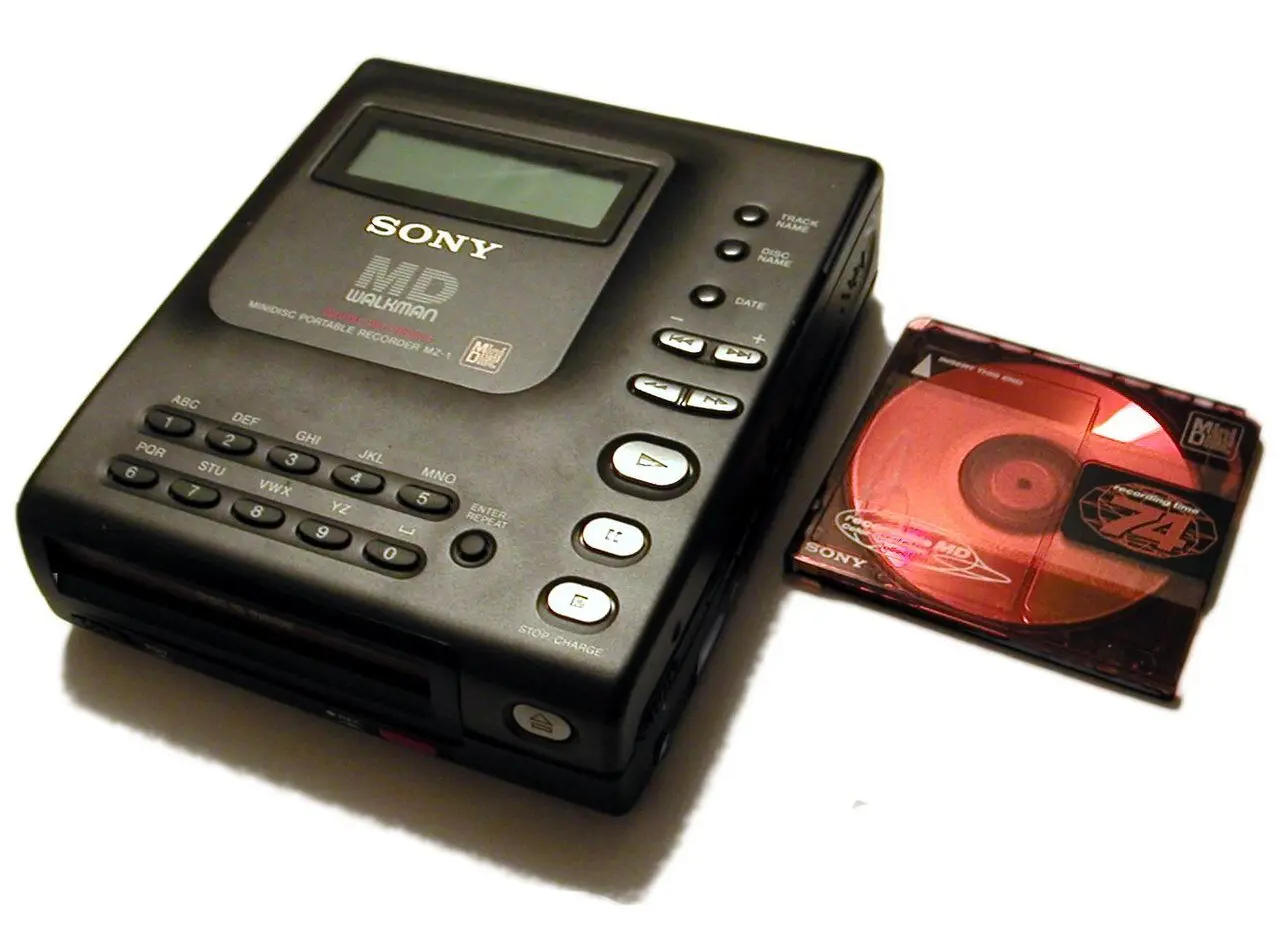
The MiniDisc (MD) went on sale in Japan in November 1992. According to Sony's history, the MZ-1 recorder, the MZ-2P player and the MDW-60 blank disc reached the shops together with 88 music titles from Sony Music Entertainment, and other countries followed in December. Sony pitched it as a small disc you could record on like a cassette and skip through instantly like a CD, and meant it to succeed the Compact Cassette.
| Item | Detail |
|---|---|
| Development begins | 1990 |
| Announcement | May 1991 |
| Release | November 1992 (Japan), December 1992 (other countries) |
| First products | MZ-1 (recorder), MZ-2P (player), MDW-60 (blank disc) |
| Disc | 6.4 cm, in a cartridge, magneto-optical recording |
| Recording time | 74 minutes (the same as a CD) |
| Audio compression | ATRAC (Adaptive TRansform Acoustic Coding) |
| Skip protection | "Shock-proof memory" using semiconductor memory |
| End of equipment sales | March 2013 (Sony) |
| End of blank disc production | February 2025 (Sony) |
Development and launch details are from Sony's history; the end dates are from Sony's notices.
A stalling cassette, and a recorder that used CDs
Sony's history says that by around 1990 sales of the Compact Cassette, pre-recorded music tapes included, had levelled off, with Japanese production volume and value falling since a peak in 1988. The CD could only play, and Norio Ohga, then Sony's president, wanted the next recordable music medium to be a disc as well.
The trigger was a "recorder using CDs" shown at the 1989 Audio Fair. After the CD, Sony had commercialised a write-once optical disc (WO) in 1986 and a rewritable magneto-optical disc (MO) in 1988, and the prototype used MO's magneto-optical recording. Ohga said the answer was not to record on CDs but to make a smaller disc to replace the cassette, and development started in 1990.
This time Sony and Philips, its partner on the CD, went separate ways. Sony's history says that Philips, which had created the Compact Cassette, was thinking of a digital cassette instead, and that repeated talks failed to bring the companies into step. Philips and others developed the Digital Compact Cassette (DCC), and Sony set the MiniDisc launch for November 1992, the same time as DCC.
ATRAC: 74 minutes on 6.4 cm
The disc was fixed at 6.4 cm. It had to hold the same 74 minutes as a CD on about a quarter of the area, and for that Sony developed a new audio compression technology, ATRAC (Adaptive TRansform Acoustic Coding). Because the disc was meant to be carried, Sony also developed "shock-proof memory", which bridged playback with sound held in semiconductor memory so that a jolt would not interrupt the music. The disc sat inside a cartridge.
Sony announced the MiniDisc system in May 1991. According to its history, Ohga used launch events in Japan and the United States to invite hardware and software makers at home and abroad to adopt MD, aiming at a launch by the end of 1992, and Sony signed licences with major manufacturers one after another. It positioned the CD for listening at leisure and the MD for use anywhere, like a Walkman.
A first model in one year
Sony's history says the engineers were handed the brief for a recorder and player about 6 cm square at the end of 1991, leaving a year until launch. The team were miniaturisation specialists who had worked on the Walkman and the D-50 portable CD player. The optical pickup was still under development, and the microcontroller software was unlike that of play-only CD players. Shizuo Takashino, the head of the business group, wrote to the family of each engineer working late nights and weekends to ask for their understanding.
On the software side, the CD pressing plants in Japan, the US and Europe could be used. Mass production of pre-recorded MDs began in Japan in August 1992 and abroad that autumn, and blank MDs went into production that July at Sony's Sendai Technology Center. For the November launch, listening campaigns ran at major electronics stores in Tokyo, Osaka and Nagoya.
A disc that caught on in Japan
According to Sony's history, industry-wide sales of MD hardware in Japan reached one million units in 1995. The format was extended beyond music, with MD Data for sound, images and text standardised in 1993 and MD Picture for images in 1994.
How far it spread varied by region. The English Wikipedia says MiniDisc was very popular in Japan and parts of Asia and did moderately well in Europe, and that Sony had sold 22 million MD players by March 2011. We could not confirm these figures in Sony's own documents.
Hi-MD: 1 GB to extend its life
On 8 January 2004 Sony Marketing announced the first products in a new Hi-MD format. A changed recording method and more efficient signal processing let existing MiniDiscs hold about twice as much, with about 300 MB of data on an 80-minute disc. A new 1 GB Hi-MD disc allowed up to about 45 hours of recording, and Hi-MD supported uncompressed linear PCM recording and playback. The release was moved from June to 10 July for the three Walkman models and the disc, and 21 July for the desktop audio unit.
The trend did not reverse. GIGAZINE reported on 8 July 2011 that Sony would end shipments of its MZ-RH1 Hi-MD Walkman in September 2011 and of Hi-MD discs in September 2012. The article put the decline down to flash-memory players that played MP3 files and worked easily with personal computers, the line that ran through MP3 and the iPod, which synced with a computer's music library.
Equipment in 2013, discs in 2025
On 31 January 2013 Sony announced that it would stop shipping its CMT-M35WM system stereo with an MD drive in March 2013 (planned), ending sales of all its MD recording and playback equipment. At that point it said it would keep making blank discs for the time being.
The discs ended in 2025. On 23 January 2025 Sony announced that production of all recordable MiniDisc and MD Data models would end in February 2025. The same notice announced the end of its recordable Blu-ray media and MiniDV cassettes, and said there would be no successors.
For the wider story of the hardware, see the hardware timeline.
Questions this page answers
- When did the MiniDisc go on sale?
- According to Sony's history, the MZ-1 recorder, the MZ-2P player and the MDW-60 blank disc went on sale first in Japan in November 1992, together with 88 music titles from Sony Music Entertainment. Other countries followed in December.
- How does a MiniDisc fit 74 minutes on such a small disc?
- To record the same 74 minutes as a CD on a 6.4 cm disc, about a quarter of a CD's area, Sony developed an audio compression technology called ATRAC (Adaptive TRansform Acoustic Coding).
- When did the MiniDisc end?
- On 31 January 2013 Sony announced that it would stop shipping its last MD system stereo in March 2013, ending sales of all its MD recording and playback equipment. Production of recordable MiniDiscs and MD Data discs ended in February 2025, with no successor.
Sources
Primary第10章 スタジオ録音もデジタルに <ミニディスク> — ソニーグループ「Sony History」(archived Nov 17, 2025)
Japanese cassette output peaking in 1988, the 1989 CD-recorder prototype and the start of development in 1990, the split from Philips, the 6.4 cm disc, 74 minutes, ATRAC and shock-proof memory, the May 1991 announcement, the November 1992 Japanese launch with 88 titles, overseas sales in December, one million units sold in Japan in 1995, MD Data and MD Picture
Primary「Hi-MD」規格 対応MDウォークマン3機種、デスクトップオーディオ1機種 計4機種 発売 — ソニーマーケティング, 2004年1月8日
Hi-MD with the 1 GB HMD1G disc and up to about 45 hours of recording, linear PCM, about double density on existing discs, and release dates moved to 10 and 21 July
Secondary一世を風靡したMD(ミニディスク)の最終進化形「Hi-MD」が出荷完了へ — GIGAZINE, 2011年7月8日
Sony's announcement that shipments of the MZ-RH1 Hi-MD Walkman would end in September 2011 and of the HMD1GA Hi-MD disc in September 2012
PrimaryMD搭載システムステレオ『CMT-M35WM』出荷終了のお知らせ — ソニー, 2013年1月31日
Shipments ending in March 2013, ending sales of all MD recording and playback equipment; MD blank disc production to continue for the time being
Primaryブルーレイディスクメディア、録音用ミニディスク、記録用MDデータ、ミニDVカセット生産終了のご案内 — ソニー, 2025年1月23日
Production of all recordable MiniDisc and MD Data models to end in February 2025, with no successor
TertiaryMiniDisc — Wikipedia
Popularity in Japan and parts of Asia; 22 million MD players sold by March 2011
Last updated: