T1#enterprise
Atari Pong Released Commercially
Metadata
- Date
- Decade
- 1970s
- Tier
- T1
- Sources
- 08
- Connections
- 00
- Tags
- #enterprise
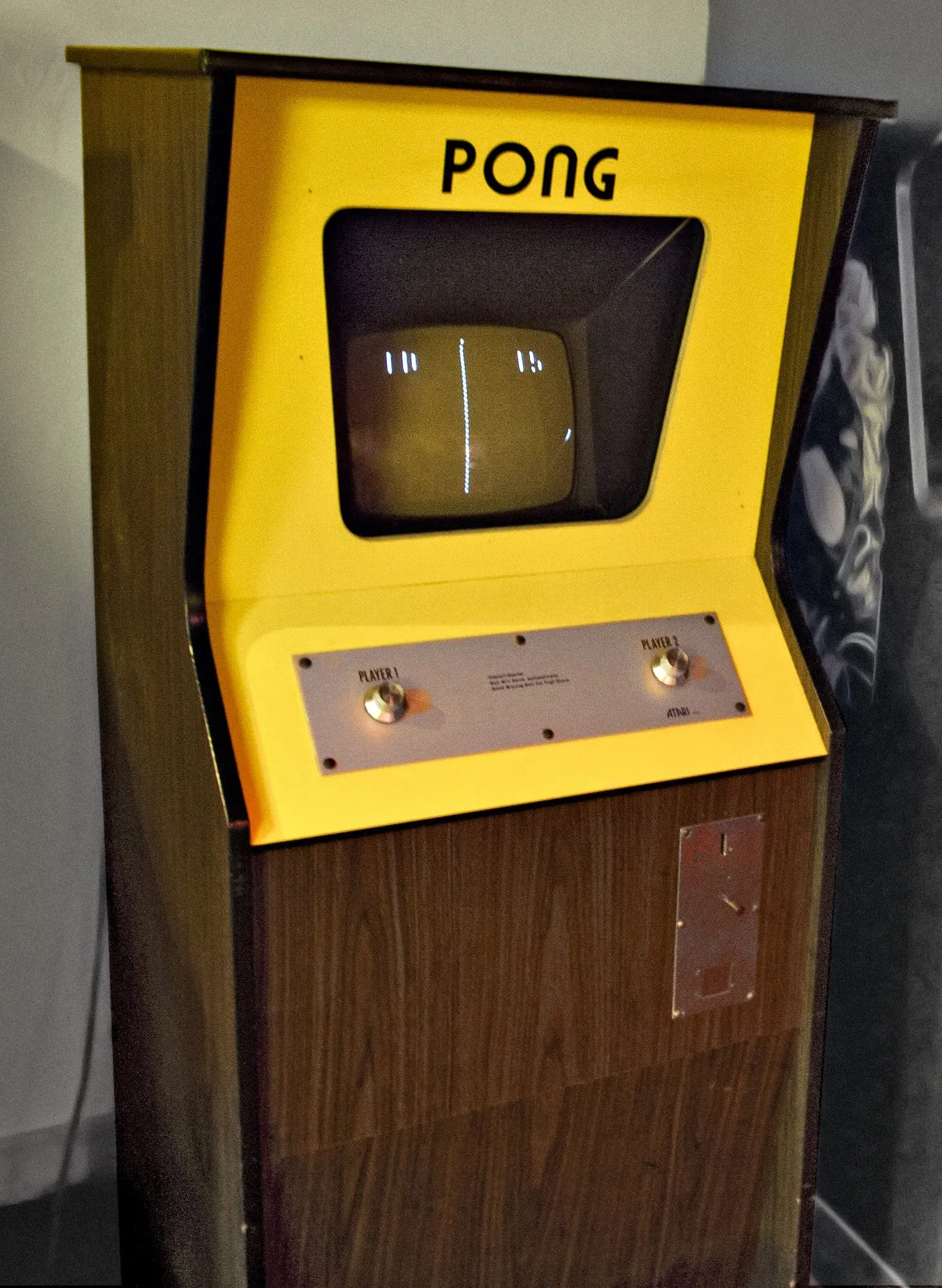
Pong is the coin-operated table-tennis game made by Atari in 1972. Each player turns a knob to move a paddle up and down the side of the screen and return a square ball. A prototype drew crowds at Andy Capp's Tavern in Sunnyvale, California, in 1972, and Atari announced the production game on 29 November 1972. It was built by engineer Allan Alcorn, to whom Atari founder Nolan Bushnell had handed it as a practice project. Pong was not the first video game, but it was the first big success that made video games a business.
A practice project
Alcorn had worked with Bushnell at Ampex. Bushnell's earlier video game, Computer Space, had come out through Nutting Associates and, in Alcorn's recollection, did not sell well. When Bushnell brought Alcorn into his new company — first Syzygy, later Atari — the first assignment was a very simple tennis game with one moving spot. The story Bushnell gave was a home-game contract from General Electric.
In his Computer History Museum oral history, Alcorn says the job was "just an exercise". Because he thought it was the real thing, he put in features to make it more playable. He also says he is sure Bushnell got the idea from seeing a demonstration of Magnavox's home console, the Odyssey.
The prototype at Andy Capp's
The prototype was built from what was at hand. Alcorn bought a $75 black-and-white television at Walgreens and converted it into a monitor, and bolted a laundromat coin box to the cabinet. The coins fell into a bread pan, and, he says, "even this bread pan would overflow at times it made so much money". There were no instructions on it at all. The three lines that the production version eventually carried — insert quarter, ball will serve automatically, avoid missing ball for high score — Alcorn says he wrote, sarcastically.
| Location | Andy Capp's Tavern, Sunnyvale, California |
| When | 1972 (sources differ between August and September) |
| Display | A converted black-and-white television (about $75) |
| Controls | Two knobs |
| Price per play | 25 cents |
| Survival | Alcorn gave the actual prototype from Andy Capp's to the Computer History Museum; it still worked as of 2002 |
Word of the one machine spread, and people started showing up to play it. Atari had meant to design games and license them to big manufacturers such as Bally, not to build them. Alcorn remembers sitting at the bar at Andy Capp's, looking at a prototype making money, while Bushnell decided that Atari would go into manufacturing after all.
29 November 1972: Pong as a product
Atari is recorded as announcing Pong on 29 November 1972. Five days earlier, on 24 November, Bushnell had filed a patent on a control system for moving images on a screen with hand-operated selectors; it was granted on 19 February 1974 as US Patent 3,793,483.
Alcorn says Bushnell sold the cabinets for $1,200 each, with operators paying cash up front. Arcade games before it had typically been 10-cent plays; at a quarter, Pong could double an operator's income.
Not "the first video game"
Calling Pong the first video game is wrong. In 1958 Brookhaven National Laboratory showed Tennis for Two on an oscilloscope, and before Pong, Magnavox's Odyssey home console already featured a similar tennis game. The Strong National Museum of Play puts it this way: Pong was not the first electronic game, but it was the first to grab wide-scale public attention. The accurate claim is that Pong was among the first commercially successful video games — the one that turned them into an industry.
The Magnavox link nearly went to court. In Alcorn's account, Magnavox wrote to say Atari was infringing its patent, and shortly before the consumer electronics show of June 1976 Atari settled rather than spend the money and time to fight. He remembers the deal as a paid-up licence of around $300,000.
Into the home, and to Japan
In 1975 Atari put Pong on a single custom chip and sold a home version through Sears. According to the Computer History Museum, Sears's first order was for 200,000 units, delivered for Christmas 1975 under the Tel-Games brand.
Pong reached Japan quickly. According to Guinness World Records, Taito launched its first coin-op cabinet, the black-and-white Elepong, in July 1973. A 4Gamer.net article points out that Elepong and Sega Enterprises' Pong-Tron, usually called Japan's first video games, were both copies of Atari's PONG, and names as the first original Japanese video games those shown at an Iwate University festival in November 1973. For the home-console era that followed a decade later, see the Famicom.
Pong timeline
| When | Event |
|---|---|
| 1972 | Alcorn builds Pong as a practice project; the prototype goes into Andy Capp's Tavern |
| 24 November 1972 | Bushnell files a patent on a control system for moving images on a screen |
| 29 November 1972 | Atari announces Pong as a product |
| July 1973 | Taito's Elepong and Sega Enterprises' Pong-Tron go on sale in Japan |
| 19 February 1974 | Bushnell's patent is granted as US Patent 3,793,483 |
| 1975 | Home Pong goes on sale through Sears; the first order is for 200,000 units |
| June 1976 | Atari settles with Magnavox and takes a licence (Alcorn's account) |
As the table shows, within four years of a single prototype Pong had gone through coin-op success, a home version, copies abroad and a patent settlement.
The consoles that followed are on the game consoles timeline; the period is on the overview timeline.
Questions this page answers
- When was Pong released?
- A prototype went into Andy Capp's Tavern in Sunnyvale in 1972 (sources differ between August and September), and Atari announced the production game on 29 November 1972.
- Was Pong the first video game?
- No. Tennis for Two (1958) and the Magnavox Odyssey's tennis game came earlier. The accurate claim is that Pong was the first big success that made video games a business.
- Who built Pong?
- Allan Alcorn, an engineer at Atari. Founder Nolan Bushnell assigned it as a practice project, telling Alcorn it was a home game for General Electric.
- What was the first Pong-style game in Japan?
- Taito's Elepong of July 1973 and Sega Enterprises' Pong-Tron are usually named. A 4Gamer.net article points out that both were copies of Atari's PONG.
Sources
The practice project and the GE story, the Odyssey, the $75 TV, coin box and bread pan, the decision at Andy Capp's, $1,200 and 25 cents, and the Magnavox settlement
SecondarySpicer, D. (2022). 50 Years of Fun With PONG — Computer History Museum blog, Nov 30, 2022
The Sears home version (200,000 units, Tel-Games)
SecondaryPong — World Video Game Hall of Fame, The Strong National Museum of Play
Pong as not the first electronic game but the first to grab wide-scale public attention
TertiaryPong — Wikipedia
The 29 November 1972 announcement, citing Atari production records
Last updated: