ORGANIZATION
Amazon
American company incorporated by Jeff Bezos in Washington State in July 1994, selling books online from July 1995 and public from May 1997. The name Amazon Web Services came first: in July 2002 it was a free XML and SOAP API opening Amazon's catalogue to outside developers. Renting computing came later, with S3 on 14 March 2006 and EC2 that August. Andy Jassy succeeded Bezos as CEO on 5 July 2021. In 2025, AWS was US$128.7 billion of US$716.9 billion in net sales — 18% — but US$45.6 billion of US$80.0 billion in operating income, 57%.
Organization
- Founded
- 1994
- Status
- Active
- Active
- 1994–
- Appearances
- 09
- Name
- ENAmazonJAAmazon
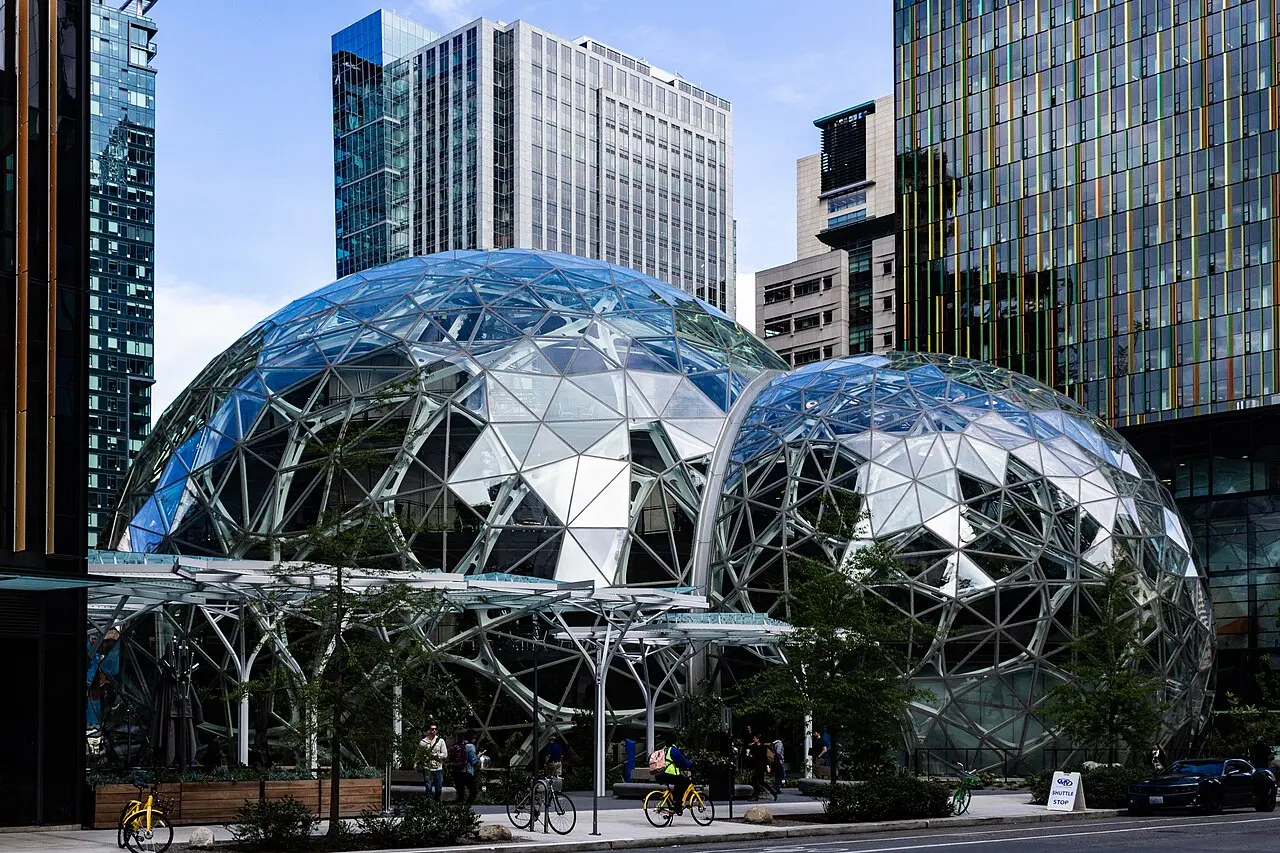
Amazon was incorporated in Washington State by Jeff Bezos in July 1994 — its financial statements date inception to 5 July — and began selling books over the web in July 1995. It reincorporated in Delaware in June 1996 and went public in May 1997. Headquartered in Seattle, it is now a conglomerate of retail, advertising, devices, video, and cloud infrastructure, employing roughly 1,576,000 people as of 31 December 2025.
Books, Prime, Kindle — and a name that predates the cloud
At the start there were only books. Net sales were US$511,000 in 1995, US$15.7 million in 1996, and US$147.8 million in 1997, by which point Amazon had served more than 1.5 million customers. The doctrine Bezos set out in that first shareholder letter — "We believe that a fundamental measure of our success will be the shareholder value we create over the long term," and "But this is Day 1 for the Internet and, if we execute well, for Amazon.com" — already contained the later preference for long-run cash generation over reported profit. On 2 February 2005 the company introduced Amazon Prime: a flat US$79 a year for unlimited two-day shipping, announced in the same release as full-year 2004 net sales of US$6.92 billion. The Kindle followed on 19 November 2007 at US$399 with 90,000 titles in its store — the point at which a retailer started building its own hardware.
The name Amazon Web Services predates the cloud. The first Amazon.com Web Services, announced on 16 July 2002, was a free XML and SOAP interface that let third-party sites search and display Amazon's catalogue and add items to Amazon shopping carts; its commercial logic ran through the Associates referral programme. Renting compute and storage by the hour and the gigabyte began later, with S3 on 14 March 2006 and EC2 in limited beta that August. From there the platform accumulated Redshift (2012), Lambda (2014), and Bedrock (2023), and by November 2024 it was hosting Claude in Palantir's accredited classified environment.
The succession ran through AWS as well. On 2 February 2021, alongside fourth-quarter results, Amazon announced that Bezos would move to Executive Chair in the third quarter and Andy Jassy would become chief executive; the 8-K filed that June fixed the date at 5 July 2021. Jassy had led AWS since its inception, as senior vice president from April 2006 and as its CEO from April 2016. A retail company put a cloud executive at the top.
18 per cent of sales, 57 per cent of the profit
| Segment | Scope | FY2025 net sales / operating income |
|---|---|---|
| North America | North American retail, advertising, subscriptions | US$426.3 bn / US$29.6 bn |
| International | Retail outside North America | US$161.9 bn / US$4.7 bn |
| AWS | Cloud infrastructure and foundation-model services | US$128.7 bn / US$45.6 bn |
The gap between where the revenue is and where the profit is defines the company. AWS accounts for 18% of net sales but US$45.6 billion of US$80.0 billion in operating income — 57%. Broken out by product and service in 2025: online stores US$269.3 bn, third-party seller services US$172.2 bn, AWS US$128.7 bn, advertising services US$68.6 bn, subscription services US$49.6 bn, physical stores US$22.6 bn. What Amazon charges other people to sell through it is already larger than AWS.
Key events
- July 1994: Incorporated in Washington State; inception dated 5 July.
- July 1995: Begins selling books online.
- May 1997: IPO. Full-year 1997 net sales are US$147.8 m.
- 16 July 2002: Amazon.com Web Services launches free — an XML and SOAP API over the product catalogue.
- 2 February 2005: Amazon Prime introduced at US$79 a year.
- 14 March 2006: Amazon S3; EC2 enters limited beta that August.
- 19 November 2007: Kindle released at US$399.
- November 2012: Amazon Redshift previewed at the first re:Invent.
- November 2014: AWS Lambda.
- 2 February and 5 July 2021: The Bezos-to-Jassy transition is announced, then takes effect.
- April 2023: Amazon Bedrock.
- 2024-2025: Convertible-note investments in Anthropic, US$2.7 bn of them in 2025; part converts to non-voting preferred stock.
- November 2024: Claude runs in the Palantir and AWS classified environment.
- 2025: US$2.5 bn charged for an FTC settlement and US$2.7 bn for severance tied to planned role eliminations.
Key metrics
- Net sales (FY2025): US$716.9 bn, up 12% / Operating income US$80.0 bn / Net income US$77.7 bn
- AWS: US$128.7 bn in sales, up 20%; US$45.6 bn in operating income
- Capital expenditure, net of proceeds from sales and incentives: US$128.3 bn, up US$50.7 bn year over year
- Free cash flow: US$11.2 bn, down from US$38.2 bn
- Employees: approximately 1,576,000 as of 31 December 2025
What US$128 bn of capex did to free cash flow
The most persistent misreading of Amazon is that AWS started the cloud. The idea of metered computing and the name AWS arrived at different times for different reasons: the name in 2002, over a catalogue API, and the business in 2006, with S3 and EC2. Flattening the origin into a single line loses what actually happened in between: a catalogue API that took four years to turn into something else entirely.
Present-day criticism clusters in three places. Labour comes first: the fulfilment network runs on about 1.576 million people, and Amazon's own 10-K lists periodic union organising efforts among its risk factors. In 2025 it booked US$2.7 billion of severance against planned role eliminations. Regulation comes second: the same year brought a US$2.5 billion charge to settle a lawsuit with the US Federal Trade Commission, plus a further US$1.1 billion covering Italian tax disputes and another settlement. Third is the weight of AI capital expenditure. Purchases of property and equipment, net, rose by US$50.7 billion in 2025 to US$128.3 billion, an increase Amazon attributes primarily to artificial intelligence, and free cash flow fell from US$38.2 billion to US$11.2 billion. That is consistent with the 1997 doctrine of maximising long-term cash flow; the size of the bet is not remotely comparable.
The Anthropic position makes the point concrete. Amazon put another US$2.7 billion into Anthropic convertible notes in 2025, part of which converted into non-voting preferred stock. It attributes the US$15.2 billion net gain recorded in non-operating income for 2025 primarily to revaluing that holding — more, in a single year, than the US$4.7 billion of operating income earned by the entire International segment. A bookseller that makes its profit in the cloud and books its gains on an AI stake has moved its centre of gravity a long way from books.
Appearances
- The Dot-Com Bubble Peaks and Bursts — NASDAQ 5,048.62
- Amazon S3 Launches — AWS's Cloud Begins with Storage
- Amazon Redshift Announced — The Cloud Data Warehouse Era Begins
- AWS Lambda — One Function, Billed by the Tenth of a Second
- The 2023 Tech Layoffs — The Month a Decade of Hiring Ended
- AWS Bedrock — Foundation Models as a Cloud Service
- pgvector Comes of Age — Putting AI Vector Search inside the RDB
- AI Goes to War — OpenAI Policy Reversal and the Anthropic-Palantir-AWS Pact
- Commerce Puts Two Anthropic Models Under Export Control — Nineteen Days Dark
Questions this page answers
- What is Amazon's country of origin, and when was it founded?
- Amazon is American. Jeff Bezos incorporated it in Washington State in July 1994, and it reincorporated in Delaware in June 1996. Its headquarters are in Seattle.
- What did Amazon sell first?
- Books. It began selling them online in July 1995 and went public in May 1997. Amazon Prime, at US$79 a year, followed in February 2005, and the Kindle in November 2007.
- Did Jeff Bezos create AWS?
- AWS was launched by Amazon while Bezos was its chief executive, but the person who led AWS from its inception was Andy Jassy (senior vice president from April 2006, CEO from April 2016). The name came first, in July 2002, on a free API over Amazon's catalogue; renting computing began with S3 in March 2006 and EC2 that August.
- Who is Amazon's CEO now?
- Andy Jassy. He took over from Bezos as CEO on 5 July 2021, and Bezos moved to Executive Chair.
Sources
Last updated: