T1#market
Windows 1.0 Released
Metadata
- Date
- Decade
- 1980s
- Tier
- T1
- Sources
- 08
- Connections
- 02
- Tags
- #market
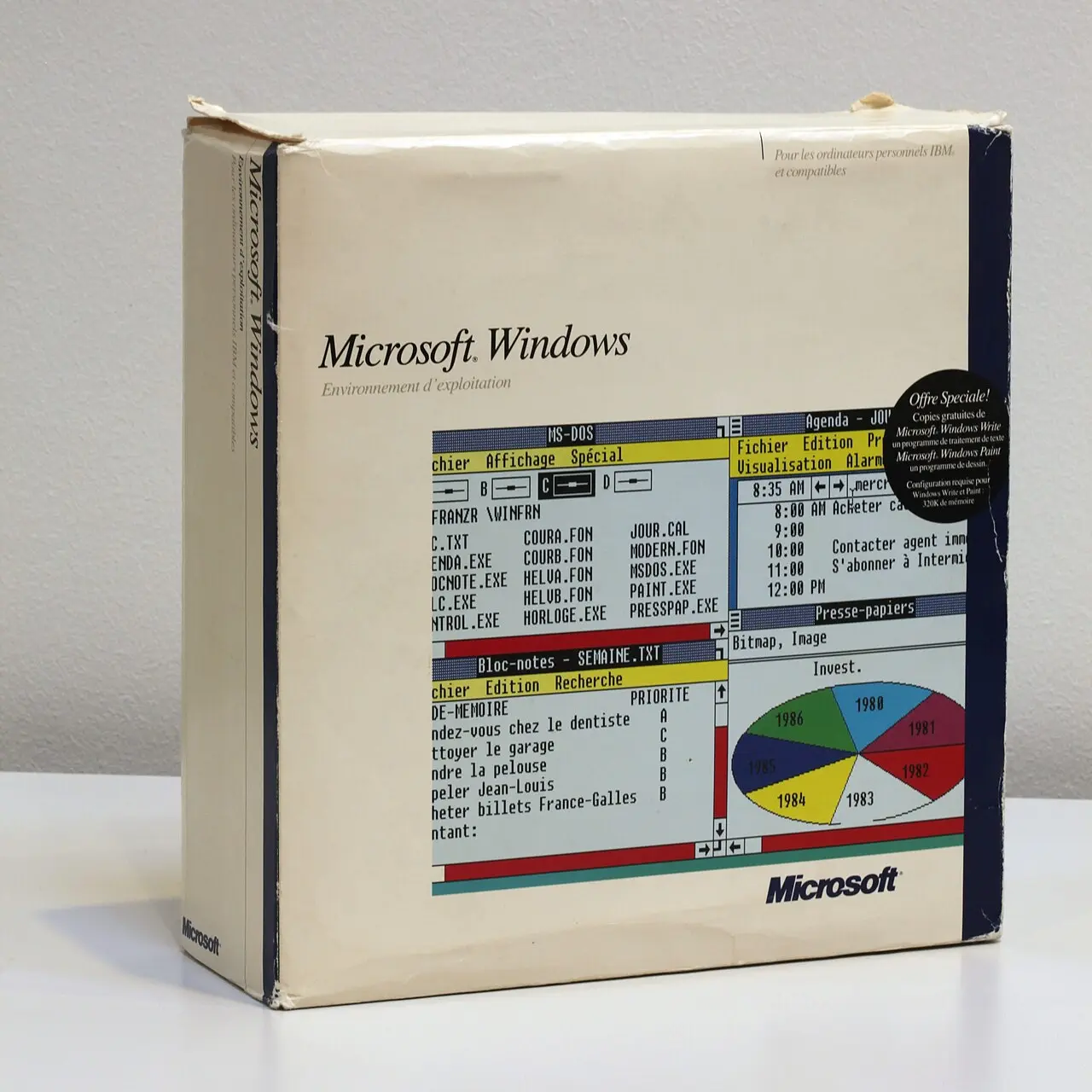
Windows 1.0 is the first Windows, shipped by Microsoft in the United States on 20 November 1985. It was not an operating system in today's sense but a graphical operating environment that ran on top of MS-DOS. Instead of typing commands, you pointed and clicked with a mouse and switched between several programs. It was the first attempt to bring that idea to IBM PC compatibles, and although it sold poorly, the line that leads to Windows 3.0 and Windows 95 starts here.
Two Years Late
Windows was announced in 1983 with much fanfare and the support of most existing PC makers. It then missed its promised dates, and, as Microsoft's own later history of Windows admits, sceptics called it "vaporware." Its development code name was Interface Manager, which came close to being the product name, but "Windows," describing the boxes on the screen, won out.
According to Tandy Trower, the product manager who finally shipped it, he moved to the Windows team in January 1985 at Steve Ballmer's invitation. Four product managers had already tried and failed to ship it, and the job had a reputation for career death.
| When | What happened |
|---|---|
| 1983 | Windows announced |
| January 1985 | Trower joins the Windows team; predecessor Scott McGregor leaves |
| November 1985 | Testing finished, launch celebrated at COMDEX; ships on 20 November |
| 9 December 1987 | Windows 2.0 introduces overlapping windows |
At COMDEX in Las Vegas, Microsoft marked the release with a "roast" of itself hosted by the columnist John C. Dvorak. Trower writes that the company was showing it was willing to admit it had totally underestimated what it would take to get Windows out the door. That release, which followed an earlier "Premiere" edition, was version 1.01; a version 1.03 with translations for several countries and bug fixes followed.
An Environment on Top of MS-DOS
Using Windows 1.0 required MS-DOS to be installed first. Microsoft's stated requirements were:
| Item | Requirement |
|---|---|
| Memory | 256 KB minimum (512 KB recommended for running several programs, or with DOS 3.0 or later) |
| Drives | Two double-sided floppy drives (a hard disk recommended) |
| Display | A graphics adapter (CGA, Hercules or EGA supported) |
Trower says it was Ballmer who set the minimum at a standard IBM PC with 256 KB of RAM and two 5.25-inch floppy drives.
Bill Gates introduced it with the words "It is unique software designed for the serious PC user…" The screen had drop-down menus, scroll bars, icons and dialog boxes, and you could switch to another program without quitting the one you were in.
Bundled Applets, Following the Mac
Alongside the MS-DOS Executive for managing files, Windows 1.0 came with Paint, Write, Notepad, Calculator, a calendar, Cardfile, a clock, a terminal program and the game Reversi. Trower recalls that he noticed the Macintosh bundled a small set of applications, MacWrite and MacPaint among them, and proposed that Windows ship with similar small programs. Paint could only draw in monochrome.
Windows That Did Not Overlap
Windows 1.0 arranged its windows as tiles that divided the screen and could not be stacked on top of one another. This was a design decision, not a technical limit. According to Trower, Windows had originally been designed with overlapping windows, and his predecessor McGregor changed it to tiling. Every windowing system then on the market or under development used overlapping windows, but there was no time to change it back before shipping. Trower restored overlapping windows in Windows 2.0.
Why McGregor chose tiling is unclear. One view holds that it kept Windows from looking too much like the Macintosh; Trower himself has suggested it may simply have been the earlier project manager's preference.
Reviews and Sales
The reviews were harsh. According to a TIME retrospective, early reviewers criticised it as far too slow, and slower still with more than one application running. The New York Times likened running Windows on a PC with 512 KB of memory to pouring molasses in the Arctic. Many people disliked the unfamiliar mouse as well.
| Period | Units | Source (as compiled by TIME) |
|---|---|---|
| November 1985 – April 1987 (Windows 1.0) | 500,000 | Computerworld |
| 1988 (after Windows 2.0 shipped) | 1 million | InfoWorld |
| 1985 – January 1990 (all versions combined) | fewer than 2 million | InfoWorld |
Across five years and every version, Windows sold fewer than two million copies. The picture changed only in 1990, when Windows 3.0 sold four million in its first year.
A Long Life
Commercially close to a failure, Windows 1.0 was not formally retired by Microsoft until December 2001, more than sixteen years after it shipped. A product that arrived one year and ten months after the Macintosh, with windows that could not overlap, would within a decade set the standard shape of the PC screen. What changed in between is covered in the articles on 3.0 and 95.
Questions this page answers
- When was Windows 1.0 released?
- It shipped in the United States on 20 November 1985. It had been announced in November 1983, so it arrived two years later than first promised. The version on store shelves was 1.01, priced at $99.
- Was Windows 1.0 an operating system?
- Not on its own. It was a graphical operating environment that ran on top of MS-DOS, which had to be installed first. It could run existing MS-DOS programs as well as applications written for Windows.
- Why couldn't windows overlap in Windows 1.0?
- Windows 1.0 tiled its windows. According to Tandy Trower, who shipped it, his predecessor Scott McGregor had changed the original overlapping design to tiling, and there was no time to change it back before release. Overlapping windows arrived with Windows 2.0 in December 1987.
- Did Windows 1.0 sell well?
- Not especially. Computerworld put sales at 500,000 copies from the November 1985 launch to April 1987. Reviews often called it slow; Windows did not become a commercial success until Windows 3.0 in 1990.
Sources
Taking over in January 1985, the predecessor's switch to tiled windows, the minimum requirements set by Ballmer, bundled applets modelled on the Mac, the COMDEX launch
TertiaryWindows 1.0 — Wikipedia
TertiaryMacintosh 128K — Wikipedia
Last updated: