T1
Windows 3.0 — The First Commercially Successful Windows
Metadata
- Date
- Decade
- 1990s
- Tier
- T1
- Sources
- 12
- Connections
- 04
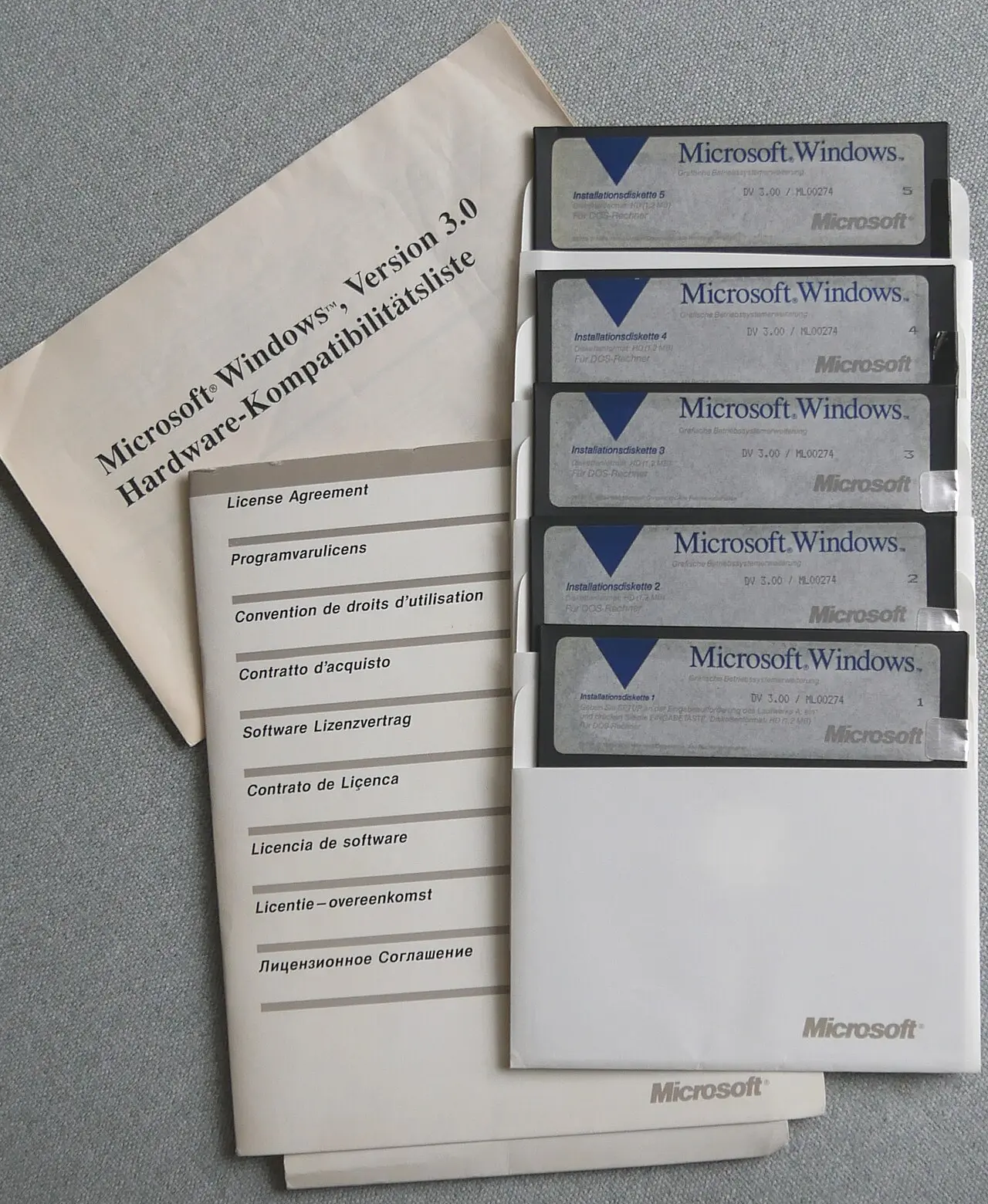
Windows 3.0 is the version of Windows that Microsoft released on 22 May 1990, and the first to be a large commercial success. For almost five years after Windows 1.0, every version of Windows combined had sold fewer than two million copies; 3.0 sold four million in its first year alone. Windows 3.1, released almost two years later on 6 April 1992, was its refinement. The two are often searched for together, but they are different products, and this article keeps them apart.
What Changed in 3.0
Microsoft's own history of Windows says that in 1990 "Windows starts to look like the versions to come." The change was both on the screen and underneath it.
| Area | What Windows 3.0 introduced |
|---|---|
| Shell | Program Manager in place of the MS-DOS Executive, with File Manager for files and Print Manager for printing |
| Display | 16-colour graphics and redesigned icons (the bundled drivers gave up to 16 colours on EGA, MCGA or VGA; 256 colours needed a capable adapter and the Palette Manager) |
| Processor support | 386 enhanced mode, making full use of the Intel 80386 |
| Operating modes | Three: real, standard and 386 enhanced |
Microsoft credits a new wave of 386 PCs with helping drive the popularity of Windows 3.0, and says that with full support for the 386, programs ran noticeably faster.
Three Operating Modes
Windows 3.0 ran in one of three modes, depending on the processor and memory available.
| Mode | Intended processor | Character |
|---|---|---|
| Real mode | Below the 80286 (8086/8088) | Compatibility mode, chiefly for older Windows 2.x applications |
| Standard mode | 80286 | Protected mode; suited to the average PC of the day |
| 386 enhanced mode | 80386 or later | Virtual memory and several MS-DOS sessions running side by side |
Describing 386 enhanced mode, Microsoft's Raymond Chen writes that "there were actually three operating systems running at the same time." In charge was a 32-bit virtual machine manager running in protected mode; the first virtual machine ran a copy of standard-mode Windows, and each of the others ran a copy of MS-DOS for a DOS session. Windows was still called a 16-bit operating system, he explains, because the applications it ran were 16-bit.
The Launch in New York
In May 1990 Microsoft staged a large launch event in New York. Steven Sinofsky, who would later run the Windows division, recalls it as one of the earliest examples, and certainly the most expensive, of a major event for a single Microsoft product. The event was relayed by satellite to conference rooms on Microsoft's campus.
It sold quickly. According to a Motley Fool retrospective, 100,000 copies went in the first two weeks. IBM, however, declined to pre-install Windows 3.0 on its PCs because it was still pushing OS/2, then about three years old. Microsoft instead signed up around 30 PC makers to bundle it.
| Period | Units | Source |
|---|---|---|
| First two weeks | 100,000 | Motley Fool |
| First year | 4 million | InfoWorld (compiled by TIME) |
| First two years of 3.0 and 3.1 combined | 10 million | Microsoft |
The Split from OS/2
The success of Windows 3.0 changed Microsoft's relationship with IBM. The two companies had signed a joint development agreement in August 1985 and had been building OS/2, the intended successor to DOS, together. Sinofsky writes that Microsoft and IBM had jointly urged developers to treat OS/2 as the long-term platform.
Once Windows 3.0, running on top of MS-DOS, began to sell, OS/2's advantages became mostly theoretical, in Sinofsky's account. Within 1990 the joint development came apart; Microsoft left OS/2 to IBM and moved its weight onto Windows. Microsoft's own history says the scale of the success caused it "to revise earlier plans."
How Windows 3.1 Differs
On 6 April 1992 Microsoft released Windows 3.1. It is easy to confuse with 3.0, but the differences are clear-cut.
| Item | Windows 3.0 (1990) | Windows 3.1 (1992) |
|---|---|---|
| Real mode | Present | Dropped; an 80286 or later required |
| Scalable fonts | Needed third-party products such as Adobe Type Manager | TrueType built in |
| Multimedia | Not in the standard product (a Multimedia Extensions edition followed in October 1991) | Sound cards, MIDI and CD audio supported |
| Bundled games | Solitaire, Reversi | Solitaire and Minesweeper (replacing Reversi) |
| Settings | INI files | Registry introduced (alongside INI files) |
The Computer History Museum gives 3.1's retail price as $149, and the InfoWorld figure compiled by TIME puts its sales at three million in roughly its first three months. A Japanese-language Windows 3.1 arrived in 1993; Microsoft Japan put first-year shipments at 1.46 million packages.
So many of the features remembered as "Windows 3.1", TrueType fonts and Minesweeper among them, were not in 3.0, while Program Manager and 386 enhanced mode were 3.0's own.
What Came Next
On the user base that 3.0 and 3.1 built came Windows 95 in 1995. It remade the screen with the Start menu and taskbar and gave Win32 applications preemptive multitasking, while still having to run the 16-bit applications written for Windows 3.1. The seams that left are covered in the Windows 95 article.
Questions this page answers
- When was Windows 3.0 released?
- On 22 May 1990. Microsoft held a large launch event in New York that day and the product went on sale at the same time. Its successor, Windows 3.1, followed almost two years later, on 6 April 1992.
- What is the difference between Windows 3.0 and Windows 3.1?
- Windows 3.1 (6 April 1992) dropped the real mode that 3.0 still had, requiring an 80286 or later, and added scalable TrueType fonts, Minesweeper, improved OLE, multimedia support such as sound and MIDI, and the registry. Program Manager and 386 enhanced mode arrived in 3.0; 3.1 inherited them.
- How many copies of Windows 3.0 were sold?
- By the InfoWorld figure compiled by TIME, four million copies in its first year. Microsoft's own history counts ten million for 3.0 and 3.1 together in their first two years. Windows 3.1 sold about three million in its first three months.
- What was new in Windows 3.0?
- Program Manager and File Manager in place of the MS-DOS Executive, Print Manager, 16-colour graphics with new icons, and 386 enhanced mode to make use of the 80386. It ran in three modes, real, standard and 386 enhanced, depending on the processor and memory.
Sources
SecondaryKouyoumdjian, V. DOS/V, Windows, Prices, and the Future... — Computing Japan, August 1994
The 1993 Japanese-language Windows 3.1 and Microsoft Japan's figure of 1.46 million packages shipped in its first year
TertiaryWindows 3.0 — Wikipedia
TertiaryWindows 3.1 — Wikipedia
TertiaryOS/2 — Wikipedia
Last updated: