Detailed · 30 events
A History of Microsoft
1970s
Microsoft's 1970s began with a single machine and ended with a business model. Gates and Allen wrote Altair BASIC without ever touching an Altair, testing it on an 8080 emulator running on Harvard's PDP-10, and sold it to MITS. In 1976 Gates complained in an open letter that hobbyist royalties valued the work at under two dollars an hour. The decisive step came in 1977, when Microsoft ended MITS's exclusive licence and offered the same interpreter to any maker of an 8-bit micro. Selling to everyone rather than to one partner returned, on a far larger scale, with the IBM PC.
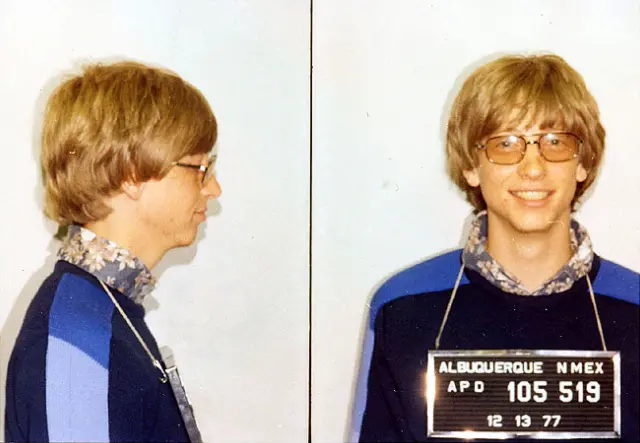
Albuquerque, New Mexico Police Department (Wikimedia Commons) · Public Domain · Commons ↗ Bill Gates and Paul Allen founded the company in Albuquerque to sell their BASIC interpreter for the Altair 8800. The original name was 'Micro-Soft'—with a hyphen. A year later, Gates' 1976 'Open Letter to Hobbyists', written in response to widespread piracy of Altair BASIC, became one of the earliest articulations of the idea of commercial software, and a symbolic document in the history of the industry.
1980s
Microsoft assembled the three products it would live on during the 1980s, and none of them started strongly. The operating system began as 86-DOS, bought outright and adapted for IBM. Windows 1.0 shipped two years after it was announced, with tiled windows and few applications, and reviewers were unkind. The first Office came out for the Macintosh, not for Windows. What the decade did settle was a pattern: supply the OS to every compatible maker, lay a graphical layer over DOS, sell the applications as one box. In 1990 Windows 3.0 and the Windows edition of Office arrived within months of each other.
- EVT.002T1The Birth of MS-DOS — PC DOS 1.0 and the IBM PCA History of Operating SystemsA General History of Information TechnologyRead more →
- EVT.003T1Lotus 1-2-3 — The Spreadsheet That Made the IBM PC the Office StandardA History of Semiconductors and HardwareRead more →
- EVT.004T1Windows 1.0 ReleasedA History of Operating SystemsRead more →
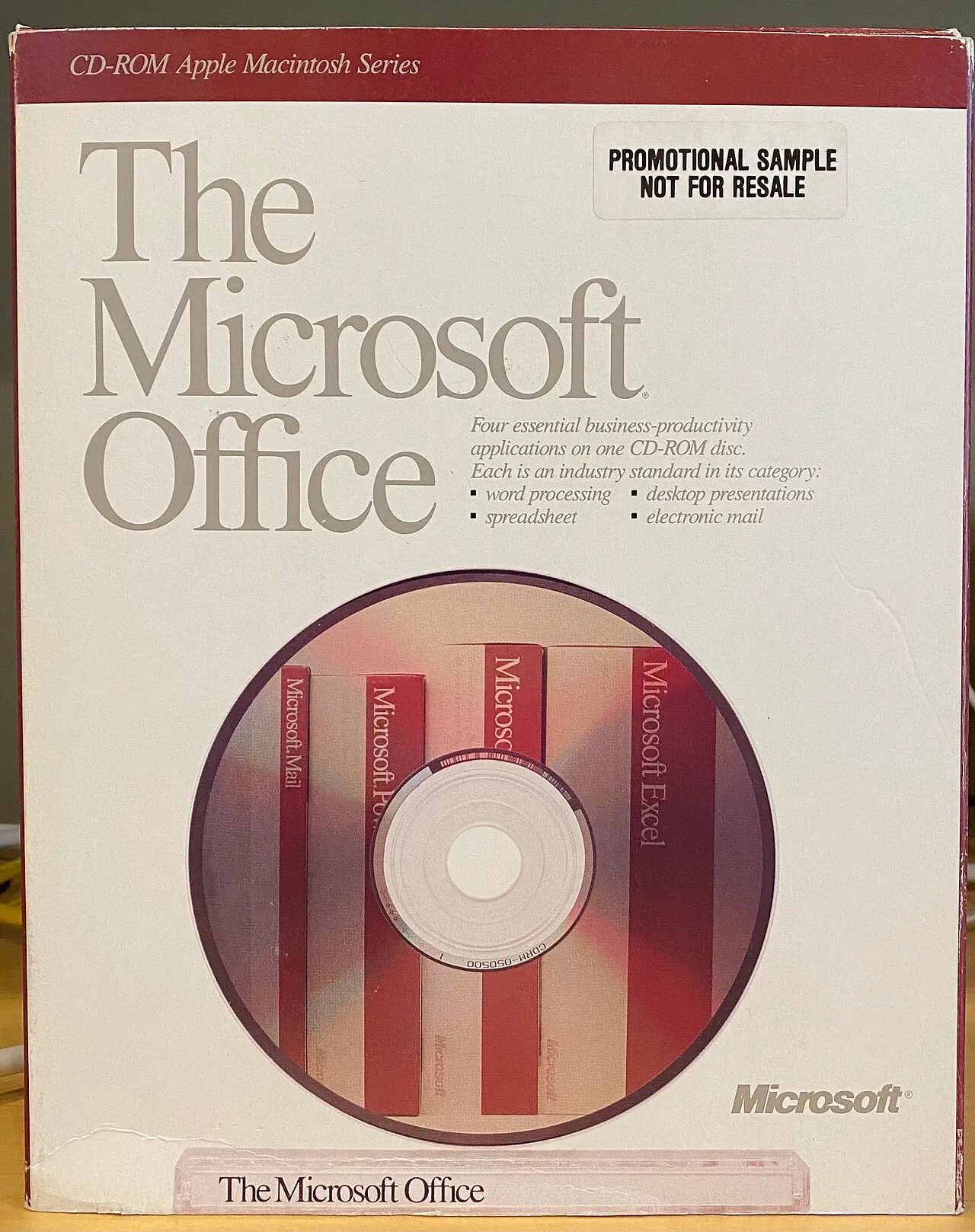
Brucery (Wikimedia Commons) · CC BY-SA 4.0 · Commons ↗ According to Microsoft's corporate history, Office for the Macintosh became available on 19 June 1989. It contained four applications—Word 4.00, Excel 2.20, PowerPoint 2.01 and Mail 1.37—so the first Office was a Mac product, not a Windows one, and it included an e-mail program. On 1 August Microsoft announced a CD-ROM edition putting the same four applications on one disc with their manuals, clip art and add-ons from other developers, at a suggested retail price of US$949 and expected by the end of September; Microsoft billed it as the first general business software for the Macintosh on CD-ROM. Office for Windows followed on 1 October 1990, a little over four months after Windows 3.0, with three applications: Word, Excel and PowerPoint. Selling documents, spreadsheets and presentations in one box became the basic shape of Office from then on.
1990s
Over the 1990s Windows went from a layer on top of DOS to the shape most people took a PC to be. Windows 3.0 was marketed on its own, apart from the OS/2 work Microsoft shared with IBM, and the four million it sold in its first year changed the balance between the two firms. Windows 95 then made the Start menu and taskbar the default picture of a desktop. Dominance on that scale drew the government in: in 1998 the Justice Department and twenty states sued, citing among other things the folding of Internet Explorer into Windows. How the case would end was left to the next decade.
- EVT.006T1Windows 3.0 — The First Commercially Successful WindowsA History of Operating SystemsRead more →
- EVT.007T1Windows NT — The 32-Bit Windows That Left DOS BehindA History of Operating SystemsRead more →
- EVT.008T1Windows 95 ReleasedA History of Operating SystemsA General History of Information TechnologyRead more →

AgnosticPreachersKid (Wikimedia Commons) · Public domain · Commons ↗ On 18 May 1998 the US Department of Justice sued Microsoft under the Sherman Act in federal court in Washington, DC, and twenty states and the District of Columbia filed a parallel suit the same day (Civil Actions 98-1232 and 98-1233). The charge was exclusionary conduct to protect its PC operating-system monopoly and extend it to browsers, including tying Internet Explorer to Windows. Judge Thomas Penfield Jackson found in his Findings of Fact of 5 November 1999 that Microsoft held monopoly power in Intel-compatible PC operating systems, ruled in his Conclusions of Law of 3 April 2000 that it had broken the law, and on 7 June 2000 ordered the company split into an operating-systems business and an applications business. On 28 June 2001 the DC Circuit, sitting en banc, upheld the monopoly-maintenance violation but reversed the attempted-monopolisation finding for browsers, remanded the tying claim, and vacated the remedy, including the breakup. Judge Jackson, who had given secret interviews to reporters while the case was pending, was removed from it. In September 2001 the DOJ said it would no longer seek a breakup, and on 2 November it settled with Microsoft; Judge Colleen Kollar-Kotelly approved the settlement on 1 November 2002. The conduct-based final judgment, after extensions, expired in May 2011.
- EVT.010T1Windows 98 — Home Windows with Built-in USB and the Browser Folded InA History of Operating SystemsRead more →
2000s
Two threads run through Microsoft's 2000s: the end of the courtroom fight and its first home console. The breakup ordered in 2000 was thrown out on appeal in 2001, and the settlement approved in 2002 imposed conduct restrictions instead, so the company stayed whole. In November 2001 Microsoft launched Xbox in North America, a console built essentially from PC parts, and with Xbox Live in 2002 it pushed online play toward the mainstream, joining Sony and Nintendo as a third major contender. In 2008 it announced a cloud computing service; its commercial launch would open the 2010s.
- EVT.011T1Windows 2000 — NT 5.0 Renamed, With Active Directory for BusinessA History of Operating SystemsRead more →
- EVT.012T1Windows Me — The Last of the Windows 9x LineA History of Operating SystemsRead more →
Microsoft launched Windows XP in New York on 25 October 2001 and declared it available worldwide. The Japanese-language edition reached Japanese shops about three weeks later, on 16 November, so Japan was not in the first wave. Built on the Windows 2000 engine, XP put home and business Windows on one code base and was sold as Home Edition and Professional. Service Pack 2 in 2004 tightened the default security settings, and XP stayed in wide use long after Vista arrived; extended support ended on 8 April 2014.
- EVT.014T1Xbox Released — Microsoft Enters the Console MarketA History of Game Consoles and Game TechnologyRead more →
- EVT.015T1Xbox 360 — Three Regions in Three Weeks, and the Red RingA History of Game Consoles and Game TechnologyRead more →

Microsoft Corporation (Wikimedia Commons) · Public domain (PD-textlogo; trademark applies) · Commons ↗ Windows Vista arrived in two steps. Development finished on 8 November 2006; volume-licensing business customers got it on 30 November; and consumers and other organisations got it on 30 January 2007, in more than 70 countries and 19 languages at once. The Japanese edition went on sale the same day, so Japan was in the first wave. Launched alongside Office 2007, it was billed by Microsoft as the most significant launch in its history. Its hardware demands cast a shadow, though: the 'Windows Vista Capable' stickers put on XP PCs before launch became the subject of a class action.
2010s
In the 2010s Microsoft turned from selling its own operating system toward hosting other people's code, both where it is written and where it runs. Windows Azure entered the cloud market behind AWS and grew on its ties to Active Directory, Office and SQL Server. TypeScript, led by the designer of C#, released its compiler under Apache 2.0. Under Satya Nadella, CEO from 2014, the company whose former chief had likened Linux to a cancer bought GitHub. In 2019 it put US$1 billion into OpenAI, at the time a research outfit with GPT-2 newly out, along with an exclusive cloud deal. That bet became the story of the 2020s.
- EVT.018T1Windows Azure Goes Live — Sixteen Months After Its UnveilingA History of Cloud ComputingRead more →
- EVT.019T1What Is Kinect? The Xbox Sensor That Made the Body the ControllerA History of Game Consoles and Game TechnologyRead more →
- EVT.020T1TypeScript Announced — MicrosoftA History of Programming LanguagesRead more →

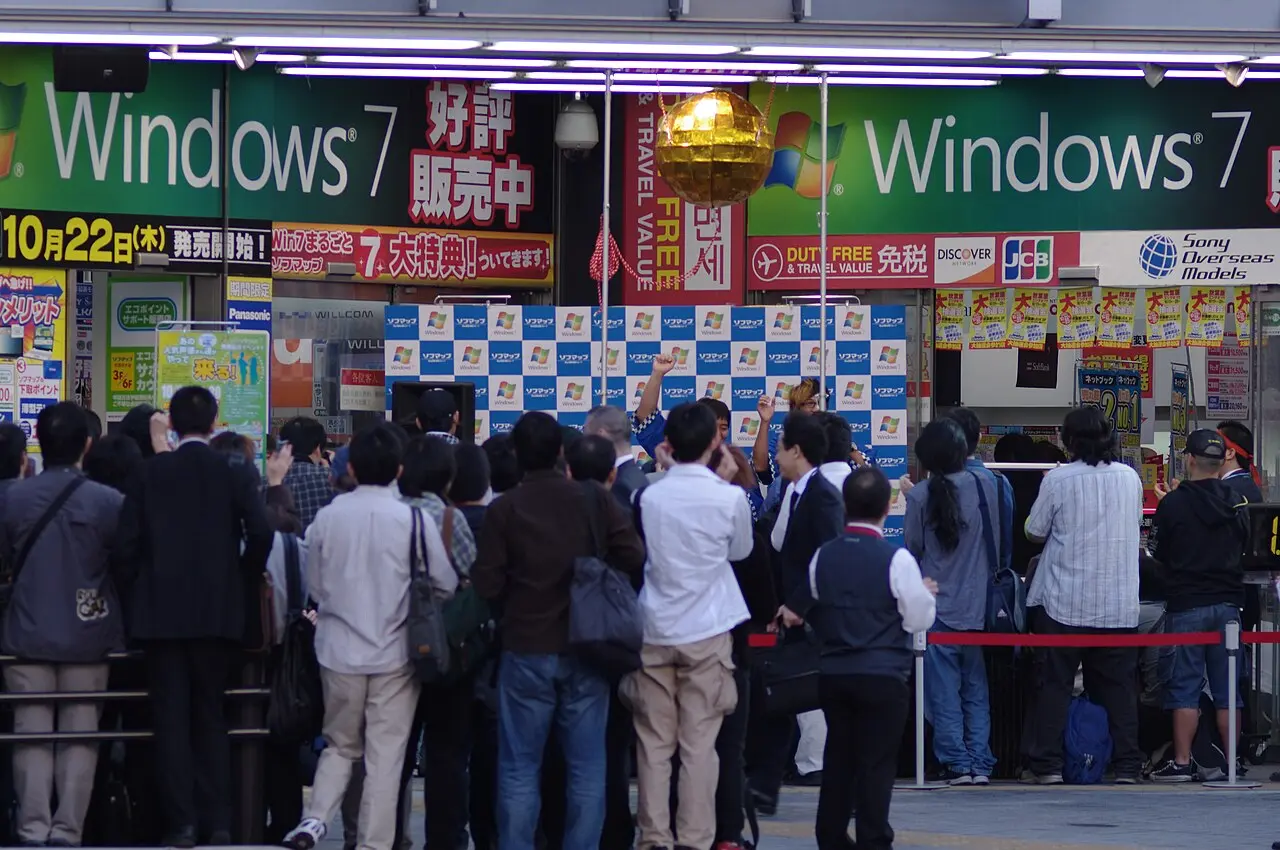
Microsoft Corporation (Wikimedia Commons) · Public domain (PD-textlogo; trademark applies) · Commons ↗ Released to manufacturing on 1 August 2012, launched at an event in New York on 25 October and put on sale on 26 October in more than 140 markets and 37 languages. Akihabara held midnight sales the same day, so Japan was in the first wave. Windows 8 put a touch-first Start screen and the new Windows Store at the centre, and arrived alongside Windows RT for ARM tablets and Microsoft Surface. Removing the familiar Start button drew strong criticism; the button came back in Windows 8.1, a free update in October 2013.
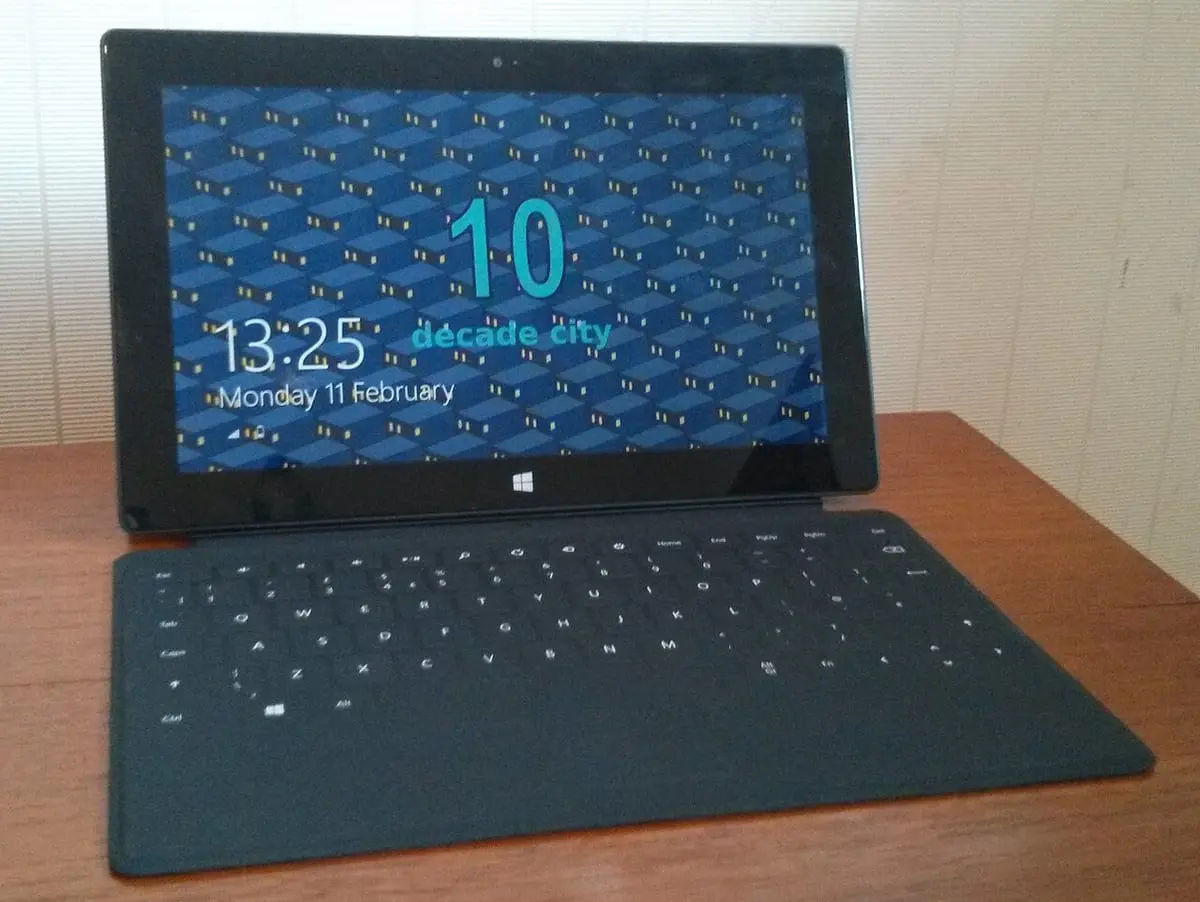
Orde Saunders (Flickr, via Wikimedia Commons) · CC BY 2.0 · Commons ↗ On 18 June 2012 in Los Angeles, Microsoft announced Surface, a tablet PC of its own design. There were two models: one with an ARM processor running Windows RT, and one with a third-generation Intel Core processor running Windows 8 Pro. Both had a 10.6-inch screen, a kickstand built into the case and a magnetic keyboard cover. The Windows RT model went on sale on 26 October 2012, the same day as Windows 8, at Microsoft Stores in the US and Canada and online, from $499 for 32 GB; Japan followed on 15 March 2013 at 49,800 yen. The Windows 8 Pro model arrived in the US and Canada on 9 February 2013 from $899. In July 2013 Microsoft took a $900 million charge for Surface RT inventory adjustments. Surface Pro 3 followed in 2014 and Surface Laptop in 2017, and in 2024 Surface was among the first Copilot+ PCs.
- EVT.023T1Xbox One — Microsoft's Third Console, Which Began With a U-TurnA History of Game Consoles and Game TechnologyRead more →



2020s
Microsoft's 2020s have been about cashing the 2019 bet across its products. Two months after ChatGPT appeared, it announced a larger, multi-year OpenAI investment; about two weeks later came a chat-equipped Bing, and in March Microsoft 365 Copilot. In gaming it closed the Activision Blizzard purchase after a federal court refused the FTC's bid to block it, and leaned harder on subscriptions. In 2024 it defined Copilot+ PCs by the speed of their NPU, but Recall, which captured the screen every five seconds, was shown to store its data in plain text and missed the launch. Where on-device AI meets private life is the question the decade leaves open.

Brian Smale / Microsoft (Wikimedia Commons) · CC BY-SA 4.0 · Commons ↗ Two months after ChatGPT's launch, Microsoft announced a multi-year, multi-stage extension of its investment in OpenAI. Reporting cited a total in the order of US$10 billion, which, with the 2019 US$1 billion, made it the largest AI-related investment in history. Azure became OpenAI's exclusive cloud, and GPT-4 was integrated across Microsoft's product line—Bing, Office, Teams, Windows, GitHub. Under the deal, Microsoft would receive a share of OpenAI's profits beyond a capped threshold; the two companies' finances became effectively inseparable.
- EVT.028T1New Bing and Microsoft Copilot — LLMs Enter SearchA History of Artificial IntelligenceA History of Search EnginesRead more →
Activision Blizzard (Wikimedia Commons) · Public domain (below threshold of originality) · Commons ↗ The acquisition Microsoft announced in January 2022 closed on 13 October 2023 after regulatory review across multiple jurisdictions. At US$68.7 billion, it was the largest deal in gaming history and one of the largest M&A transactions in tech overall. Major IP—Call of Duty, World of Warcraft, Diablo, Candy Crush—moved under Xbox / Microsoft Gaming. The US FTC's attempt to block it was denied in federal court; the UK CMA cleared a restructured deal in which Activision's cloud-streaming rights outside the EEA were sold to Ubisoft for fifteen years. Three months after closing, in January 2024, Microsoft Gaming laid off 1,900 staff, and the strategy of putting Call of Duty on Xbox Game Pass on day one accelerated the company's all-in pivot to subscriptions.
