T1
iPhone 6 and 6 Plus — The Pivot to Big Screens
Metadata
- Date
- Decade
- 2010s
- Tier
- T1
- Sources
- 11
- Connections
- 02
The iPhone 6 and iPhone 6 Plus were announced on 9 September 2014, opened for pre-order on Friday 12 September and went on sale together on Friday 19 September 2014. The first ten countries were the US, Australia, Canada, France, Germany, Hong Kong, Japan, Puerto Rico, Singapore and the UK. Japan was in that first wave; Apple's Japanese release added that NTT Docomo, KDDI and SoftBank would all carry it.
China was not. Its regulator, the Ministry of Industry and Information Technology, approved the phones only at the end of September, and they went on sale there on 17 October 2014, four weeks after the US. A second wave of 22 countries, from Austria to the United Arab Emirates, arrived on 26 September.
Two sizes on day one
For the first time, Apple launched two iPhones of different sizes on the same day.
| iPhone 6 | iPhone 6 Plus | |
|---|---|---|
| Display | 4.7-inch Retina HD | 5.5-inch Retina HD |
| Resolution | 1334 × 750 | 1920 × 1080 |
| Thickness | 6.9 mm | 7.1 mm |
| Optical image stabilisation | No | Yes |
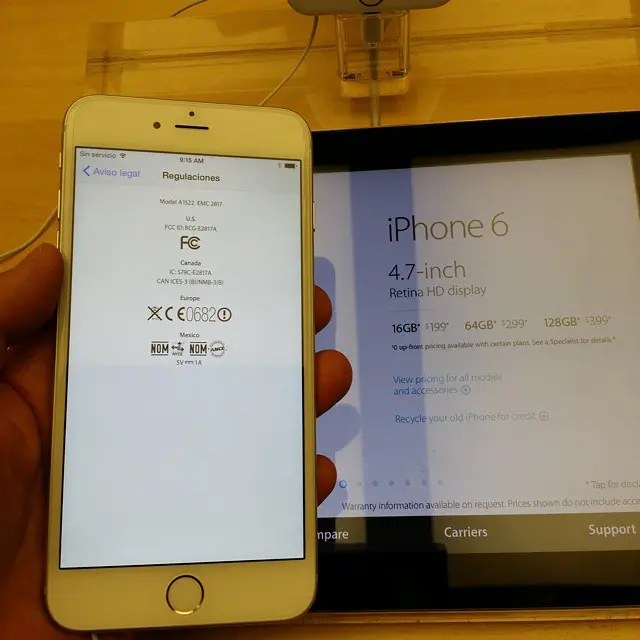
| US price, 2-year contract | $199 / $299 / $399 | $299 / $399 / $499 |
| Capacities | 16 / 64 / 128 GB | 16 / 64 / 128 GB |
The capacities also changed shape. The iPhone 5 had come in 16, 32 and 64GB; now the middle tier was 64GB and the top was 128GB, at the same $199/$299/$399 price points for the smaller phone. The bigger phone was a straight $100 premium at every tier.
Why the iPhone grew
Through the iPhone 4S the iPhone screen was 3.5 inches, and the iPhone 5 had stretched it only to four by making it taller. Rivals had gone further. The clearest marker is Samsung's Galaxy Note, unveiled at IFA Berlin in 2011 and first released in Germany in late October that year with a 5.3-inch screen — a size later labelled "phablet".
The iPhone 6 Plus answered that category directly, roughly three years later, and the 4.7-inch iPhone 6 became the new standard size. Apple's press release called the pair "the biggest advancements in iPhone history"; that is its own description.
The larger screens forced one new interaction. iOS 8 added Reachability: double-tap the Home button and the top half of the screen slides down within reach of a thumb. It existed because the phones were now too tall to use one-handed.
Apple Pay and the first NFC iPhones
The same event introduced Apple Pay. Apple said it worked with the iPhone 6 and 6 Plus "through a groundbreaking NFC antenna design", with card details stored as a device-specific number in a dedicated chip called the Secure Element and payments authorised by Touch ID. These were the first iPhones with NFC.
The phones shipped without the service switched on. Apple Pay went live in the US on 20 October 2014, with the free iOS 8.1 update — a month after the phones went on sale.
For buyers in Japan the gap was much longer. Apple Pay arrived in Japan on 25 October 2016, and in-store payments there, including Suica, ran over Sony's FeliCa standard rather than the NFC type the iPhone 6 supported. According to NFC World's report of the launch, the devices that worked were Japanese models of the iPhone 7, 7 Plus and Apple Watch Series 2. A Japanese iPhone 6 owner was never able to tap to pay in a Japanese shop with it. That story continues on the iPhone 7 page.
Other changes inside
- A8 chip, which Apple described as having a "second generation 64-bit desktop-class architecture"
- M8 motion coprocessor, now with a barometer
- Focus Pixels on the rear camera sensor for faster autofocus
- LTE across up to 20 bands, plus VoLTE and Wi-Fi calling where carriers supported them
Ten million in three days
On 22 September 2014, Apple announced it had sold more than 10 million iPhone 6 and iPhone 6 Plus units in the three days after launch, which it called a new record. That is Apple's own figure; it came without a split between the two models or by country, and it did not yet include China. Two years earlier Apple had reported more than five million iPhone 5 units over the same three-day span.
"Bendgate"
Within a week, reports spread online that the 6 Plus could bend. Apple responded on 25 September with a statement reported by TechCrunch and others: bending in normal use was extremely rare, and in the first six days of sale only nine customers had contacted Apple about a bent iPhone 6 Plus. Apple also pointed to steel and titanium inserts at stress points in the aluminium body.
Where the iPhone 6 sits
The iPhone 6 and 6 Plus fixed the two-size pattern the line has kept since. The next big rethink of the front of the phone came with the iPhone X in 2017, which dropped the Home button altogether.
The whole line is on the iPhone timeline; the company on Apple.
Questions this page answers
- When was the iPhone 6 released?
- It was announced on 9 September 2014, opened for pre-order on 12 September and released on 19 September. The iPhone 6 and iPhone 6 Plus went on sale the same day, and Japan was among the first ten countries, with NTT Docomo, KDDI and SoftBank all carrying it. China came later, on 17 October.
- How much did the iPhone 6 and 6 Plus cost at launch?
- In the US, with a two-year contract, the iPhone 6 cost $199 for 16GB, $299 for 64GB and $399 for 128GB; the iPhone 6 Plus was $100 more at each tier, $299, $399 and $499. Apple's press release gave only US dollar prices.
- What was the difference between the iPhone 6 and 6 Plus?
- The iPhone 6 had a 4.7-inch, 1334 × 750 display and the 6 Plus a 5.5-inch, 1920 × 1080 one. Only the 6 Plus had optical image stabilisation in its camera. Both used the A8 chip.
- Could the iPhone 6 use Apple Pay in Japan?
- Not for in-store payments. Apple Pay launched in the US on 20 October 2014 and reached Japan on 25 October 2016. In-store payments and Suica in Japan required FeliCa, which arrived with the Japanese iPhone 7, 7 Plus and Apple Watch Series 2.
Sources
PrimaryApple、iPhone 6とiPhone 6 Plusを発表 — Apple Newsroom(日本), 2014年9月
The three Japanese carriers and the launch date
PrimaryiPhone 5 First Weekend Sales Top Five Million — Apple Press Release, Sep 24, 2012
The comparable three-day figure two years earlier
TertiaryiPhone 6 — Wikipedia
Last updated: