T1
iPhone 5s — Touch ID and the 64-bit A7
Metadata
- Date
- Decade
- 2010s
- Tier
- T1
- Timelines
- A History of Semiconductors and Hardware · A History of the iPhone · A History of Mobile Phones and Smartphones
- Sources
- 08
- Connections
- 03
The iPhone 5s was announced on 10 September 2013 and released on Friday 20 September 2013. Apple named eleven first-day countries and territories: the US, Australia, Canada, China, France, Germany, Hong Kong, Japan, Puerto Rico, Singapore and the UK. Japan was in the first wave. So was China, which had not been among the nine launch-day countries for the iPhone 5 the year before.
Japan had a second piece of news. This was the generation in which NTT Docomo began selling the iPhone. Apple and Docomo announced on 10 September (11 September in Japan) that the iPhone 5s and the iPhone 5c, unveiled alongside it, would be available on Docomo's network from 20 September. With that, all three of Japan's major carriers — SoftBank, au and Docomo — sold the iPhone.
In the US, with a two-year contract, the iPhone 5s cost $199 for 16GB, $299 for 32GB and $399 for 64GB. The plastic-bodied iPhone 5c, launched with it, was $99 for 16GB and $199 for 32GB.
What changed from the iPhone 5
| iPhone 5s (2013) | iPhone 5 (2012) | |
|---|---|---|
| Home button | Touch ID fingerprint sensor built in | No fingerprint sensor |
| Chip | A7, 64-bit | A6 |
| Motion coprocessor | M7 | None |
| Rear camera | 8MP, larger sensor with 1.5-micron pixels, f/2.2 | 8MP |
| Flash | True Tone flash | Not True Tone |
| Slow-motion video | 120 fps | None |
| Colours | Gold, silver, space gray | No gold option |
| Carriers in Japan | SoftBank, au, Docomo | SoftBank, au |
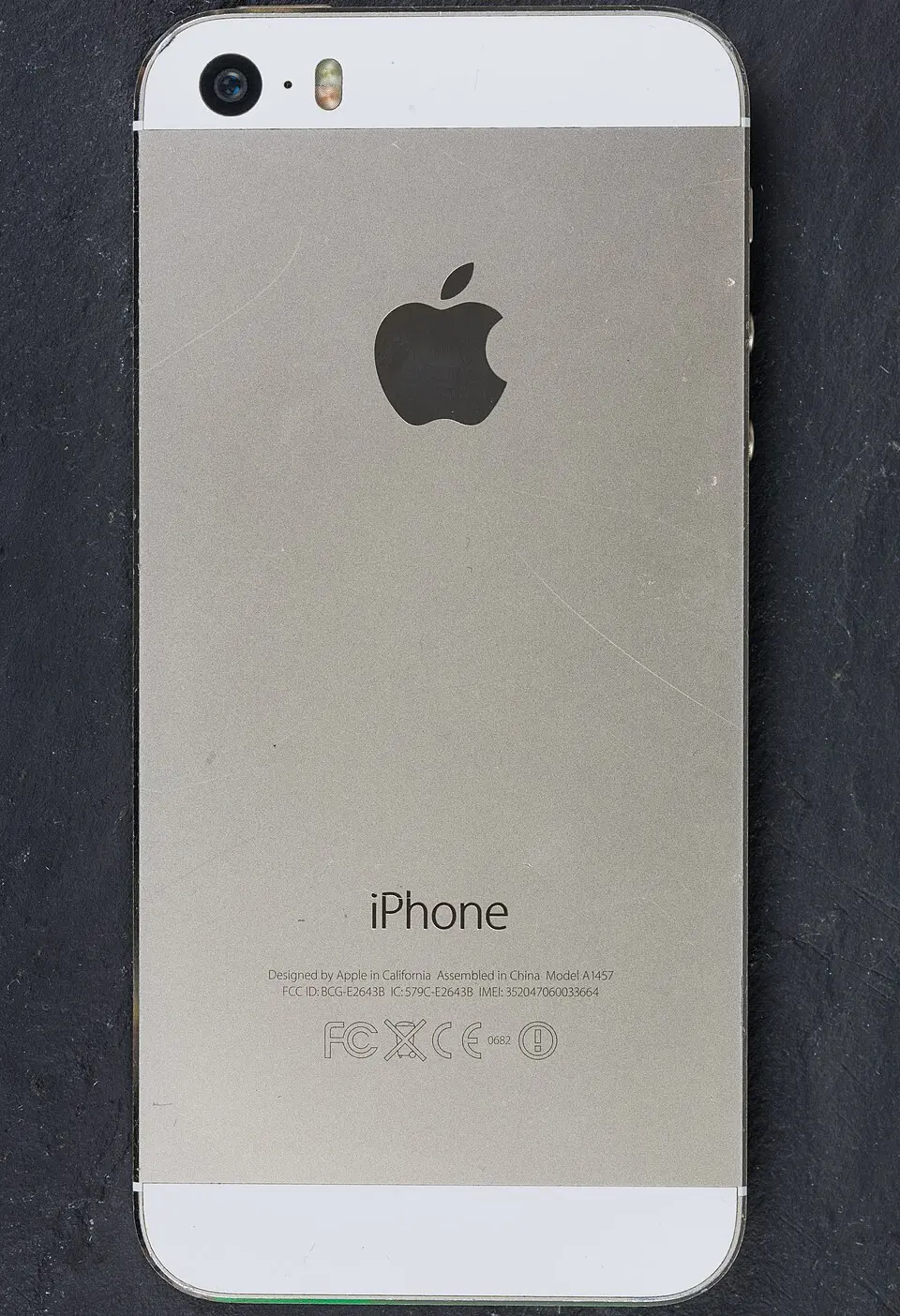
The four-inch screen and the shape of the aluminium body carried over from the iPhone 5. Seen from the front, the visible difference was the home button, which now held a fingerprint sensor.
Touch ID: a home button that reads fingerprints
The feature the iPhone 5s is remembered for is Touch ID. As Apple described it, a laser-cut sapphire crystal built into the home button worked with a capacitive touch sensor to take a high-resolution image of the fingerprint and read it accurately from any angle. It had two jobs: unlocking the phone with a touch, and approving purchases from the iTunes Store, App Store and iBooks Store.
On the fingerprint data itself, Apple's press release said it was encrypted and stored in the Secure Enclave inside the A7 chip, never stored on Apple's servers and never backed up to iCloud. Keeping the biometric data on the device was a design carried forward to Face ID.
The iPhone 5s was not the first smartphone with a fingerprint sensor: Motorola's Atrix 4G, released in the US in February 2011, already had one. What the iPhone 5s changed was to turn the button people pressed every time they unlocked the phone into the sensor itself, making it part of everyday use.
A7: a 64-bit smartphone
The other pillar was the chip. Apple opened its press release by calling the iPhone 5s the "world's first smartphone with 64-bit desktop-class architecture". That is Apple's own claim. The A7 had more than a billion transistors and, by Apple's figures, up to twice the CPU and graphics performance.
Alongside it came the M7 motion coprocessor. In Apple's description, it gathered data from the accelerometer, gyroscope and compass, offloading that work from the A7 to save power.
How competitors took it
The move to 64 bits came sooner than rivals expected. In December 2013 AppleInsider relayed the account of an unnamed Qualcomm insider, first published on a HubSpot blog: 64-bit had been on the industry's roadmaps, but nowhere near Apple's timing, and the industry was caught unprepared. It is one anonymous person's account, not an official industry position.
In public the reaction was different. Qualcomm's then chief marketing officer, Anand Chandrasekher, dismissed 64-bit as a marketing gimmick with no benefit to consumers. Qualcomm later retracted the remarks as inaccurate, and he was moved out of the role.
Nine million in three days
On 23 September 2013 Apple announced that the iPhone 5s and iPhone 5c together had sold nine million units in their first three days, a first-weekend record. Tim Cook said the initial supply of the iPhone 5s had sold out. No split between the two models was given.
What Touch ID became
A year later Touch ID became a key for payments. Apple Pay, announced on 9 September 2014, was presented as using the security and convenience of Touch ID, and went live in the US in October. In-store payments needed the iPhone 6 and 6 Plus, which combined Touch ID with NFC.
The sensor got faster with the iPhone 6s in 2015, and the iPhone X replaced it with Face ID in 2017.
For the generation before, see the iPhone 5. The whole line is on the iPhone timeline, and the company on Apple.
Questions this page answers
- When was the iPhone 5s released?
- It was announced on 10 September 2013 and released on 20 September in the US, Australia, Canada, China, France, Germany, Hong Kong, Japan, Puerto Rico, Singapore and the UK, so Japan was in the first wave.
- How much did the iPhone 5s cost at launch?
- In the US, with a two-year contract, it cost $199 for 16GB, $299 for 32GB and $399 for 64GB. The iPhone 5c, released the same day, was $99 for 16GB and $199 for 32GB.
- When did NTT Docomo start selling the iPhone?
- From 20 September 2013, with the iPhone 5s and iPhone 5c. Apple and Docomo announced it on 10 September (11 September in Japan), and from then all three of Japan's major carriers sold the iPhone.
- Did Touch ID start with the iPhone 5s?
- Yes. The fingerprint sensor was built into the home button and could unlock the phone and approve purchases in the iTunes Store, App Store and iBooks Store. Apple said the fingerprint data was encrypted and stored in the Secure Enclave inside the A7, never on Apple's servers or in iCloud.
Sources
Touch ID's design and uses, the Secure Enclave, the A7 "world's first smartphone with 64-bit desktop-class architecture", M7, camera, colours and prices
PrimaryiPhone 5s & iPhone 5c Arrive on Friday, September 20 — Apple Newsroom, Sep 16, 2013
The 20 September launch countries, including Japan and China, and US prices
PrimaryNTTドコモとApple、日本でiPhoneを9月20日(金)より提供開始 — Apple Newsroom(日本), 2013年9月11日
Docomo offering the iPhone 5s and 5c from 20 September
PrimaryFirst Weekend iPhone Sales Top Nine Million, Sets New Record — Apple Newsroom, Sep 23, 2013
Nine million 5s and 5c units combined in three days; initial 5s supply sold out
PrimaryApple Announces Apple Pay — Apple Newsroom, Sep 9, 2014
Apple Pay built on Touch ID, launching in the US in October
SecondaryApple's 64-bit A7 SoC 'set off panic' for chipmakers — AppleInsider, Dec 17, 2013
An anonymous Qualcomm insider's account via a HubSpot blog, and the retraction of Chandrasekher's remarks
TertiaryMotorola Atrix 4G — Wikipedia
US release in February 2011 with a fingerprint sensor
TertiaryiPhone 5s — Wikipedia
Last updated: