T1#consumer
Famicom Disk System — Games Rewritten for ¥500
Metadata
- Date
- Decade
- 1980s
- Tier
- T1
- Sources
- 06
- Connections
- 01
- Tags
- #consumer
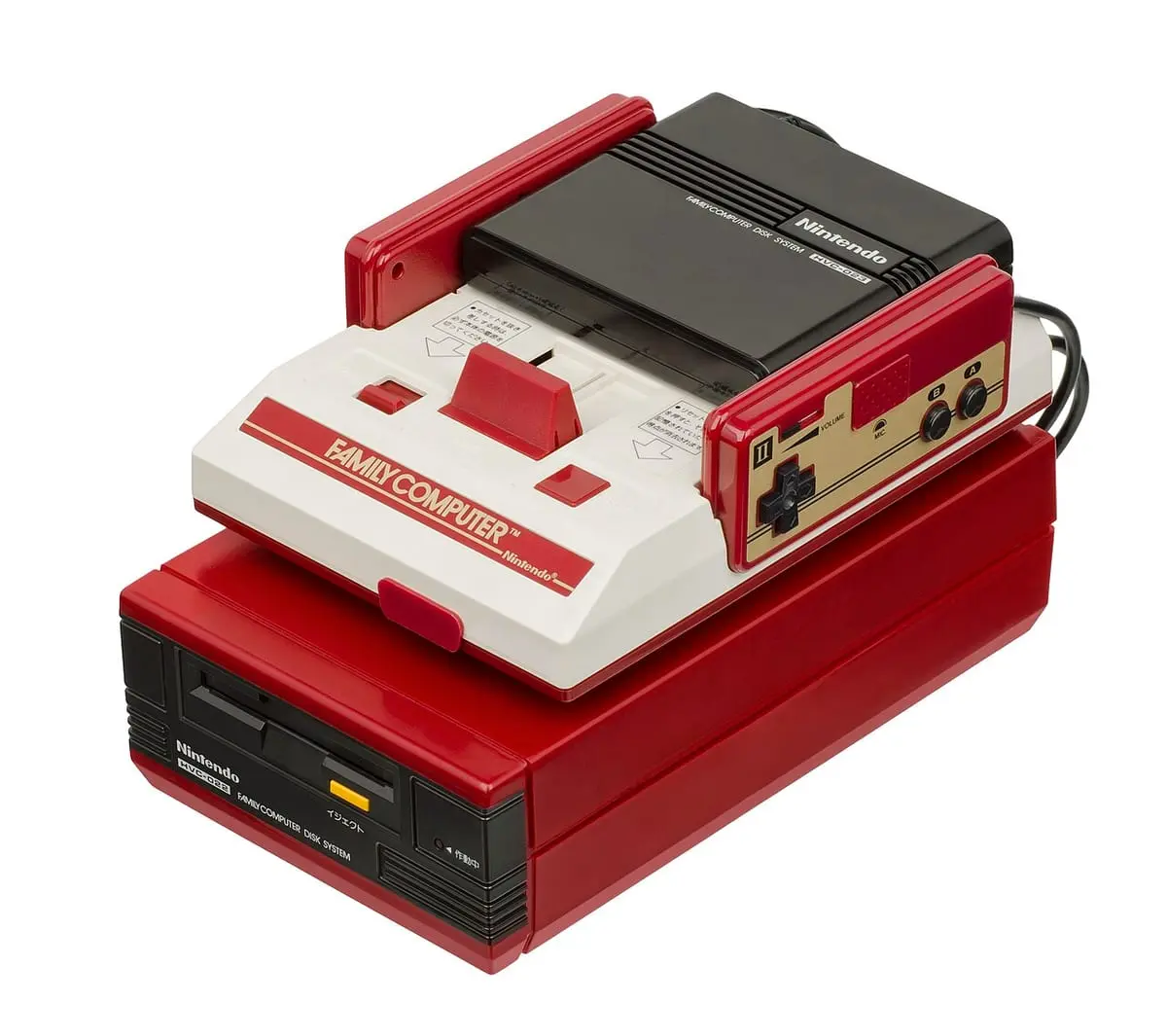
The Famicom Disk System went on sale in Japan on Friday 21 February 1986. It was a product for Japan: no version was released in North America or Europe. The Legend of Zelda came out on Disk Card the same day. Nintendo's official page does not give the hardware price; English and Japanese Wikipedia both put it at ¥15,000. A Disk Card could be taken to a "Disk Writer" kiosk in a shop and rewritten with a different game for ¥500, with some exceptions.
| Item | Detail | Source |
|---|---|---|
| Release date | Friday 21 February 1986 | Nintendo |
| Region | Japan (a North American release was announced, then cancelled) | English Wikipedia |
| Price | ¥15,000 | English and Japanese Wikipedia |
| Rewrite fee | ¥500 (some exceptions) | Nintendo |
| Launch titles | The Legend of Zelda and others | Nintendo; Famitsu |
| End of rewriting service | 30 September 2003 | Nintendo |
The Disk System was not a console in its own right but an add-on for the Family Computer of 1983. Even so, it tried to change both the medium and the way games were sold, which made it closer to a generational shift than an accessory.
How it connected
According to Nintendo's official page, the disk drive (model HVC-022) came with a RAM adapter (HVC-023). The RAM adapter went into the Famicom's cartridge connector, and a cable from it plugged into the back of the drive. Power came from six C-size batteries or a separately sold AC adapter (HVC-025).
| Item | Detail |
|---|---|
| Disk drive | HVC-022, a 2.8-inch drive |
| Included | RAM adapter (HVC-023), RF extension cord (HVC-026) |
| Power | Six C batteries (sold separately) or the AC adapter (HVC-025, sold separately) |
| Size and weight | 150 mm wide, 246 mm deep, 73 mm high; about 1,470 g with batteries |
| Capacity | About three times a ROM cartridge |
| Saving | Built into every Disk Card |
Nintendo gives the capacity only as "about three times" a cartridge. Japanese Wikipedia puts it at 112 KB across both sides (56 KB per side) and describes the medium as based on Mitsumi's Quick Disk; English Wikipedia gives the same figure.
Selling by rewriting
According to Famitsu's 2024 retrospective, Disk Card games cost about half as much as cartridges, and the Disk System was promoted with the slogan that the age of buying software was giving way to the age of rewriting it. Denfami Nico Gamer notes that cartridges at the time cost roughly ¥4,000 to ¥6,000.
Nintendo describes the mechanism: Disk Writers were installed in department stores, toy stores and Famicom shops, and an existing Disk Card could be rewritten with another game for ¥500 (except for some titles). Famitsu adds that a game could never sell out of shop stock.
Disk Cards had one more use. According to Famitsu, cards with a blue shutter could send data to Nintendo through a "Disk Fax" in the shop, so players could enter game tournaments.
Zelda and Metroid
The headline launch title was The Legend of Zelda, which Nintendo's timeline lists as the first game in the series. Famitsu says the launch line-up also included Super Mario Bros., Golf, Tennis, Baseball, Soccer and Mahjong. The Mysterious Murasame Castle, planned for launch, was delayed twice and arrived in April.
Later Disk System games included Metroid, Castlevania and Famicom Detective Club. According to Nintendo's timeline, 86 cartridge titles and 34 Disk Card titles came out in 1986, the first year with more than 100 releases.
Stuck in Japan, overtaken by cartridges
According to English Wikipedia, a North American release was announced in 1986 and cancelled by November 1988. The same article lists fragile disks, widespread piracy and slow loading among the system's problems.
Japanese Wikipedia attributes the decline to cartridges catching up. One-megabit, then two-megabit ROM cartridges appeared during 1986, and battery-backed cartridges that could save followed in 1987. Within a few years the disk's advantages in capacity and saving were no longer special.
Nintendo's timeline, in its entry for the early 1990s, when Street Fighter II and Dragon Quest V reached the Super Famicom, says in-store rewriting ended and the Famicom gradually came to the end of its role. Rewriting inside Nintendo continued, however, and according to Nintendo's official page the service ended on 30 September 2003. Famicom production also continued until 2003.
Units sold
An official Nintendo sales figure could not be found. Japanese Wikipedia, citing a Nintendo online magazine, gives "more than 4 million," and English Wikipedia gives about 4.4 million.
Nintendo's next step was to put more into the cartridge, not the disk. The successor console, the Super Famicom, launched on 21 November 1990. For the wider story, see the game consoles timeline.
Questions this page answers
- When was the Famicom Disk System released?
- It went on sale in Japan on Friday 21 February 1986, the same day as The Legend of Zelda. It never launched in North America or Europe.
- How much did the Famicom Disk System cost?
- Nintendo's own page does not list the price; English and Japanese Wikipedia give ¥15,000. Rewriting a Disk Card at a Disk Writer cost ¥500, with some exceptions.
- When did the Disk Card rewriting service end?
- According to Nintendo, on 30 September 2003. Nintendo's timeline says in-store rewriting ended in the early 1990s, while rewriting inside Nintendo continued until 2003.
Sources
Primaryディスクシステムとは? — 任天堂
Release date, model numbers, connection through the RAM adapter, three times a cartridge's capacity, saving, the ¥500 rewrite and its end on 30 September 2003
Primaryファミコン年表 — 任天堂
The Legend of Zelda at launch, the 1986 software count, the end of in-store rewriting in the early 1990s, rewriting inside Nintendo until 2003
Secondaryファミコン ディスクシステムが発売された日。500円の書き換えサービスが安価で便利だった — ファミ通.com、2024年2月21日
Launch titles, games at about half the price of cartridges, the delay of The Mysterious Murasame Castle, Disk Fax
Secondary『ファミリーコンピュータ ディスクシステム』の発売日は1986年2月21日 — 電ファミニコゲーマー、2025年2月20日
Cartridge prices of the time (¥4,000 to ¥6,000)
Tertiaryファミリーコンピュータ ディスクシステム — Wikipedia
The ¥15,000 price, 112 KB capacity, sales, reasons for the decline
TertiaryFamicom Disk System — Wikipedia
The cancelled US release, piracy, about 4.4 million units
Last updated: