PERSON
Steve Wozniak
The engineer who designed the Apple I and the Apple II essentially single-handed. While designing calculators at Hewlett-Packard he was a fixture of the Homebrew Computer Club; he built the Apple I board in 1976 and the Apple II in 1977. Colour on a domestic television, BASIC in ROM, eight expansion slots, and a floppy disk controller built from eight integrated circuits — every one of them an exercise in removing parts. He ended full-time work at Apple in early 1985 after a plane crash in February 1981, and received the National Medal of Technology with Steve Jobs that year.
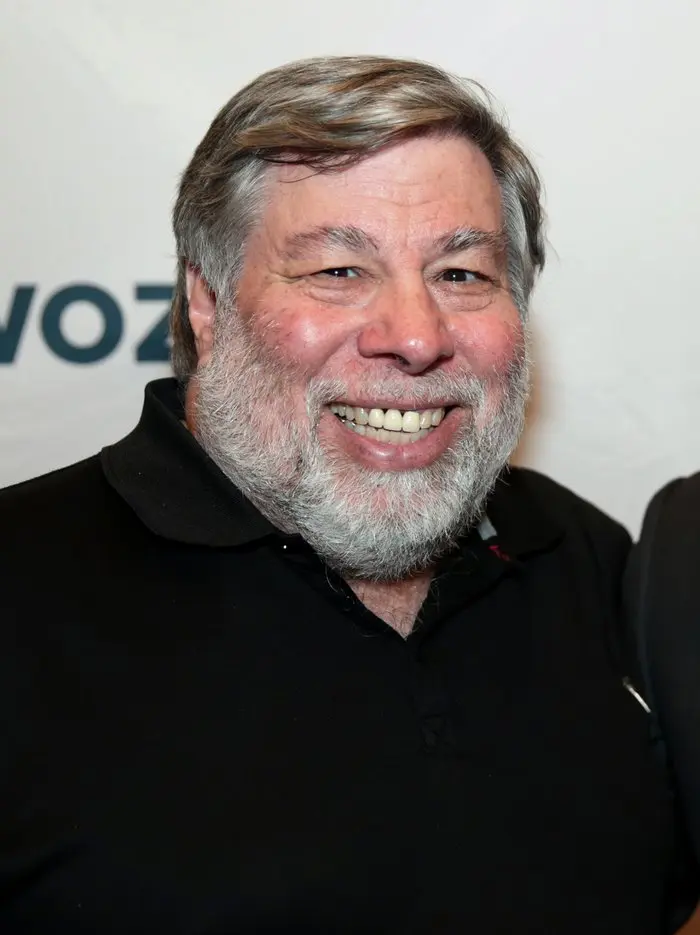
Profile
- Born
- 1950
- Status
- Living
- Span
- 1950–
- Appearances
- 01
- Name
- ENSteve WozniakJAスティーブ・ウォズニアック
Stephen Gary Wozniak, born 11 August 1950, co-founded Apple and designed the Apple I and Apple II. The consistent property of his work is neither performance nor elegance but chip count: doing what everyone else did with fewer parts. In the middle 1970s that translated directly into price.
Background
Born in San Jose, California, to an engineer at Lockheed. He enrolled at the University of California, Berkeley, dropped out, and went to work at Hewlett-Packard designing calculators — an ideal apprenticeship in getting a fixed set of functions out of a minimum of components.
From 1975 he was a regular at the Homebrew Computer Club in Palo Alto, where people who had got hold of a microprocessor brought in whatever they had made it do. Wozniak built the Apple I board to show it there, not to sell it; the basic design was finished by 1 March 1976.
Three Decisions in the Apple II
Three of the choices in the Apple II went on mattering.
Pulling colour out of the NTSC standard itself. The MOS 6502 runs at 1.023 MHz because that is exactly two-sevenths of the NTSC colour subcarrier frequency. Colour comes out of that coincidence of timing rather than out of dedicated circuitry. The motive was not lofty: Wozniak had built Breakout for Atari in hardware and wanted to write it in software. Colour went in for that, then a speaker for the sound, then a minimal paddle circuit.
Eight expansion slots. As Apple II History records, Steve Jobs thought two would suffice — printer and modem. Wozniak, drawing on what he had seen at Hewlett-Packard, insisted that users would always find something to fill a spare slot, and held the number at eight. It made the machine more expensive to build, and it created the peripheral market that became one of the Apple II's real assets.
A floppy disk controller in eight integrated circuits. Over the Christmas holidays of 1977, with Randy Wigginton, he built the Disk II controller — eight ICs, by the Computer History Museum's account, achieving in programmed logic what competitors implemented in dedicated hardware. It was demonstrated at CES in January 1978.
He also wrote Integer BASIC, without an assembler: instructions worked out on paper and converted to hexadecimal by hand.
After 1981
On 7 February 1981 the light aircraft he was piloting crashed near Santa Cruz. He suffered head injuries and a period of anterograde amnesia — the inability to lay down new memories. It began his separation from day-to-day work at Apple.
He afterwards returned to Berkeley and completed a degree in electrical engineering and computer sciences in 1986. In 1982 and 1983 he mounted the US Festivals, combining music and technology. His full-time employment at Apple ended in early 1985, though he remained on the payroll long afterwards.
Honours
- 1985 — the National Medal of Technology, shared with Steve Jobs, "For their development and introduction of the personal computer which has sparked the birth of a new industry extending the power of the computer to individual users." It was the medal's first year.
- 1998 — IEEE Computer Society Computer Entrepreneur Award, with Paul Allen, Bill Gates and Steve Jobs
- 2000 — inducted into the National Inventors Hall of Fame
Later Ventures
After Apple came CL 9, founded in 1985 to build a programmable universal remote control, shipped in 1987; Wheels of Zeus, founded 2001 for wireless location technology and wound up in 2006; Woz U, an online technology education service launched in 2017; and Privateer, co-founded with Alex Fielding in 2021 to track orbital debris. None approached the Apple II.
His standing does not rest there. The Apple that made the Macintosh was built by Jobs's conviction and by the implementation work of people like Bill Atkinson — but the Apple that existed to do so was funded by the Apple II. And the Apple II existed because one engineer kept believing it could be done with fewer chips.
Appearances
Sources
Last updated: