T1#market#open-source
Netscape Navigator 1.0 Released
Metadata
- Date
- Decade
- 1990s
- Tier
- T1
- Sources
- 12
- Connections
- 02
- Tags
- #market#open-source
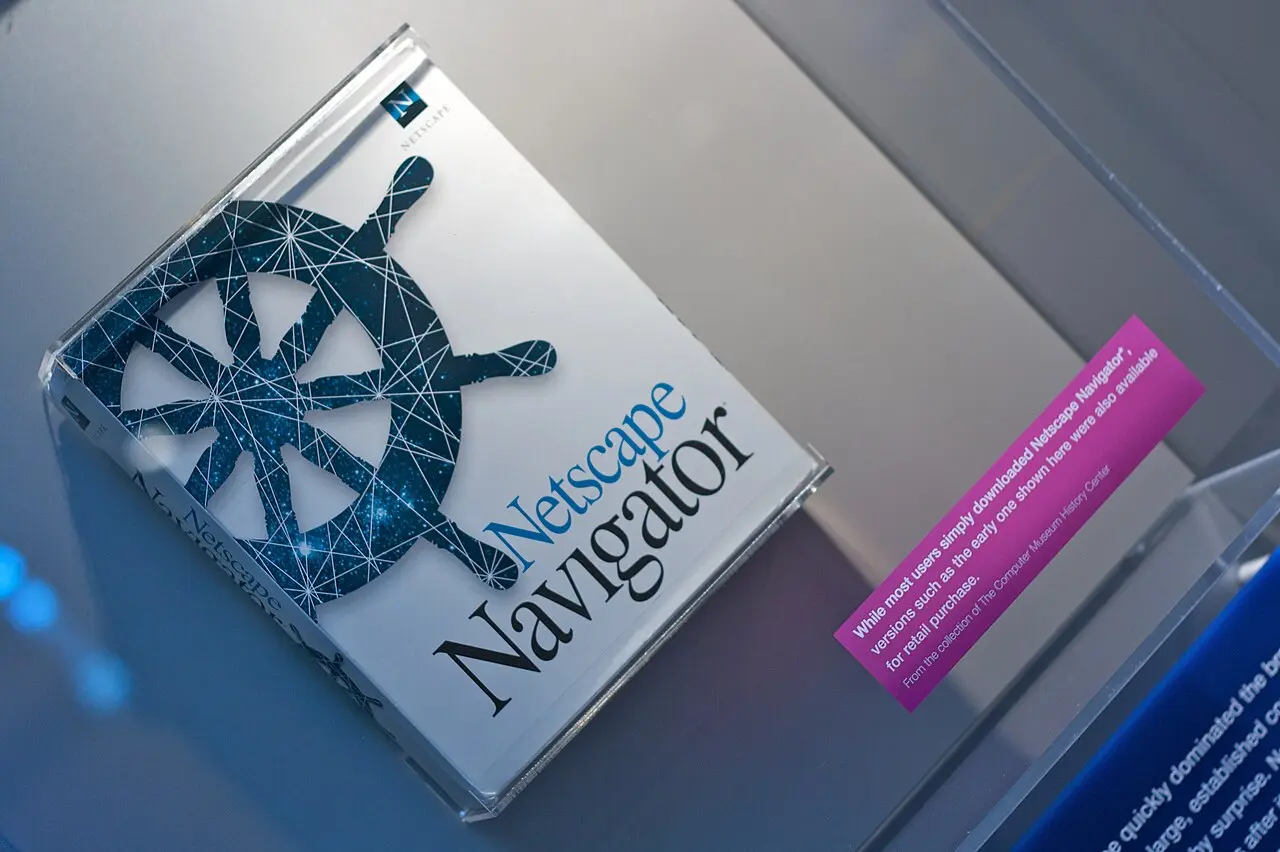
Netscape is the name of both Netscape Navigator, the browser that defined the Web in the mid-1990s, and Netscape Communications, the company that made it. The company was founded by Marc Andreessen, who had built NCSA Mosaic, and Jim Clark, founder of Silicon Graphics. By giving the browser to individuals free while selling commercial licences and server software, and through the frenzy of its 1995 stock-market debut, Netscape became one of the earliest companies to show the public that business could be done on the internet.
A Six-Month-Old Company Gives Away a Beta
On 13 October 1994 a company in Mountain View, California, announced that it was offering its new network navigator free over the internet. The free download covered individual, academic and research users; commercial users could buy licences starting at $99 per user. The announcement framed this as building on the tradition of internet software being offered free of charge.
The beta's selling point was speed:
- Continuous document streaming: reading and interacting with a page while it was still downloading
- Multiple simultaneous network accesses: several documents or images fetched in parallel
- Native JPEG support
The company said the browser was optimised to run smoothly over 14.4 kbit/s modems and claimed performance "at least ten times that of other network browsers" — its own figure. From the start it stressed a common feature set and interface across Windows, Macintosh and the X Window System.
Giving Up the "Mosaic" Name
The company was first called Mosaic Communications. On 14 November 1994 it announced it was changing its name to Netscape Communications, to establish its own identity and to accommodate concerns expressed by the University of Illinois. The release ends by noting that NCSA Mosaic is a trademark of the University of Illinois.
The same release says the founding team included, besides Andreessen, five other former students and staff of the university who had been instrumental in NCSA Mosaic's design and development. Eric Sink, a developer at Spyglass, which had licensed Mosaic's technology and trademarks from NCSA, recalls the episode from the other side: Spyglass held the legal right to the Mosaic trademark, and after a good deal of lawyering the company changed its name.
Version 1.0 and SSL: Browser and Server Together
On 15 December 1994 Netscape shipped Navigator 1.0 together with version 1.0 of its Netsite server line.
| Product | Price (December 1994 announcement) |
|---|---|
| Netscape Navigator (commercial, single user) | from $39 |
| Netsite Communications Server | $1,495 |
| Netsite Commerce Server | $5,000 |
Navigator 1.0 was a free download for academic and non-profit use and for evaluation. The Commerce Server built in Secure Sockets Layer (SSL), based on RSA Data Security technology, to encrypt traffic and authenticate the server, and Netscape announced it as "the first secure server software available for the Internet." Online publications, financial services and shopping were the uses named from day one.
In the release Andreessen said that with these products "the Internet is now open for business." Encryption that would later underpin HTTPS reached both ends of the connection, browser and server, at the same moment.
The IPO of 9 August 1995
What made Netscape a household name was less its products than its share price.
| Item | Figure |
|---|---|
| Shares offered | 5 million |
| Offering price | $28 |
| Opening price | $71 |
| First-day close | $58.25 |
| Market value at the close | about $2.9 billion |
| First-day volume | nearly 14 million shares |
The Associated Press reported the next day that nearly three times as many shares had changed hands as had been issued, and that the market value was close to Dell's. According to the same report, revenue had been $700,000 from the company's founding in April 1994 through December, and $16.6 million in the first half of 1995; the company was not yet profitable, and it was sixteen months old. AP also reported that free downloads had given Netscape more than 7 million users, 70 percent of the people using the Web.
In retrospect the IPO is often cited as the point where the dot-com bubble began.
The Browser War and How It Ended
Netscape's success drew Microsoft into the browser market. Microsoft built Internet Explorer on a licence for Spyglass Mosaic, the browser Spyglass had written (the story is in the Mosaic article). IE 1.0 arrived on the same day as Windows 95, as part of the paid Microsoft Plus! add-on.
Competing against a browser built into Windows, Netscape fell behind. On 22 January 1998 it made Navigator and Communicator 4.0 free for all users and announced that it would publish the source code of the next-generation Communicator. That decision gave rise to the Mozilla project, and later to Firefox.
The company's independence did not last. According to its SEC filings, Netscape signed a merger agreement with America Online (AOL) on 23 November 1998, and the merger was completed in March 1999, a little more than three and a half years after the IPO.
What Remained
Much of what Netscape introduced outlived the company. SSL was carried forward into TLS, whose first specification states that it is based on SSL 3.0. The source code lived on as Mozilla. And a browser given away free, which became universal after the 1998 announcement, is now simply what a browser is.
Questions this page answers
- When was Netscape Navigator released?
- The first public beta was released on the internet on 13 October 1994, and version 1.0 shipped on 15 December 1994. The company was called Mosaic Communications when the beta came out and renamed itself Netscape Communications on 14 November.
- Was Netscape free?
- Only partly, at first. Version 1.0 was free for academic and non-profit use and for evaluation, while commercial users paid from $39 per user. It became free for everyone on 22 January 1998, in the same announcement that promised to publish the source code of the next version.
- How is Netscape related to Mosaic?
- Marc Andreessen, who created NCSA Mosaic as an undergraduate, founded Mosaic Communications, Netscape's predecessor, with Silicon Graphics founder Jim Clark in April 1994. After concerns from the University of Illinois, which held the Mosaic trademark, the company renamed itself Netscape Communications that November.
- What happened to Netscape?
- It lost the market to Microsoft's Internet Explorer, announced in January 1998 that it would release its source code, which gave rise to the Mozilla project, signed a merger agreement with AOL on 23 November 1998, and was absorbed when the merger completed in March 1999.
Sources
Offered at $28, opened at $71, closed at $58.25; $2.9 billion market value; nearly 14 million shares traded
TertiaryNetscape — Wikipedia
Last updated: