Detailed · 17 events
A History of Open Source and Free Software
1960s
Open source in this timeline begins with an operating system nobody was allowed to sell. After Bell Labs withdrew from Multics in 1969, and with the group's requests for a new machine going nowhere, Ken Thompson began writing a file system, a shell, an editor and an assembler on a little-used PDP-7. What carried that experiment into the history of shared software was law, not engineering. A 1956 consent decree had barred AT&T from new businesses beyond common-carrier communications, so Bell Labs could not sell UNIX; in the 1970s it sent the system to universities, source included, at nominal cost.
1970s
In the 1970s a UNIX that arrived with its source became something recipients changed and mailed back. Berkeley received a Version 4 tape in January 1974; in the autumn of 1975 Ken Thompson spent a sabbatical there and brought up Version 6. Two new graduate students, Bill Joy and Chuck Haley, improved the Pascal system and built the ex editor, and Joy mailed about thirty free tapes of the result as 1BSD. Sites patched what they received and sent tapes back, an informal two-way flow of source. The same line would carry TCP/IP and the socket API in the 1980s.
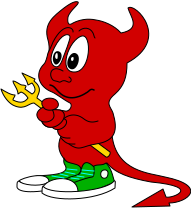
Poul-Henning Kamp (Wikimedia Commons) · Beerware License · Commons ↗ The First Berkeley Software Distribution (1BSD), assembled from 1977 by the Berkeley graduate student Bill Joy, went out as a tape. It was an add-on to AT&T Bell Labs' Sixth Edition UNIX, not an operating system in its own right: the Pascal system, with the ex editor tucked into a subdirectory of the Pascal source. About thirty copies shipped over the following year. From here flowed vi and the C shell in 2BSD, TCP/IP and sockets in 4.2BSD, SunOS, FreeBSD / NetBSD / OpenBSD, and the foundations of macOS. The 1992-1994 USL v. BSDi lawsuit, settled out of court, ultimately shaped the modern premise that the right to redistribute source code can be guaranteed by licence.
1980s
In the 1980s sharing moved from custom into the wording of a licence. Richard Stallman, who had watched the MIT AI Lab's hackers leave for Symbolics and been refused printer source code under a nondisclosure agreement, announced on Usenet in 1983 that he would write a complete UNIX-compatible system and give it away. The Free Software Foundation followed in 1985, and GPLv1 in 1989 required every redistribution to carry the same terms. That was copyleft, a different line from the permissive BSD and MIT licences that ran beside it. GNU entered the 1990s with most of a UNIX userland but no working kernel.
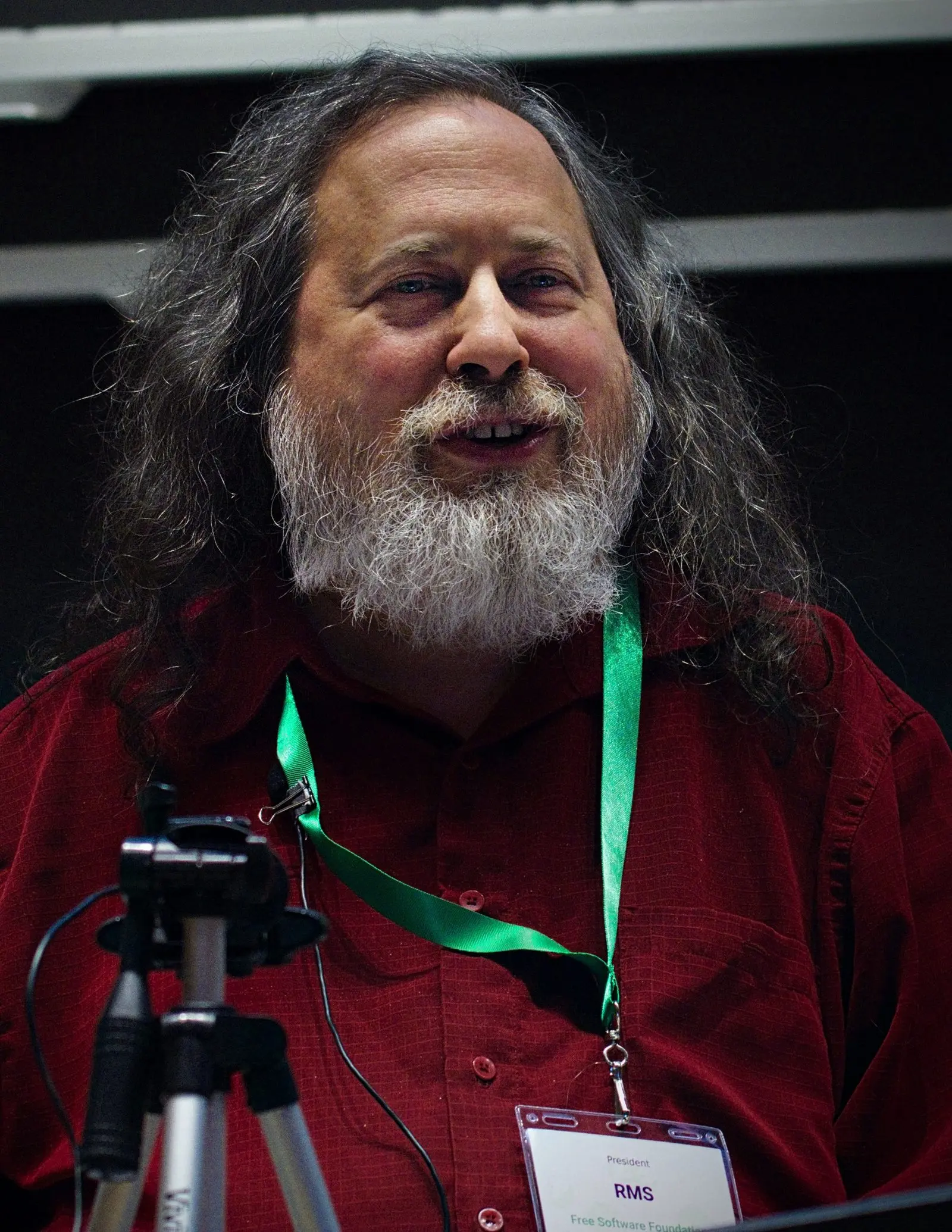
Ruben Rodriguez (Wikimedia Commons) · CC BY 4.0 · Commons ↗ Richard Stallman of the MIT AI Lab posted to the Usenet groups net.unix-wizards and net.usoft under the subject 'new UNIX implementation'; the body opened 'Free Unix!' and announced GNU (GNU's Not Unix), a UNIX-compatible system he would write from scratch and give away freely. Work actually began in January 1984; the GNU Manifesto and the Free Software Foundation both followed in 1985, GPLv1 in 1989, GPLv2 in 1991—the licence the Linux kernel adopted in 1992, fusing GNU and Linux into the substrate of the modern open-source economy. The origin point of free software as both philosophy and legal apparatus.
1990s
In the 1990s shared code moved into the foundations of the Web, and the gap between free of charge and open source became visible. The Linux kernel switched to the GPL in 1992 and joined GNU's tools. Mosaic cost nothing for non-commercial use, yet it was proprietary. When NCSA's HTTPd stalled, administrators who kept patching it released Apache, which led all web servers by 1996. In 1998 Netscape, cornered by Internet Explorer, opened the source of its flagship product. The tools used to build the kernel itself were what the next decade would remake.
- EVT.004T1Linux — Linus Torvalds' 21-Year-Old AnnouncementA History of Operating SystemsA General History of Information TechnologyRead more →
- EVT.005T1NCSA Mosaic — A Web Browser That Showed ImagesA History of the Internet and the WebA General History of Information TechnologyRead more →
- EVT.006T1Netscape Navigator 1.0 ReleasedA History of the Internet and the WebRead more →

Apache Software Foundation (Wikimedia Commons) · Apache License 2.0 · Commons ↗ After development of the NCSA HTTPd stalled, eight web administrators—led by Brian Behlendorf—formed a group to maintain and extend the server, releasing Apache HTTP Server 0.6.2 in April 1995. The name came from its origin as a set of patches to NCSA HTTPd: 'a patchy server'. By 1996 Apache had the largest market share of any web server, a position it would hold for more than two decades. The Apache Software Foundation followed in 1999; the Apache License 2.0 (2004) became one of the most widely adopted permissive licences in open source.

Mozilla Foundation (Wikimedia Commons) · CC BY 3.0 / MPL 2.0 · Commons ↗ Cornered by Internet Explorer, Netscape Communications announced that it would publish the source of the next-generation Communicator and make its current client free the same day. mozilla.org launched on 23 February; the code itself shipped on 31 March under the Netscape Public License 1.0, with MPL 1.0 for new files. It was the first serious example of a flagship commercial product being open-sourced, and Netscape's own CTO credited Eric Raymond's essay 'The Cathedral and the Bazaar' as an inspiration for the decision. From here flowed the Mozilla Suite, Mozilla 1.0 (2002), Firefox 1.0 (2004), and today's Mozilla Foundation / Corporation structure.
2000s
In the 2000s the decisive work was on the tools for pooling code rather than on any single program. When the free version of BitKeeper, which Linux kernel development relied on, was withdrawn, Linus Torvalds wrote a distributed version-control system himself and had the kernel tree inside it thirteen days after starting. Three years later GitHub put Git behind a website and made forks, pull requests and issues the everyday mechanics of contributing to someone else's project. As collaboration gathered on a single commercial service, who owned that service became the next decade's question.
- EVT.009T1Firefox 1.0 — The Open-Source Browser That Took On Internet ExplorerA History of the Internet and the WebRead more →

Jason Long (Wikimedia Commons) · CC BY 3.0 · Commons ↗ When BitKeeper—then used by Linux kernel development—stopped supplying its free version, Linus Torvalds designed and implemented his own distributed version-control system. Work began on 3 April 2005; the first commit landed on 7 April; on 16 April the Linux kernel tree (2.6.12-rc2) was imported into Git. Thirteen days, or in Torvalds' own words about ten. The design—content-addressed objects keyed by SHA-1, cheap branches, fully distributed repositories—became the standard, the substrate of GitHub, GitLab, and Bitbucket, and an indispensable layer of modern software development.

GitHub (Wikimedia Commons) · CC BY 4.0 · Commons ↗ On 10 April 2008, Tom Preston-Werner, Chris Wanstrath, PJ Hyett, and Scott Chacon launched GitHub to the public (the private beta began in February 2008). By hiding the difficulty of Git's command line behind a web UI and adding social primitives—Pull Request, Fork, Issue, Star—GitHub dramatically accelerated open-source development, discovery, and adoption. Microsoft acquired the company for US$7.5 billion in 2018 (see github-acquisition-2018). By the end of 2024 GitHub reported 150 million developers and 518 million projects, having become the de facto public infrastructure of modern software development.
2010s
This timeline's 2010s hold a single event: the place where open-source collaboration gathered changed hands. In June 2018 Microsoft announced a deal to buy GitHub, worth US$7.5 billion and paid in its own stock, and the open-source community reacted sharply; this was the company whose chief executive, in 2001, had called Linux a cancer on intellectual property. With Nat Friedman in charge, GitHub went on running on its own. In June 2021 it previewed GitHub Copilot, and whether GPL-licensed code may be used to train models remains an open argument.
2020s
In the 2020s the Linux kernel, written for three decades in C and assembly alone, admitted a second language. The case was memory safety, and the aim was new code, chiefly drivers, rather than a rewrite of what existed. Linux 6.1 took only the scaffolding; the first driver, a reference one, came in 6.8, and GPU drivers from 6.15. In between, a quarrel over letting Rust drivers call the kernel's DMA interface ended with Torvalds ruling that maintainers control their code but not who calls it, and several developers walked away. By December 2025 Rust was no longer labelled an experiment, though it remains well under one percent of the source.
- EVT.013T1Stable Diffusion Goes Public — Image Generation on Your Own GPUA History of Artificial IntelligenceAI and Society: A HistoryAI and Copyright: A HistoryRead more →
- EVT.014T1Rust Enters the Linux Kernel — A Second Language in MainlineA History of Programming LanguagesA History of Operating SystemsRead more →
- EVT.015T1Meta's LLaMA — A Research Release, a Leak, and the Open-Weights DebateA History of Artificial IntelligenceRead more →
- EVT.016T1Auto-GPT — The Day 'AI Agent' First Went ViralA History of Artificial IntelligenceA History of AI AgentsRead more →
- EVT.017T1MCP — How One Company's Connector Became the Industry's StandardA History of Artificial IntelligenceA History of AI AgentsRead more →