T1#consumer#regulation
AI Eats Search — Google AI Overviews and the Rise of Perplexity
Metadata
- Date
- Decade
- 2020s
- Tier
- T1
- Sources
- 10
- Connections
- 05
- Tags
- #consumer#regulation
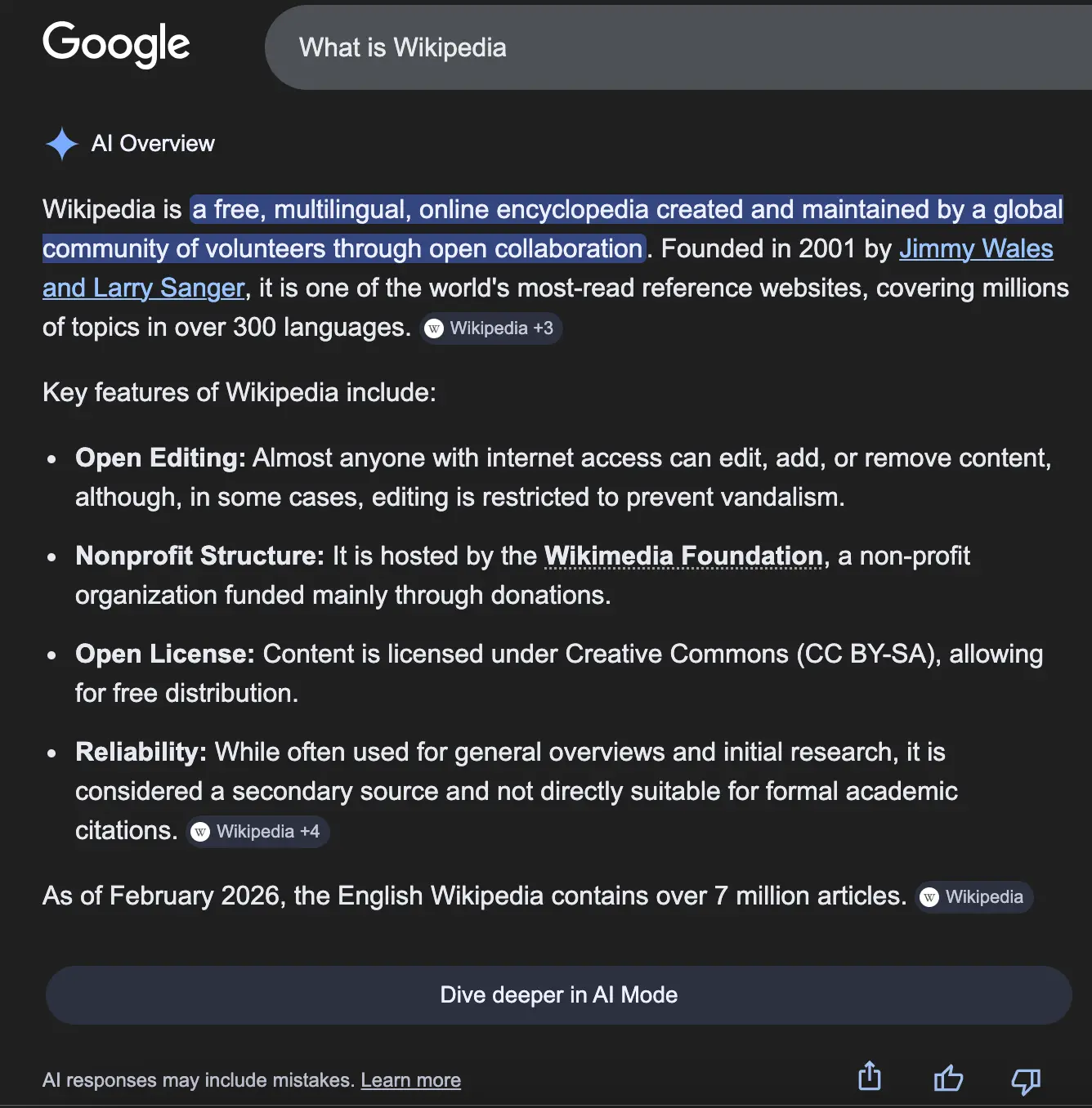
On 14 May 2024, at the Google I/O developer conference, Sundar Pichai announced the United-States-wide rollout of AI Overviews. A few paragraphs of Gemini-generated summary now sat at the very top of the search results page, and users could get an "answer" without clicking any underlying link. It was the production graduation of the feature that had run as the "Search Generative Experience (SGE)" through 2023. Twenty-six years after Google launched its "ten blue links" in 1998, the search page had been fundamentally redrawn.
"Glue on Pizza" — The Days After Launch
Within days, AI Overviews made an ignominious kind of history.
- Asked why cheese will not stick to pizza, the system suggested "mixing in about 1/8 cup of non-toxic glue" (sourced from an eleven-year-old joke on Reddit).
- Asked whether one should eat rocks daily, it answered that "geologists recommend at least one small rock per day" (sourced from the satirical site The Onion).
- For "what to do if depressed", an answer included "jump off the Golden Gate Bridge".
- A list of US presidents identified Barack Obama as "the first Muslim president", a conspiracy theory pulled from a Reddit thread.
Screenshots spread across social media and "LLM hallucination" became a household term. By late May Google announced mitigations: damping user-generated-content (Reddit, forums) as sources, excluding satirical sites, and suppressing AI Overviews for health, financial, and electoral queries.
From SGE to AI Overviews — and What "Launch" Meant
When the feature appeared as SGE at Google I/O 2023 it was a "Labs experiment". The 2024 rename and roll-out was not a label change; it was the switch to default-on. There was initially no user-facing opt-out toggle (a partial "Web" filter was added later), and the feature was pushed to everyone searching on Google.com in the US. Expansion followed: in August 2024 to the UK, India, Brazil, Japan, Indonesia, and Mexico; in October 2024 to more than 100 countries and 30 languages.
The Publisher Hit — Zero-Click Searches Explode
The decisive economic impact of AI Overviews was that clicks from the results page to external links collapsed.
- Pew Research (July 2025) — a link inside an AI Overview was clicked just 1% of the time; the ordinary search results below it were clicked on 8% of searches when an AI Overview was present, against 15% when it was not (900 US adults, roughly 69,000 searches).
- Similarweb (2025) — for news queries, zero-click searches (searches that end without leaving Google) rose from 56% in May 2024 to 69% in May 2025.
- Authoritas (2025) — when an AI Overview appeared, publisher click-through fell by about 47.5% on desktop and 37.7% on mobile.
- Digital Content Next (August 2025) — across 19 member publishers, median year-on-year Google referral traffic was down 10% over an eight-week stretch in May–June 2025.
The travel blog The Planet D, a much-cited case, saw visitors halved within months of the May 2024 launch, laid off staff, then watched traffic fall another 90%, and stopped publishing in 2025. Small and mid-sized independent publishers reported analogous collapses worldwide.
A Structural Shift in the SEO Industry
For 25 years since Google's founding in 1998, the SEO industry had pursued one objective: rank first on Google. AI Overviews changed the rules of the game.
New acronyms entered the vocabulary: AEO (Answer Engine Optimization), GEO (Generative Engine Optimization), LLMO (LLM Optimization). Optimisation shifted from "be clicked" to "be cited by the LLM". Structured data (Schema.org), author profiles, site authority, fact density were reweighted as signals.
Regulators moved too. The US Department of Justice's antitrust suit found Google a monopolist in search in August 2024; publisher coalitions filed parallel cases; the European Commission opened DMA-related inquiries. AI Overviews was no longer a UI change — it was an antitrust object.
Perplexity and ChatGPT Search — The Other Answer Engines
Parallel to AI Overviews, a separate line of "answer engines" emerged.
Perplexity AI (founded August 2022, CEO Aravind Srinivas) grew explosively from 2024. By mid-2025 it carried a valuation of roughly US$18 billion, with about 45 million monthly active users and 780 million queries per month, and annualised recurring revenue around US$200 million by September 2025. Citation-grounded answers, real-time web search, and academic mode drew loyal users. At the same time, major publishers (the New York Times, Forbes, Wired) sued or publicly accused Perplexity of unauthorised scraping and inaccurate attribution.
OpenAI's ChatGPT Search entered preview in October 2024 and rolled out to all ChatGPT users in early 2025. Lacking its own crawler at scale, OpenAI combined search APIs (including Bing) with direct fetches. ChatGPT itself hit 800 million weekly users by October 2025—an order of magnitude beyond Perplexity—so even modest search-feature adoption represented a sizeable answer-engine surface.
In market-share terms, LLM-based search still accounted for only single-digit percent of total query volume at the start of 2026. The phase was not "Google killed" but "Google's margins and the publisher economy eroded".
The Loop That Funded the Web
AI Overviews rewrote the basic economics of the open web.
The old loop ran like this: publishers made content; Google crawled and indexed it; users searched; Google returned links; clicks generated ad revenue for publishers; publishers made more content. Google and publishers were complementary goods, and for 25 years both prospered from the same cycle.
AI Overviews removed the click. Publisher content is still consumed as raw material for AI-generated answers, but the link, even when shown, is not clicked. A complementary relationship became an extractive one.
This is not only Google's problem. LLMs as a class depend on the web as training corpus and as retrieval source, while simultaneously breaking the economic cycle that funds the web. Journalism, expert blogs, hobbyist communities, niche reference sites — the very material LLMs distil into their answers — is becoming economically unsustainable. The structural problem became visible on 14 May 2024.
The question that remains: in the LLM era, who is going to write the web? There is no answer yet.
Sources
TertiaryAI Overviews — Wikipedia
Last updated: