T1#samsung#galaxy#android#smartphone
Samsung Galaxy S Launches — The Android Empire's Real Beginning
Metadata
- Date
- Decade
- 2010s
- Tier
- T1
- Sources
- 06
- Connections
- 03
- Tags
- #samsung#galaxy#android#smartphone#korea
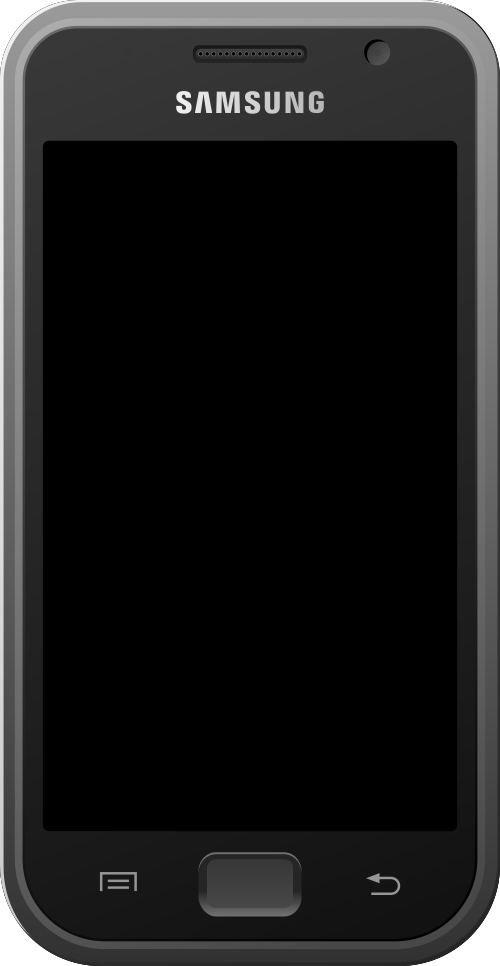
On 4 June 2010, after a launch announcement in Zurich on 2 June, Samsung Electronics began selling the Galaxy S (model GT-I9000). Singapore went first, with Europe following; the United States came from later that summer with multiple carrier-specific variants (T-Mobile Vibrant, AT&T Captivate, Sprint Epic 4G, Verizon Fascinate). The rollout eventually spanned 110 carriers in 100 countries.
The specification was conspicuous for a 2010 flagship. A 4-inch Super AMOLED screen (800×480, an early mass-produced device using Samsung's own organic-EL panel), Samsung's own 1 GHz Cortex-A8-based "Hummingbird" SoC (S5PC110), 512 MB of RAM, 8/16 GB of internal storage, a microSD card slot, a 5-megapixel rear camera, and Android 2.1 Eclair (later updated to 2.2 Froyo, then 2.3 Gingerbread). It was 9.9 mm thick and weighed 119 g.
Ten million units sold worldwide by the start of January 2011, about seven months in — the biggest Android hit to that date, and the device at the centre of Android's volume acceleration in 2010.
Why Samsung Bet on Android
In 2010 Samsung was already one of the largest mobile-phone makers in the world, but well behind Nokia (Symbian) and Apple (iOS) in smartphones. Samsung's in-house Bada OS overlapped uncomfortably with Android, and gathering third-party developers around a proprietary platform was not a realistic strategy.
From around 2009, Samsung pivoted to making Android its main line; the Galaxy S was developed as the first flagship under full Android commitment. From Android 1.0 on the HTC Dream in 2008, it took Samsung only two years to position itself as the representative Android maker.
For Google, Samsung's serious commitment was equally decisive. The existing Android OEMs — HTC, Motorola, Sony — were mid-sized; Samsung was a vertically integrated industrial giant that fabricated its own memory, SoCs, and display panels. Google's strategy of "fighting iOS on volume with Android" was not really possible without Samsung in it.
A Continuous Run of S-Series Hits
The original Galaxy S continued selling into 2011 and is estimated to have reached around 25 million cumulative units. The successors form an unbroken sequence.
- Galaxy S II (2011) — over 40 million units, the biggest Android device in history at the time
- Galaxy S III (2012) — over 50 million units, "Designed for Humans" campaign
- Galaxy S4 (2013) — 40 million units
- Galaxy S5 (2014) — water resistance, fingerprint sensor
- Galaxy S6 / S6 edge (2015) — glass back, dual-edge display
- Galaxy S8 / S9 (2017-18) — 18.5:9 tall displays
- Galaxy S10 (2019) — 5G model, triple camera
- Galaxy S20 / S21 / S22 / S23 / S24 / S25 / S26 (2020-2026) — continuous yearly cadence, integrated AI features
Samsung has never published a cumulative S-series total, but adding up the generations puts it in the hundreds of millions; across the whole Galaxy brand (including the A series, Note, and Z foldables), Samsung ships over 200 million units in a single year. Since 2011 the global number-one position in annual smartphone shipments has usually been Samsung's — though Apple took it in 2023 and again in 2025.
The Patent War with Apple
The Galaxy S's success drew direct legal confrontation with Apple. In April 2011, Apple filed patent and design-infringement suits against Samsung in the United States, with the core claim that the Galaxy S's appearance, icon arrangement, and scroll behaviour deliberately imitated the iPhone.
The litigation ran in multiple jurisdictions for more than seven years.
- August 2012, a jury verdict in the Northern District of California ordered Samsung to pay Apple US$1.05 billion in damages.
- Subsequent remands and recalculations of damages produced a total of about US$930 million after a November 2013 retrial, and a unanimous Supreme Court ruling in December 2016 sent certain design-patent damages back for recalculation.
- In May 2018 a jury put the figure at US$539 million; the following month the two companies settled on undisclosed terms, closing the US litigation.
- Parallel proceedings in Korea, Germany, Japan, the UK, the Netherlands, and Australia were stepwise resolved by 2018.
The body of decisions left new precedent across the smartphone industry on the scope of design patents and the validity of functional patents, and redefined each company's patent strategy.
The Note 7 Recall
The Galaxy Note 7, launched in August 2016, was Samsung's large-screen stylus-equipped model. Batteries began catching fire or exploding around the world within weeks; in September, Samsung issued a first recall, and in October it halted all production and sales. The US FAA and other civil-aviation authorities took the unusual step of banning the Note 7 from aircraft cabins.
The direct loss was around US$5.3 billion; the longer-term brand damage exceeded the number. But Samsung recovered quality control with the Galaxy S8 in 2017 and clawed back market share. The episode is still taught in MBA programmes as a textbook case of large-enterprise recall management.
The Counterweight to an Apple-Only Story
The Galaxy S series is not merely "an Android handset that sold well". It is the counterweight that broke the Apple-only narrative of premium smartphones.
- The 80%+ Android share of the global smartphone market does not hold up without Samsung.
- Super AMOLED displays, high-megapixel cameras, the early commercialisation of 5G — Samsung led the hardware competition with Apple on multiple axes.
- The cooperative-yet-tense relationship between "the largest Android maker" and "the OS supplier Google" continues to determine the trajectory of the Android platform as a whole.
As of 2026, the Galaxy S26 places AI features (Galaxy AI, integration with Google Gemini) at the core, and together with the foldable models (Z Fold, Z Flip) Samsung continues to run transitional experiments toward whatever comes after the smartphone.
Related Events
The foundation on which the Galaxy S stood up was Android 1.0 on the HTC Dream in 2008; the opponent Samsung has continued to face is the original iPhone of 2007 and its successor line. For the wider lineage of mobile devices, see the history of mobile phones and smartphones.
Sources
Last updated: