PERSON
Sergey Brin
Co-founder of Google, first author of the 1998 paper 'The Anatomy of a Large-Scale Hypertextual Web Search Engine', President of Google and, from 2015 to 2019, President of Alphabet. In 2008 he disclosed on his own blog that he carries the LRRK2 G2019S mutation associated with Parkinson's disease. He stepped back from day-to-day management in December 2019 but stayed on the board, holding 25.3% of total voting power, and has since returned to hands-on work on Gemini.
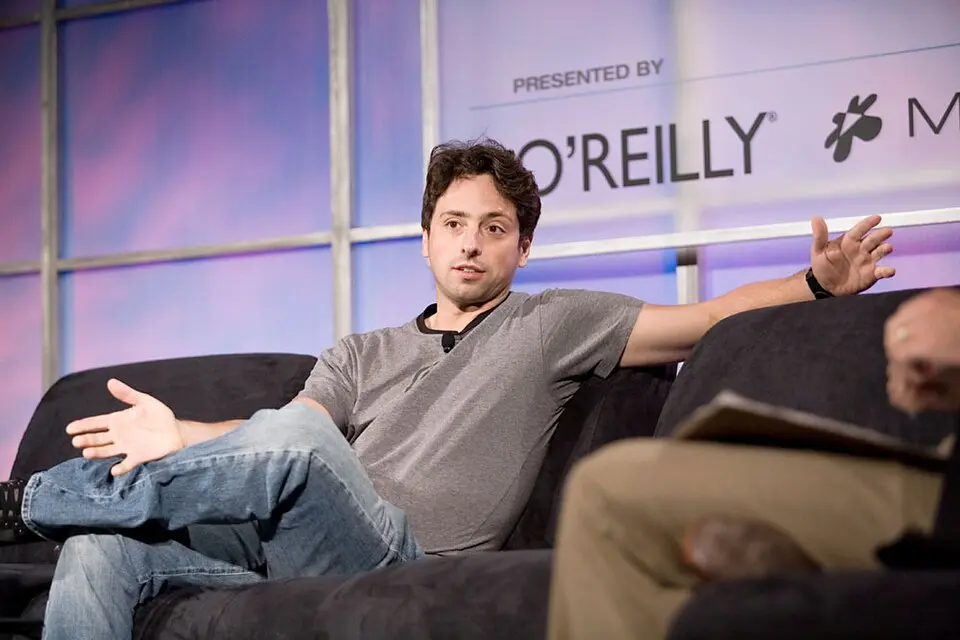
Profile
- Born
- 1973
- Status
- Living
- Span
- 1973–
- Appearances
- 01
- Name
- ENSergey BrinJAセルゲイ・ブリン
Sergey Mikhailovich Brin (born 21 August 1973) co-founded Google and is the first author of the 1998 paper that described its design. Where Larry Page took on the shape of the company and its capital, Brin stayed on the technical side throughout. He left the presidency of Alphabet in December 2019 — and then went back into the office and joined the hands-on work on Gemini.
Background
Brin was born in Moscow; his family emigrated to the United States in 1979, and his father, a mathematician, taught at the University of Maryland. Brin took a BS with high honors in mathematics and computer science at Maryland and an MS in computer science at Stanford — the breakdown appears in the director biographies of Alphabet's annual proxy statement. He never returned to finish the Stanford PhD.
The 1998 paper — a note on the byline
Reading a hyperlink as an academic citation was joint work, but the paper that described it, "The Anatomy of a Large-Scale Hypertextual Web Search Engine" (Computer Science Department, Stanford University), carries the byline Sergey Brin and Lawrence Page, in that order — Brin first. It pairs with the patent on the ranking method, US 6,285,999, which was filed naming Page as sole inventor. The division of labour between the two does not reduce to a sentence. What the paper argued belongs to the 1998 entry.
Roles at Google and Alphabet
The proxy biography sets out the sequence: President of Google and Chairman of its board from September 1998 to July 2001; President, Technology and Co-Founder from July 2001 to April 2011; President of Google again from May 2011 to October 2015; President of Alphabet from October 2015 to December 2019.
Through the Alphabet years Brin took the side of the business furthest from search and advertising — self-driving cars, balloons, and wearables. Google Glass remains the emblematic failure. On 20 May 2025, appearing unannounced in an onstage conversation with Demis Hassabis at Google I/O, Brin said he "made a lot of mistakes with Google Glass" and that he "didn't know anything about consumer electronic supply chains".
LRRK2 — the founder who published his own genome
On 18 September 2008 Brin posted an entry titled "LRRK2" to his personal blog, too. He described his mother's long path through misdiagnosis to a diagnosis of Parkinson's disease, and his own decision — prompted by his then wife, a co-founder of 23andMe — to look up a single variant in his raw data. "But, of course, I learned something very important to me," he wrote. "I carry the G2019S mutation and when my mother checked her account, she saw she carries it too." On his lifetime odds of developing the disease he declined to pick a number: "it is somewhere between 20% to 80% depending on the study and how you measure."
What is unusual is not only that a technology executive published his own disease risk, but the register of the post. Brin flagged that early studies have small samples and selection biases before quoting any figure at all. He became, from then on, a major funder of Parkinson's research.
Stepping back — and what stayed
On 3 December 2019 Page and Brin published a joint letter handing both chief-executive roles to Sundar Pichai: "Alphabet and Google no longer need two CEOs and a President." The same letter stated that they would "remain actively involved as Board members, shareholders and co-founders."
As of 6 April 2026, Brin holds 358,939,978 shares of Class B common stock — 42.9% of the class — each carrying ten votes, giving him 25.3% of Alphabet's total voting power. With Page's 27.4%, the founders hold a majority. Brin's total director compensation for 2025 was one dollar.
Back on Gemini
A few years after stepping back, Brin returned to the work itself. At Google I/O on 20 May 2025 he acknowledged that he had effectively come out of retirement for Gemini, said he is in the Mountain View office nearly every day, and described helping the Gemini team on multimodal projects such as the video model Veo 3. "Anybody who's a computer scientist should not be retired right now," he said. "They should be working on AI."
On 7 December 2025 he appeared at the closing event of Stanford Engineering's centennial year, in conversation with the university's president and the dean of engineering, reflecting on his time as a student and on the early days of Google. His remarks there about the decision to un-retire were widely reported; Stanford's own published record of the event does not carry the wording verbatim.
Legacy
Brin's significance now rests less on his founder's stake than on the plain fact of the return. There is no other case of the person who wrote the design of web search sitting back down, twenty-seven years later, inside the model-development work of the generative-AI era. Across the merger of DeepMind with Google Brain, the shipping of Gemini, and the rewriting of search itself through AI Overviews, the presence on the floor of a man holding a quarter of the votes is not a detail that Alphabet's decision-making can be read without.
Appearances
Sources
TertiarySergey Brin — Wikipedia
Last updated: