T1#market#open-source#ethics
Android 1.0 and the HTC Dream
Metadata
- Date
- Decade
- 2000s
- Tier
- T1
- Timelines
- A General History of Information Technology · A History of Operating Systems · A History of Mobile Phones and Smartphones
- Sources
- 09
- Connections
- 02
- Tags
- #market#open-source#ethics
In August 2005, BusinessWeek reported that Google had "quietly acquired startup Android Inc." The company was 22 months old, based in Palo Alto, and so secretive that the magazine could say little about it beyond that it made software for mobile phones. Its co-founder Andy Rubin had previously started the mobile-device maker Danger. Google's only comment was that it had bought Android "because of the talented engineers and great technology."
Three years later, on 23 September 2008, the result of that purchase was shown in New York: a phone with a sliding keyboard, and the software development kit to write programs for it.
Three Dates, Often Confused
Android's "launch" is usually given as one date, but it was three separate events, and each is recorded in its own primary source:
| Date | Event | Source |
|---|---|---|
| 5 Nov 2007 | Android announced with the founding of the Open Handset Alliance (34 companies) | OHA press release |
| 23 Sep 2008 | Android 1.0 SDK released; T-Mobile G1 (HTC Dream) unveiled | Android Developers Blog; T-Mobile |
| 22 Oct 2008 | G1 goes on sale in the US, $179 with a two-year contract | T-Mobile |
This page takes the middle date, when the platform was declared stable and the first device was shown. The 2007 announcement was of a plan; the October sale was of a product. 23 September was the day both existed.
The Open Handset Alliance
The November 2007 announcement did not come from Google alone. Thirty-four companies formed the Open Handset Alliance to back the platform: handset makers such as HTC, Motorola, Samsung and LG; operators including T-Mobile, Sprint Nextel, China Mobile, KDDI and NTT DoCoMo; chip companies such as Qualcomm, Broadcom, Intel, NVIDIA and Texas Instruments; and software firms. The alliance promised a "fully integrated mobile 'software stack'" released under an open-source licence, with phones expected in the second half of 2008. An early-access SDK followed a week later.
The structure was the strategy. Google would not make the phone. It would supply an operating system that manufacturers and carriers could adopt, modify and ship on their own hardware. That was the opposite of the approach Apple had taken with the iPhone in 2007, where one company controlled the hardware, the operating system and, from July 2008, the App Store.
Android 1.0 SDK
On 23 September 2008 the Android Developers Blog announced the Android 1.0 SDK, release 1. The point of the announcement was stability: after a year of development and preview releases, this was the first official stable version, and developers could now rely on the APIs in the SDK. The team also said it intended to release the platform's source code as open source in the fourth quarter of 2008, working with the Open Handset Alliance.
Underneath, Android combined:
- A Linux kernel. The Android Open Source Project describes today's Android kernel as based on an upstream Linux Long Term Supported kernel, with Android-specific patches. The lineage goes back to Linux itself
- The Dalvik virtual machine, which ran applications packaged in the Dalvik Executable (DEX) format. Dalvik was later replaced by the Android Runtime (ART), introduced as an option in Android 4.4 and made the runtime in Android 5.0
- Google's applications and an application store, at first called Android Market
The T-Mobile G1
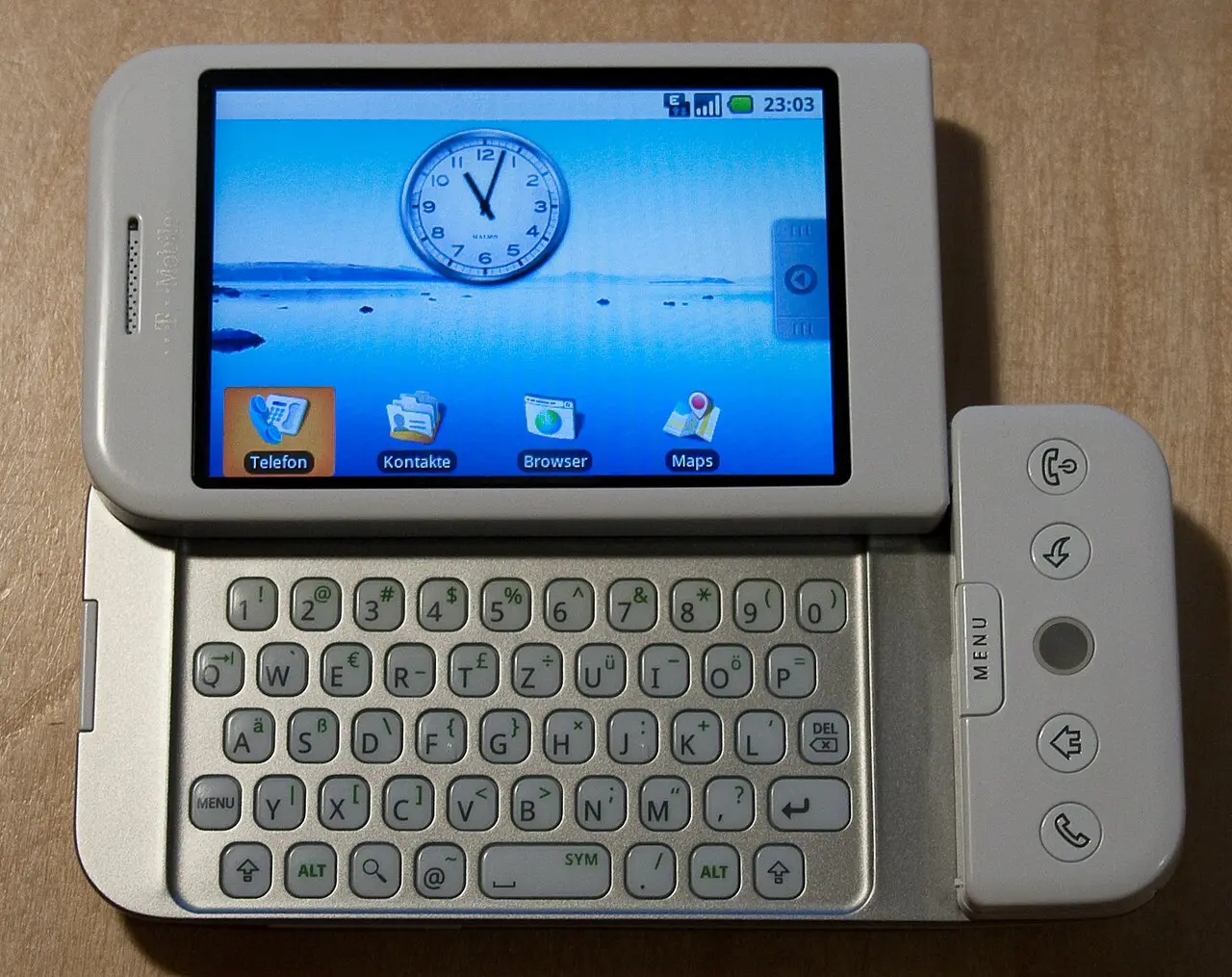
The first phone was built by HTC, which called it the Dream, and sold by T-Mobile as the T-Mobile G1. T-Mobile's press release on 23 September called it "the world's first Android-powered mobile phone." It combined a touch screen with a full QWERTY keyboard that slid out from underneath, and a trackball for one-handed navigation. It supported T-Mobile's 3G and EDGE networks and Wi-Fi.
Much of the release is about Google services: one-touch Google Search, Gmail, YouTube and Google Maps with Street View, which T-Mobile said worked with the phone's built-in compass—a feature it called an industry first. The release also stated that the G1 was the first phone to provide access to Android Market.
The phone could be pre-ordered from the day of the announcement. US availability followed on 22 October at $179 with a two-year voice and data contract; the UK was promised for November, and Germany, Austria, the Czech Republic and the Netherlands for the first quarter of 2009.
Andy Rubin, by then Google's senior director of mobile platforms, described the launch as "an important first step for the Open Handset Alliance."
From One Phone to Most of the Market
The G1 arrived in a smartphone market where Nokia's Symbian and BlackBerry were long established and the iPhone was a year old. One phone from one carrier changed little by itself. What mattered was the licensing model: because the platform was open source and backed by an alliance of manufacturers and operators, any of them could ship it.
Measured today, the result is lopsided. Statcounter's figures for September 2026 put Android at 69.17 percent of mobile operating-system share worldwide and iOS at 30.81 percent. The metric deserves care: Statcounter measures page views from mobile devices across the websites it tracks, not the number of phones sold or in use. It is a measure of usage on the web, and by that measure roughly seven in ten mobile page views come from Android.
The model that produced that share—an operating system given to other companies' hardware rather than sold on Google's own—was set out in November 2007 and first shown as a finished product on 23 September 2008, on a phone with a keyboard.
Questions this page answers
- When was Android released?
- Three dates, and they are routinely conflated. The platform was unveiled on 5 November 2007 with the Open Handset Alliance; the Android 1.0 SDK and the HTC Dream were shown on 23 September 2008; the phone went on sale on 22 October 2008 at $179 on a two-year contract.
- What does Android's roughly 70% share measure?
- In Statcounter's figures for September 2026, Android had 69.17% of worldwide mobile OS share and iOS 30.81%. The figures are based on page views from mobile devices to the websites Statcounter tracks, not on handsets sold or in use.
Sources
SecondaryMobile Operating System Market Share Worldwide — Statcounter GlobalStats
September 2026: Android 69.17%, iOS 30.81% (page-view based)
Last updated: