T1
Google App Engine — Bring the Code, Google Runs It
Metadata
- Date
- Decade
- 2000s
- Tier
- T1
- Timelines
- A History of Cloud Computing
- Sources
- 07
- Connections
- 03
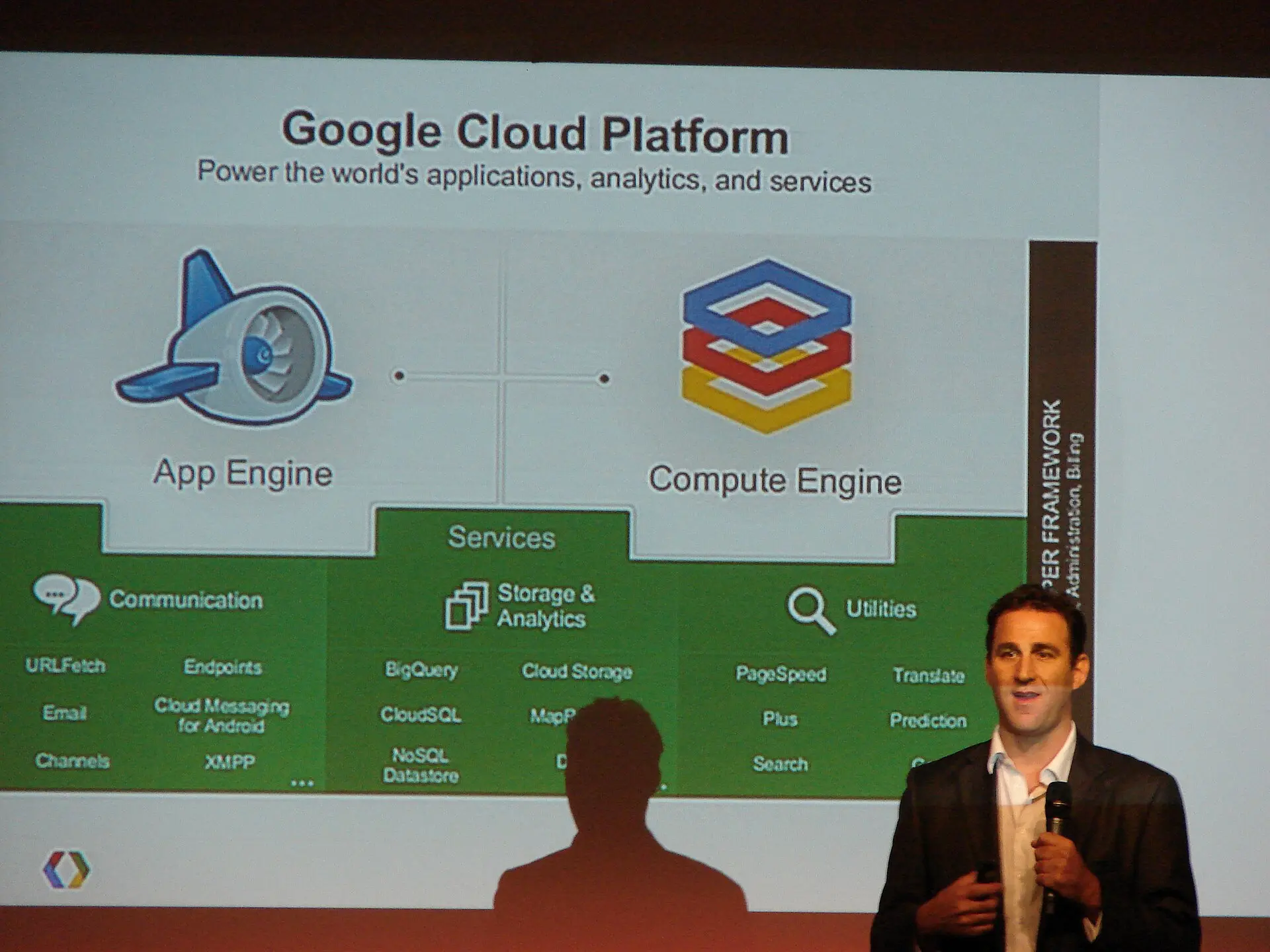
Google App Engine was launched as a preview on the evening of 7 April 2008, at a Google developer event called Campfire One. It let developers upload a web application and have Google run it on Google's own infrastructure — scaling it, storing its data, serving its traffic — without the developer renting or managing a single server. The preview was open to the first 10,000 developers to sign up, it was free within fixed quotas, and its only language was Python. Java followed in April 2009, and App Engine did not leave preview to become a fully supported Google product until November 2011.
In today's terms it was a platform as a service (PaaS): the customer brings code, the provider handles everything beneath it.
What Google announced
Google's App Engine blog opened that night with a post by product manager Paul McDonald, saying the preview release had been launched at "tonight's Campfire One". He described App Engine as a developer tool for running web applications on Google's infrastructure. Google's developer blog posted the same news after the event.
The preview came with:
| Item | Preview (April 2008) |
|---|---|
| Access | First 10,000 developers to sign up |
| Storage | 500 MB |
| CPU | 200 million megacycles a day |
| Bandwidth | 10 GB a day |
| Rough capacity | About 5 million page views a month, by Google's estimate |
| Price | Free within the quotas, which Google said would stay free |
| Language | Python only |
The package included persistent storage built on Google's Bigtable and GFS, automatic scaling, Google APIs for user sign-in and email, and an SDK for running the application locally before uploading it.
Why Python
Three weeks later, a Google Developer Podcast episode with the App Engine team recorded that Python was chosen as the first language. The guests included tech lead Kevin Gibbs and Guido van Rossum, Python's creator, who by then worked at Google. Van Rossum explained that the runtime was the full Python language but that some libraries were missing, mostly for security reasons — App Engine ran many customers' code side by side and had to fence each one in.
That fence was the defining trade-off. Applications also stored their data in a schema-less datastore rather than a relational database — on the podcast Gibbs walked through how that differed in practice. In return, Google handled scaling.
App Engine against S3 and EC2
App Engine arrived two years after Amazon's first infrastructure services, and offered almost the opposite deal.
| Amazon S3 / EC2 (2006) | Google App Engine (2008) | |
|---|---|---|
| What you rent | Storage by the gigabyte; virtual machines by the hour | A place to run an application |
| What you manage | The operating system and everything above it | Only your code |
| Scaling | Start more instances yourself | Automatic |
| Languages | Anything that runs on the machine | Python only at first |
| Price at launch | Metered from the first gigabyte or hour | Free within quotas |
S3 and EC2 gave developers raw parts and left assembly to them. App Engine took the parts away and gave them a finished platform with rules. Both models survived; the question of how much of the stack the customer should see has run through every cloud service since.
Java, then out of preview
On 7 April 2009, a year to the day after launch, Google announced a second language. The post, titled "Seriously this time, the new language on App Engine: Java™", said Java had been the first and most popular request since launch. Java support opened as an early look to the first 10,000 developers, alongside scheduled tasks (cron), access to data behind corporate firewalls, and bulk import into the datastore.
App Engine stayed a preview for three and a half years. On 7 November 2011, with release 1.6.0, the App Engine team wrote that it had graduated from preview and was now a fully supported Google product. The same post:
- introduced a 99.95% SLA for paid applications using the High Replication Datastore
- reported more than 100 billion hits a month, more than 300,000 active applications and more than 100,000 developers — Google's own figures
- moved billing from CPU use to instance hours, a change that many developers questioned in the comments
| Date | Milestone |
|---|---|
| 7 April 2008 | Preview at Campfire One; Python only; first 10,000 developers |
| 7 April 2009 | Java early look |
| 7 November 2011 | Out of preview with release 1.6.0; 99.95% SLA; new pricing |
What came after
In June 2014, on the day Google announced Kubernetes, Eric Brewer's post also announced extensions that let App Engine developers build and deploy Docker images in Managed VMs — a way out of the original sandbox for applications that needed more than it allowed. The same question shaped AWS Lambda in 2014, which took the hands-off model further, down to a single function.
The company is covered on Google, and the sequence on the cloud computing timeline.
Questions this page answers
- When was Google App Engine launched?
- It launched as a preview on the evening of 7 April 2008 at the Campfire One developer event, open to the first 10,000 developers. It left preview and became a fully supported product on 7 November 2011.
- Which language did App Engine support at launch?
- Python only. A Google podcast recorded that Python was chosen as the first language, with Python's creator Guido van Rossum appearing as part of the team. Java was added as an early look for the first 10,000 developers on 7 April 2009.
- What were App Engine's free quotas?
- In the preview, 500 MB of storage, 200 million CPU megacycles a day and 10 GB of bandwidth a day — about 5 million page views a month, by Google's estimate.
- How did App Engine differ from Amazon EC2?
- EC2 rented virtual machines by the hour and left everything from the operating system up to the customer. App Engine asked only for code and handled scaling and storage itself, at the price of Python-only support at first and a schema-less datastore.
Sources
PrimaryIntroducing Google App Engine + our new blog — Paul McDonald, Google App Engine Blog, April 7, 2008
Launch at Campfire One, first 10,000 developers, free quotas, Bigtable and GFS, automatic scaling
PrimaryGoogle Developer Podcast Episode 15: Google App Engine — Google Developers Blog, April 30, 2008
Python chosen as the first language; Guido van Rossum and Kevin Gibbs as guests
PrimaryApp Engine 1.6.0 Out of Preview Release — Google App Engine Blog, November 7, 2011
Out of preview, 99.95% SLA, usage figures, instance-hour billing
TertiaryGoogle App Engine — Wikipedia
Last updated: