PERSON
Larry Page
Co-founder of Google and inventor of PageRank; the patent on the method (US 6,285,999) names Lawrence Page as sole inventor and Stanford University as assignee, filed 1998 and granted 2001. He was Google's CEO twice — 1998–2001 and 2011–2015 — created the holding company Alphabet in 2015 and became its CEO, then stepped back from day-to-day management in December 2019. He remains an Alphabet director and, through Class B stock, holds 27.4% of total voting power as of April 2026.
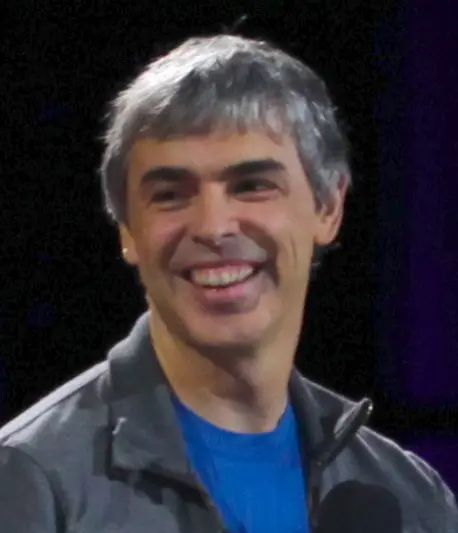
Profile
- Born
- 1973
- Status
- Living
- Span
- 1973–
- Appearances
- 01
- Name
- ENLarry PageJAラリー・ペイジ
Lawrence Edward Page (born 26 March 1973) co-founded Google and invented PageRank, the method that estimates a page's importance from the structure of the links pointing at it. His record as an executive is discontinuous: he was Google's CEO twice, from 1998 to 2001 and again from 2011 to 2015; in 2015 he created the holding company Alphabet and moved across to run it; and in December 2019 he stepped away from day-to-day management altogether. He is nonetheless still an Alphabet director, and as of April 2026 he alone controls 27.4% of the company's voting power.
Background
Page was born in Lansing, Michigan. He holds a BSE from the University of Michigan with a concentration in computer engineering and an MS in computer science from Stanford — the breakdown appears in the director biographies of Alphabet's annual proxy statement. What happened between his arrival in Stanford's PhD programme, his partnership with Sergey Brin, and the company's incorporation belongs to the 1998 entry rather than here.
PageRank — importing citation into search
Academia has long measured a paper's importance by how often it is cited. Page moved the idea onto the web: define a page's importance recursively, as a function of how many links point at it and how important those linking pages are in turn.
The paper and the patent do not carry the same byline, a detail that is routinely reversed. The 1998 paper "The Anatomy of a Large-Scale Hypertextual Web Search Engine" is by Sergey Brin and Lawrence Page, in that order. The patent on the method — "Method for node ranking in a linked database", US 6,285,999 — names Lawrence Page as sole inventor and the Board of Trustees of the Leland Stanford Junior University as assignee. It was filed on 9 January 1998 and granted on 4 September 2001, three years to the day after the company was incorporated.
Two turns as CEO
The proxy biography records the sequence: CEO of Google from September 1998 to July 2001; President, Products from July 2001 to April 2011; CEO again from April 2011 to October 2015. He was also CFO from September 1998 to July 2002. During the second CEO term Android, Chrome and YouTube matured into pillars of the business, while the company simultaneously reached into territory far from search and advertising — self-driving cars, the Life Sciences group and its glucose-sensing contact lens, the longevity company Calico. The 2015 letter would call these efforts "pretty far afield of our main internet products" and use them as the examples of what belonged in Alphabet rather than Google.
Alphabet — rebuilding the container
On 10 August 2015 Page announced the holding company in a letter titled "G is for Google": "we are creating a new company, called Alphabet. I am really excited to be running Alphabet as CEO with help from my capable partner, Sergey, as President." The same letter named Sundar Pichai CEO of Google and explained the name: "We liked the name Alphabet because it means a collection of letters that represent language, one of humanity's most important innovations, and is the core of how we index with Google search!" He added that he also liked that it reads as "alpha-bet (Alpha is investment return above benchmark), which we strive for!"
The design principle is one sentence long: "Alphabet is about businesses prospering through strong leaders and independence." Each business gets its own CEO; the parent keeps capital allocation and hiring. Waymo, Wing, Verily and Calico owe their freedom from Google's quarterly cycle to that restructuring.
Stepping back, keeping control
On 3 December 2019 Page and Brin published a joint letter. Comparing the company to a 21-year-old, they wrote: "While it has been a tremendous privilege to be deeply involved in the day-to-day management of the company for so long, we believe it's time to assume the role of proud parents—offering advice and love, but not daily nagging!" And: "Alphabet and Google no longer need two CEOs and a President." They also stated that they would "remain actively involved as Board members, shareholders and co-founders."
That last clause was not a formality. As of 6 April 2026 Page holds 389,051,160 shares of Class B common stock — 46.5% of the class — and each Class B share carries ten votes, giving him 27.4% of Alphabet's total voting power. Added to Brin's 25.3%, the two founders command a majority. Page's total director compensation for 2025 was one dollar. Men who left the management of the company remain, on the arithmetic of the share register, its final decision-makers.
After Google
Page has appeared in public rarely since. The venture most associated with him was the electric-aircraft company Kitty Hawk, led by Sebastian Thrun, which wound up on 21 September 2022 with the statement: "We have made the decision to wind down Kittyhawk. We're still working on the details of what's next." Cora, the autonomous air-taxi programme spun into the Boeing joint venture Wisk Aero in 2019, survived the shutdown. In March 2025 The Information reported that Page was working on a new company, Dynatomics, applying large language models to generating manufacturable product designs, led by Kitty Hawk's former CTO Chris Anderson. Neither Page nor the company has confirmed it publicly.
Legacy
The durable invention is a single idea: read a link as a citation. It detached result quality from hand-maintained directories and made the whole web a computable object. The advertising business that followed became the capital that pays for Android, YouTube and DeepMind.
The second is corporate shape. The 2015 restructuring was the container a search company needed in order to house self-driving cars and drug discovery at the same time. Page has said little since 2019, but the container and the votes are still his.
Appearances
Sources
TertiaryLarry Page — Wikipedia
Last updated: