T1#market#labor#enterprise
Electric Atlas — The Humanoid That Went from Research Robot to Factory Product
Metadata
- Date
- Decade
- 2020s
- Tier
- T1
- Timelines
- A History of Humanoid and AI Robots
- Sources
- 09
- Connections
- 03
- Tags
- #market#labor#enterprise
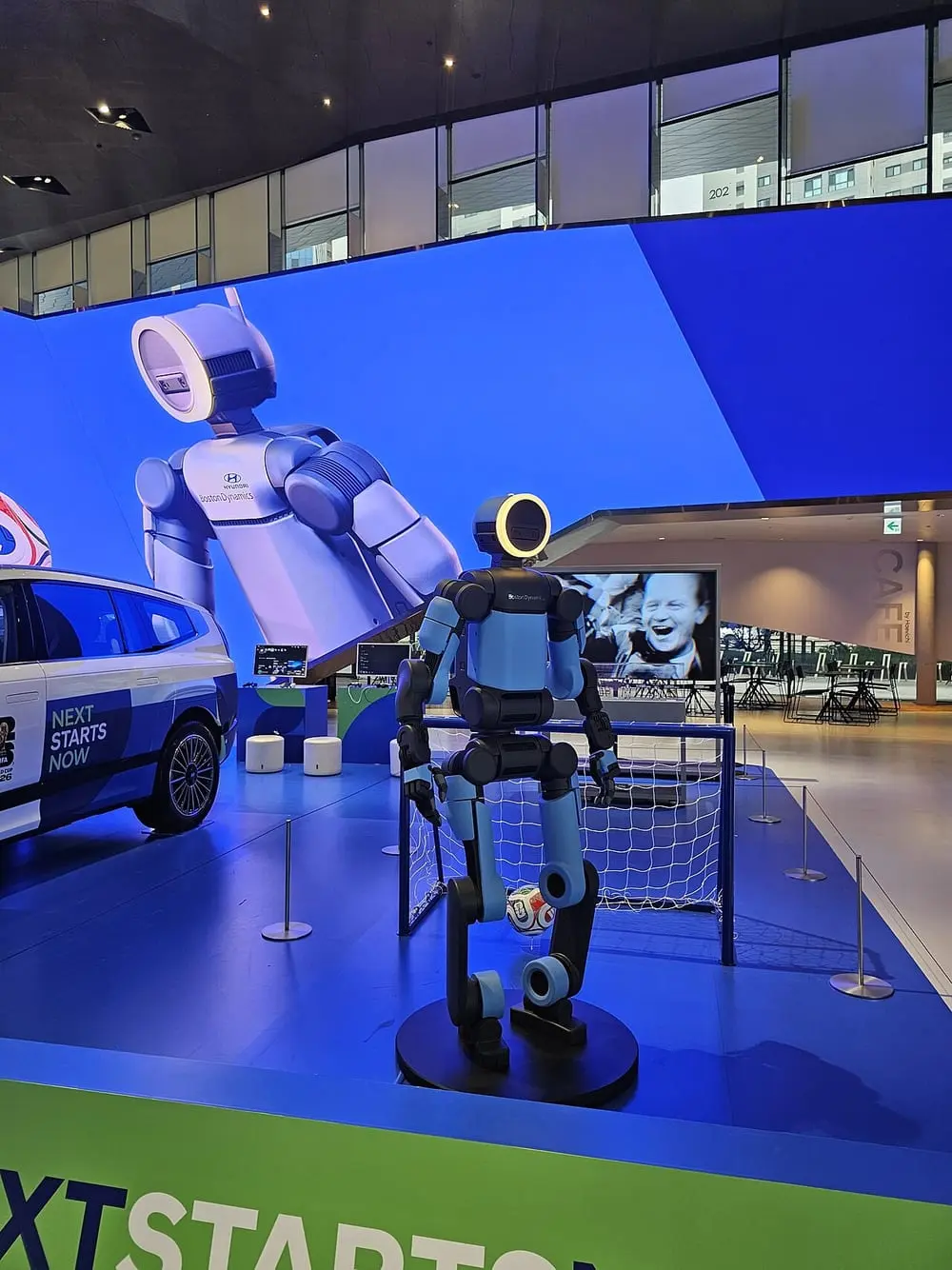
The electric Atlas is a fully electric humanoid robot that Boston Dynamics unveiled on 17 April 2024. In the same week the company announced the retirement of the hydraulic Atlas it had used for more than a decade. The new Atlas was built not as a research machine for a disaster-response competition but as a product to work in the factories of Hyundai, its parent company. A product version was unveiled at CES in January 2026, and production has begun.
From hydraulic to electric
In a blog post titled "An Electric New Era for Atlas", Boston Dynamics introduced the new Atlas as a fully electric robot designed for real-world applications, and said it would be stronger, with a broader range of motion, than any of its previous generations. According to ABC, the company did not say at that point what those applications would be.
Its plan was to partner with a small group of innovative customers and spend the next few years testing and refining Atlas applications, beginning with Hyundai. Boston Dynamics wrote that Hyundai, besides investing in the company, was building the next generation of automotive manufacturing capabilities and would be a perfect testing ground for new Atlas applications. The post also said the company had equipped its robots with new AI and machine-learning tools, including reinforcement learning and computer vision.
Two shifts happened here. One was power: from a machine with hydraulic lines and a pump to one driven by electric motors. The other was purpose: from a research robot showing off its athleticism in videos to a product doing set jobs in a customer's factory.
Teaching movement with data
The way the new Atlas's movements are made changed too. In October 2024 Boston Dynamics began joint research with Toyota Research Institute (TRI). According to TRI, in results shown in August 2025 a single Large Behavior Model controlled Atlas's whole body through long sequences of packing and sorting that combined walking, crouching and lifting. Whereas many humanoids separate walking and balance control from arm control, TRI explained, this model treats the hands and feet almost identically.
According to Boston Dynamics' technical write-up, the model is a 450-million-parameter Diffusion Transformer that takes in images, the robot's body state and language prompts and outputs whole-body actions 30 times a second. Its training data came from demonstrations in which people wearing VR headsets teleoperated Atlas, and from simulation. TRI writes that new skills can be taught by adding human demonstrations, without writing new code. Compared with the era of ASIMO, when people programmed movements in, the approach has been turned around.
CES, January 2026: the product version
On 5 January 2026 Boston Dynamics unveiled the product version of Atlas at CES in Las Vegas and said production would begin immediately at its Boston headquarters. The main specifications, as the company described them, were as follows.
| Item | Boston Dynamics' description |
|---|---|
| Degrees of freedom | 56 (fully rotational joints) |
| Reach | 2.3 m |
| Payload | Up to 50 kg |
| Battery | Walks to a charging station and swaps its own batteries without stopping work |
| Control | Autonomous, teleoperated or tablet steering |
| Environment | Water-resistant, -20°C to 40°C |
All 2026 deployments were already committed, with fleets going to Hyundai's Robotics Metaplant Application Center (RMAC) and Google DeepMind; additional customers were planned from early 2027. Boston Dynamics agreed a partnership with Google DeepMind to integrate its AI foundation models into Atlas, and Hyundai Mobis will supply the actuators.
The Robot Report framed the partnership as a reunion with Google, the company's former owner, and reported that Google DeepMind would use its Gemini Robotics foundation models. According to the publication, Hyundai aims to manufacture up to 30,000 humanoids a year by 2028, and plans to put Atlas to work on parts sequencing in 2028 and complex assembly in 2030. Boston Dynamics' own announcement says that Hyundai Motor Group, its majority shareholder, plans to deploy tens of thousands of its robots in its facilities and has announced a $26 billion US investment that includes a robotics factory able to produce 30,000 robots a year.
A change at the top
The year of productisation also brought new leadership. According to The Robot Report, Robert Playter, who joined Boston Dynamics in 1994 and had been CEO since 2019, announced in February 2026 that he was stepping down, with 27 February as his last day; chief financial officer Amanda McMaster served as interim CEO until a successor was found. On 6 October 2026 Boston Dynamics announced the appointment of Rohit Prasad, formerly Amazon's head scientist for Alexa and artificial general intelligence, as CEO, effective 7 October. A leader of voice-assistant and foundation-model development now runs the robot company.
Expectations and reality
Atlas is an example of a humanoid robot born as a research machine entering the production plans of a factory. Many of the capabilities and deployment numbers above, however, are announcements and plans by Boston Dynamics and Hyundai; the record on the factory floor is still to come. In 2025 the president of the International Federation of Robotics (IFR) said that if and when mass adoption of humanoids will happen remains uncertain, and that they are expected to complement existing robots rather than replace them.
In the same years Tesla's Optimus and Figure in the US, and Unitree in China, have been racing to put humanoids into factories and homes. The wider story is in the humanoid and AI robots timeline.
Questions this page answers
- When was the electric Atlas unveiled?
- On 17 April 2024. Boston Dynamics announced the retirement of the hydraulic Atlas in the same week and unveiled the fully electric new Atlas. It presented a product version at CES on 5 January 2026.
- What can the product version of Atlas do?
- According to Boston Dynamics it has 56 degrees of freedom, a reach of 2.3 metres and can lift up to 50 kg. It walks to a charging station to swap its own batteries, can run autonomously, by teleoperation or by tablet steering, and is rated for -20°C to 40°C. These are the company's own figures.
- Where will Atlas be used?
- Boston Dynamics said its 2026 deployments were fully committed to Hyundai's Robotics Metaplant Application Center (RMAC) and Google DeepMind. According to The Robot Report, Hyundai plans to use Atlas for parts sequencing from 2028 and complex assembly from 2030.
- Who owns Boston Dynamics?
- Hyundai Motor Group, which completed its acquisition from SoftBank in June 2021. In its January 2026 announcement Boston Dynamics described Hyundai Motor Group as its majority shareholder.
Sources
PrimaryAn Electric New Era for Atlas — Boston Dynamics
A fully electric Atlas for real-world applications; stronger with a broader range of motion than previous generations; Hyundai as the first testing ground; years of testing with a small group of customers; reinforcement learning and computer vision
The video released on Wednesday (17 April), applications not specified, the retirement of the hydraulic version
The joint research announced in October 2024, a single model controlling the whole robot, adding skills by human demonstration
PrimaryLarge Behavior Models and Atlas Find New Footing — Boston Dynamics
A 450M-parameter Diffusion Transformer, data collected by teleoperation with a VR headset, one policy driving the whole body at 30 Hz, tasks switched by language prompts
PrimaryBoston Dynamics Unveils New Atlas Robot to Revolutionize Industry — Boston Dynamics, January 5, 2026
Production of the product version; 2026 deployments; 56 DOF, 2.3 m reach, 50 kg; self battery swapping; three control modes; the Google DeepMind partnership; Hyundai Mobis actuators; Hyundai's plans for tens of thousands of robots and a 30,000-a-year factory
Gemini Robotics foundation models, Carolina Parada's remarks, up to 30,000 a year by 2028, sequencing in 2028 and assembly in 2030, the TRI relationship
The IFR president's view that mass adoption remains uncertain and that humanoids will complement rather than replace existing robots
Last updated: