Detailed · 9 events
A History of Humanoid and AI Robots
1960s
1970s
A humanoid robot completed at Waseda University in 1973. Four laboratories in the School of Science and Engineering formed a bio-engineering group and began the WABOT (WAseda roBOT) project in 1970, led by Professor Ichiro Kato, whom Waseda calls the father of Japanese robotics research, with the speech-recognition and synthesis specialist Professor Katsuhiko Shirai among the collaborators. It walked on two legs, gripped and carried objects with hands fitted with tactile sensors, measured the distance and direction of objects with artificial eyes and ears, and spoke with people in Japanese through an artificial mouth. Its researchers compared its intelligence to that of a child of one and a half. Waseda describes it as the world's first full-scale humanoid robot. WABOT-2, which read sheet music and played an electronic organ, followed in 1984 and was shown at Expo '85 in Tsukuba. WABOT-1 is on display in the lobby of Building 63 on the Nishi-Waseda campus.
2000s
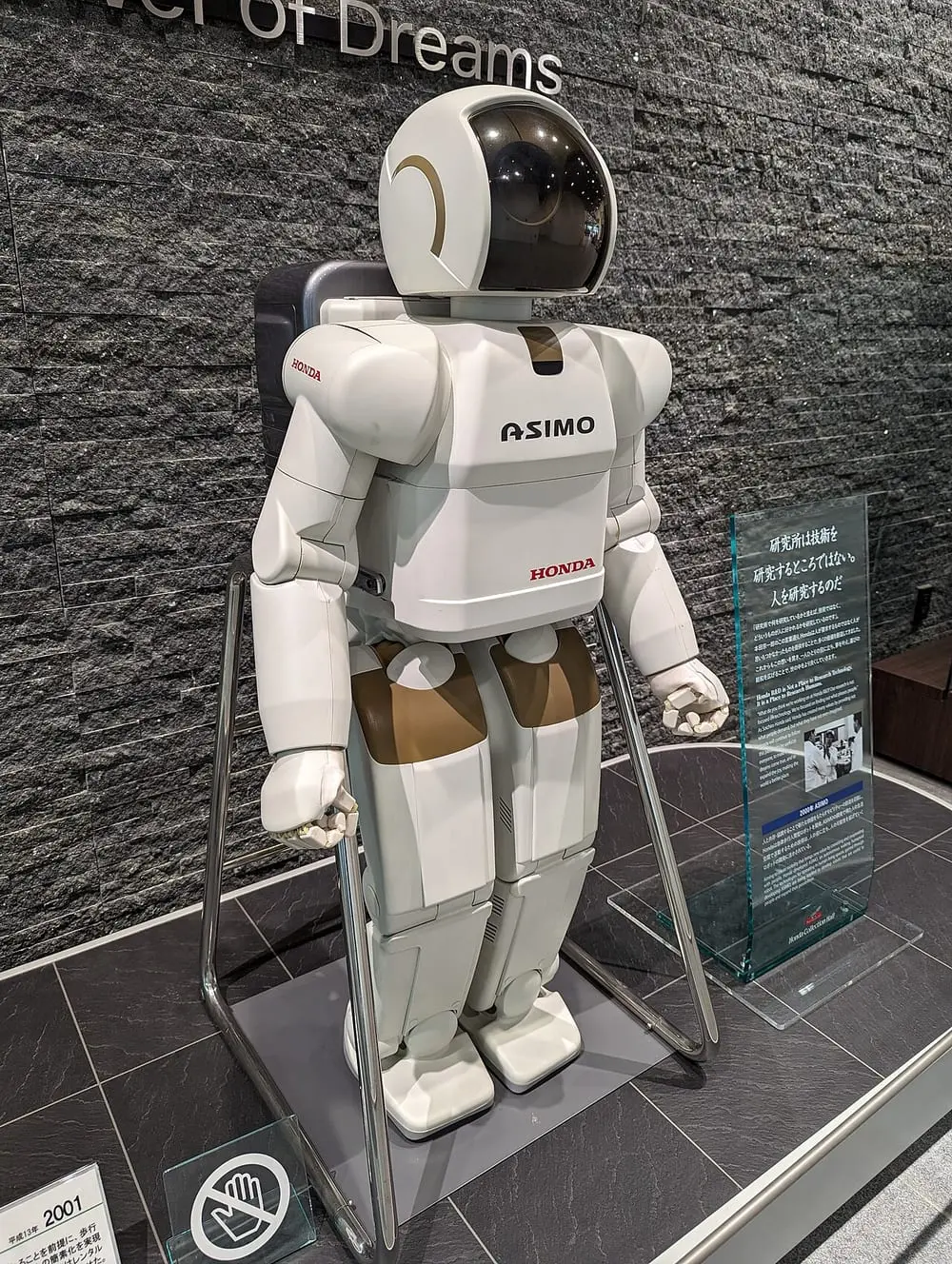
Syced (Wikimedia Commons) · CC0 · Commons ↗ A humanoid robot that Honda announced and demonstrated at its Tokyo headquarters on 20 November 2000. At 120 cm and 43 kg it was far smaller and lighter than its predecessor P3 (160 cm, 130 kg), and new walking control, which predicted its next move and shifted its centre of gravity in advance, gave it a gait close to a person's. It had 26 degrees of freedom and walked at 0 to 1.6 km/h. The name stands for Advanced Step in Innovative Mobility. Honda's research into two-legged walking began with E0 in 1986, and P2, shown in December 1996, carried its computers and batteries in its torso and ran without wires. ASIMO entered Honda's rental business in 2001 and later gained face recognition, running and task-sharing among several units; the 2011 version ran at 9 km/h. At Japan's National Museum of Emerging Science and Innovation (Miraikan) it performed from January 2002, before an estimated two million visitors over 20 years, until its demonstrations ended on 31 March 2022.
2010s
In the 2010s humanoids were tried from two directions. In the United States a DARPA competition, launched after the Fukushima nuclear disaster, asked for machines that could work at disaster sites; the hydraulic Atlas began tethered to off-board power and directed by an operator, and by the 2015 finals ran on batteries and wireless links. In Japan a mobile operator put Pepper, which rolled on wheels and was billed as reading emotions from faces and voices, into its shops and sold it to the public on monthly contracts. Boston Dynamics later came under SoftBank, while Pepper production stopped within a few years of launch.
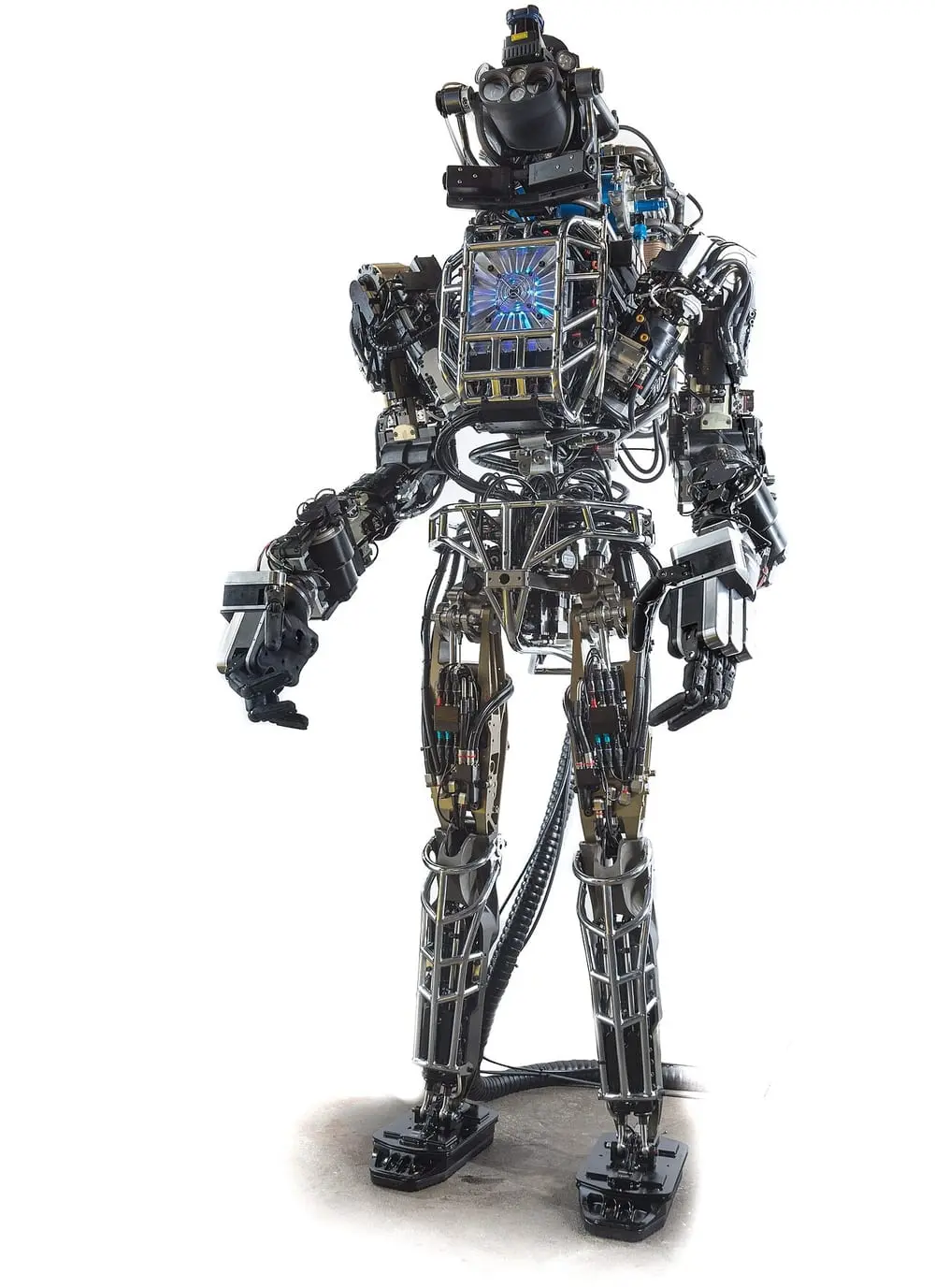
DARPA (Wikimedia Commons) · Public domain · Commons ↗ A humanoid robot unveiled by the US Defense Advanced Research Projects Agency (DARPA) on 11 July 2013, built by Boston Dynamics for the DARPA Robotics Challenge (DRC). It stood 6 feet 2 inches tall, weighed 330 pounds, moved 28 joints hydraulically and carried LIDAR and stereo cameras in its head. At first it was tethered to an off-board power supply and computer, through which a human operator issued commands. The DRC was launched in response to the 2011 Fukushima nuclear disaster to spur robots that could help people in disasters, and Atlas robots went to the seven teams that came through a virtual qualifying round. By the June 2015 finals Atlas ran on battery power and wireless communication, and Florida's IHMC, using Atlas, finished second behind KAIST's DRC-HUBO from South Korea. Google bought Boston Dynamics in 2013; it passed to SoftBank in 2017 and to Hyundai Motor Group in 2021. The hydraulic Atlas was retired in April 2024.
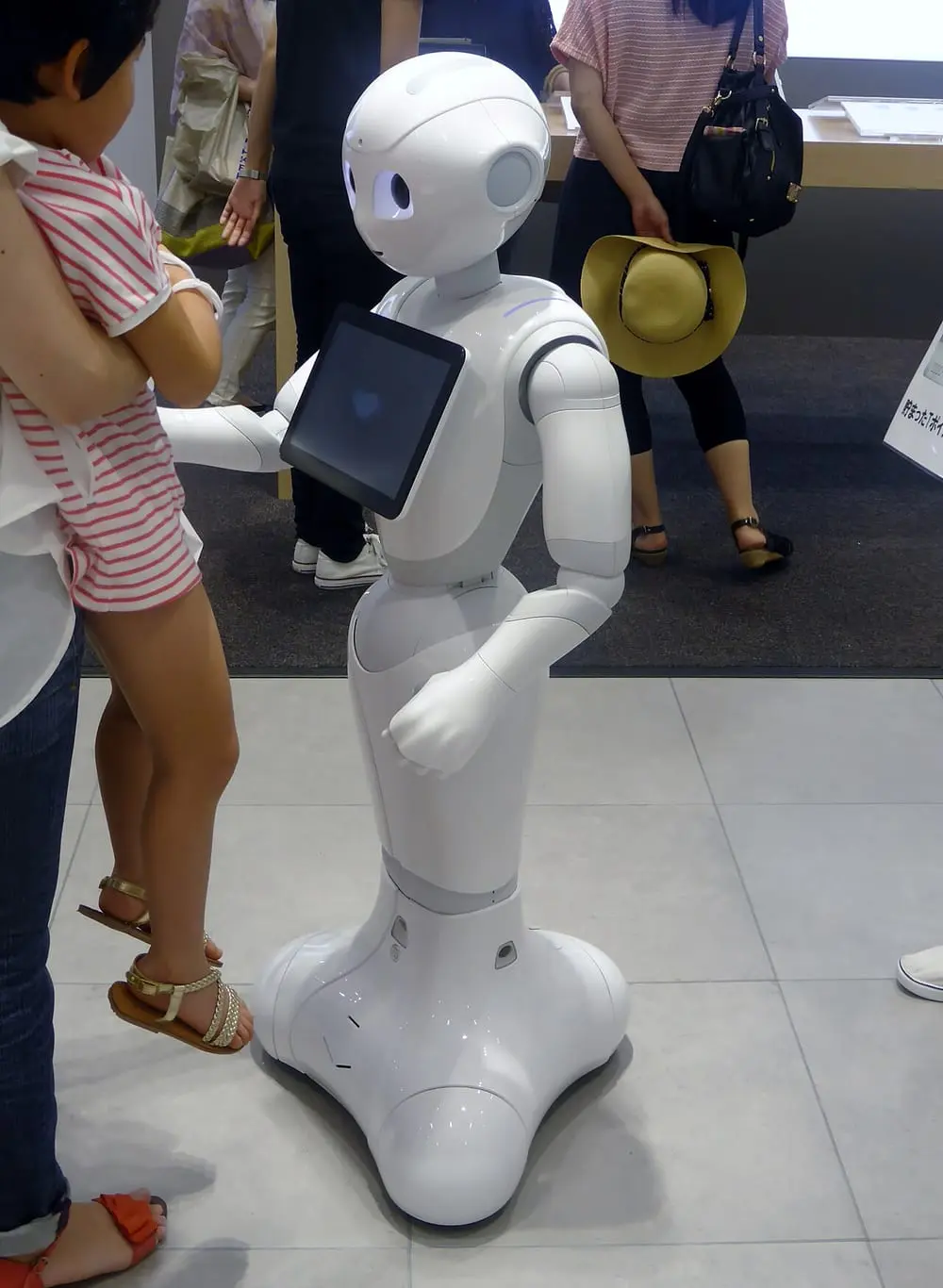
Tokumeigakarinoaoshima (Wikimedia Commons) · CC0 · Commons ↗ On 5 June 2014 SoftBank Mobile unveiled Pepper, a humanoid developed with France's Aldebaran, and billed it as the world's first personal robot that reads emotions. It stood 1,210 mm tall, weighed 28 kg, moved on wheels rather than legs, carried a 10.1-inch touch display on its chest, and was said to gauge people's feelings from their faces and voices. It began greeting customers in SoftBank shops the next day; 300 developer units went on sale on 27 February 2015, and general sales began on 20 June 2015. The body cost 198,000 yen before tax, but buying online required 36-month subscriptions to a basic plan and an insurance pack, and the 1,000 units for June sold out in a minute. That month Alibaba and Foxconn agreed to invest 14.5 billion yen each in SoftBank's robotics business. In June 2021 Reuters, citing sources, reported that production had stopped the previous year after about 27,000 units; Bloomberg said assembly had halted as inventory piled up, and SoftBank said production might resume.
2020s
In the 2020s humanoids moved from laboratory demonstrations into factory production plans and investment theses. Tesla began with a person in costume, faced reports of teleoperation when its prototypes mingled with guests, and has yet to reach the volumes it promised. Figure partnered with a language-model company, then switched to a model of its own, while Boston Dynamics rebuilt its hydraulic research machine as an electric product. In China, under state guidance, cheap machines shipped in volume and a listing raised vast sums. Movements once programmed by hand are now learned from demonstrations, though when humanoids will spread widely is still unclear.
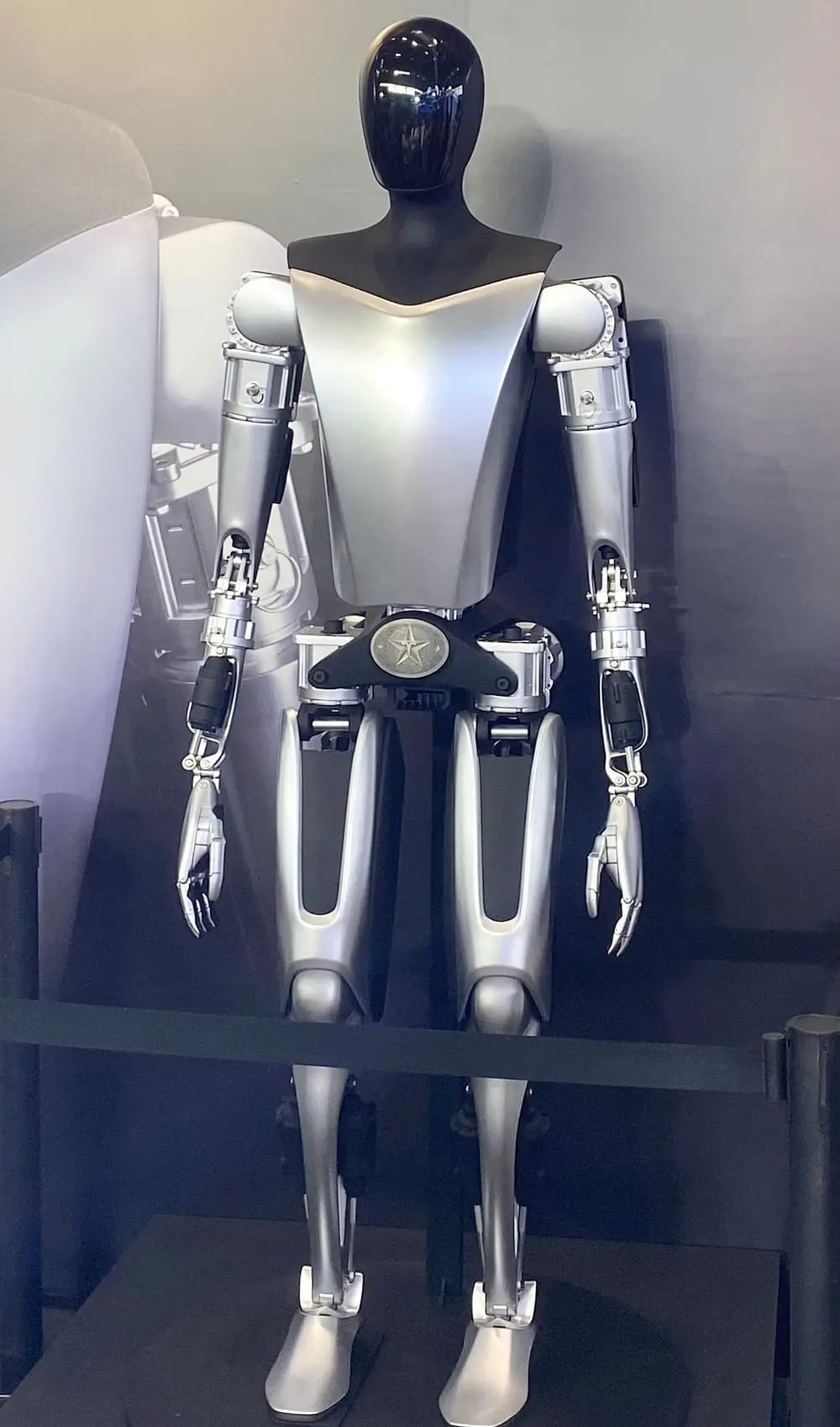
Benjamin Ceci (Wikimedia Commons) · Public domain · Commons ↗ A humanoid robot plan Tesla announced at its AI Day on 19 August 2021. First called Tesla Bot, it was presented as a robot 5 feet 8 inches tall, weighing 125 pounds and walking at 5 miles per hour, but what appeared on stage was a person in a robot costume. At AI Day on 30 September 2022 an Optimus prototype walked across the stage untethered for the first time, and Musk said a mass-produced unit would probably cost less than $20,000. At the We, Robot event on 10 October 2024 Optimus robots served drinks to guests, but Bloomberg and others reported that people were remotely operating them. Musk predicted about 10,000 would be built in 2025, which did not happen, and in January 2026 he acknowledged that no Optimus was yet doing useful work in Tesla's factories. In July 2026 Tesla said it had decommissioned the Model S and X lines at its Fremont factory and was installing first-generation Optimus lines, expecting production in 2026.
Figure is a humanoid-robot start-up in California founded by Brett Adcock in 2022. In January 2024 it signed its first commercial agreement, with BMW, to bring its Figure 01 humanoid into the Spartanburg plant in South Carolina in stages. On 29 February 2024 it raised $675 million at a $2.6 billion valuation from investors including Microsoft, the OpenAI Startup Fund, NVIDIA and Jeff Bezos, and announced a collaboration with OpenAI to develop next-generation AI models for humanoid robots. In February 2025, however, it ended its OpenAI agreement and unveiled Helix, its own vision-language-action model. In April 2025 Fortune reported that the CEO's descriptions of the BMW work were overstated. That September Figure raised more than $1 billion at a $39 billion valuation, and in October it unveiled Figure 03, aimed at homes. According to Figure, Figure 02 ran for 11 months at BMW and contributed to the production of more than 30,000 X3s. In November 2025 its former head of product safety sued, alleging he was fired after raising safety concerns.