T1#research#military
Atlas — The Hydraulic Humanoid Built for the DARPA Robotics Challenge
Metadata
- Date
- Decade
- 2010s
- Tier
- T1
- Timelines
- A History of Humanoid and AI Robots
- Sources
- 08
- Connections
- 02
- Tags
- #research#military
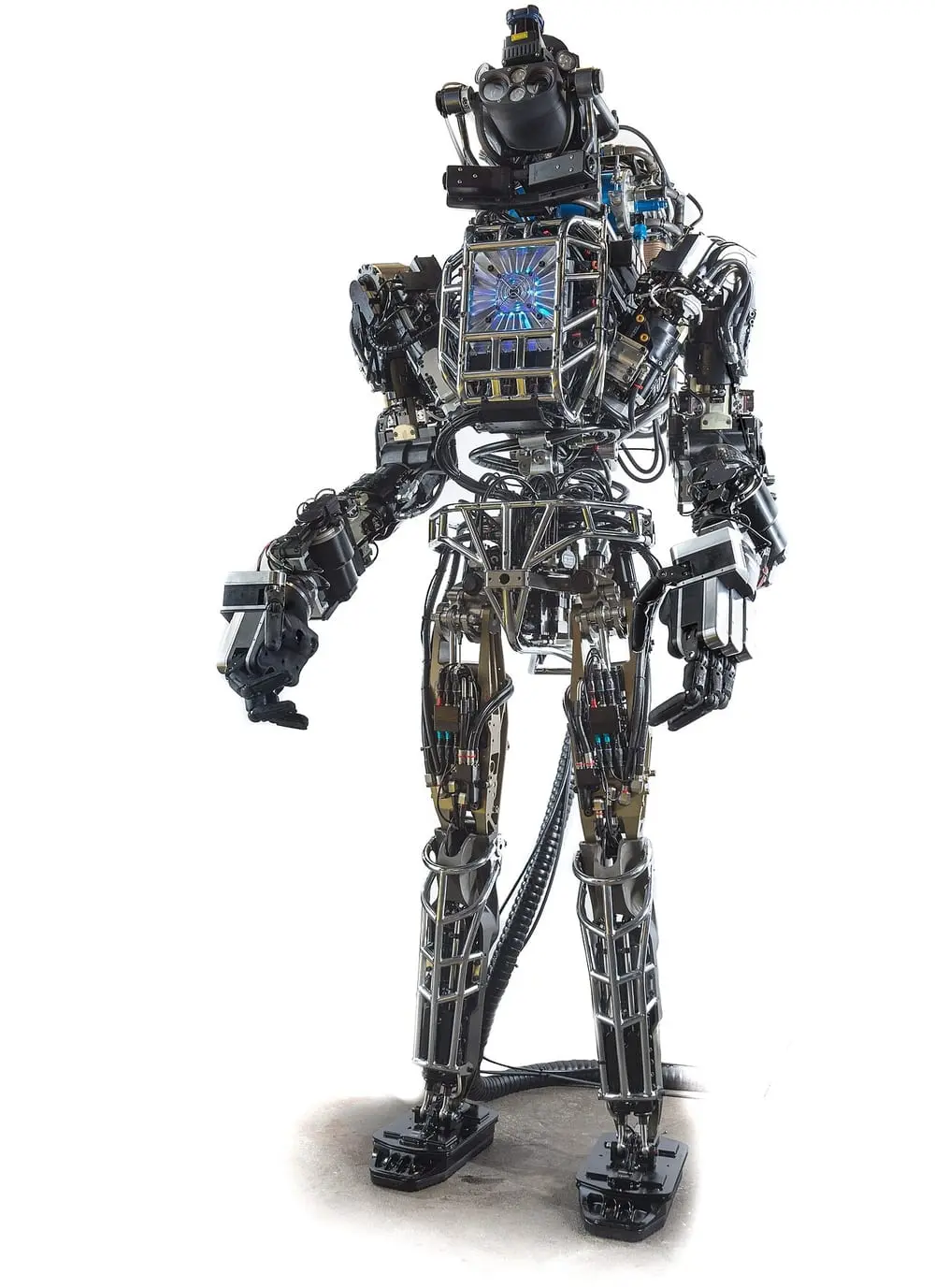
Atlas is the humanoid robot Boston Dynamics built for the DARPA Robotics Challenge (DRC) of the US Defense Advanced Research Projects Agency, which DARPA unveiled on 11 July 2013. Standing 6 feet 2 inches and weighing 330 pounds, with 28 hydraulically driven joints, it was handed out to competing research teams as a shared "body" on which to run their own software. The Atlas name, later carried by an electric robot built as a factory product, starts here.
A competition born of Fukushima
According to DoD News, the Pentagon's news service, DARPA launched the DRC in response to the 2011 nuclear disaster at Fukushima, Japan. The aim was to spur robots that could carry out rescue and recovery work in place of people in poisonous environments that humans cannot enter. DARPA's announcement said the robots would have to perform tasks of the kind that might be needed in a disaster-response scenario.
The competition proceeded in stages. First came the Virtual Robotics Challenge (VRC), fought inside a simulator; the seven teams that came through it (Tracks B and C) received an Atlas together with DARPA funding and technical support from Boston Dynamics. The six Track A teams, who built their own robots, included Carnegie Mellon's CHIMP, NASA JPL's RoboSimian, NASA Johnson Space Center's Valkyrie and the Japanese start-up SCHAFT.
The 2013 Atlas
DARPA's announcement says the seven teams first met Atlas on 8 July 2013 at Boston Dynamics' headquarters in Waltham, Massachusetts. The main specifications were as follows.
| Item | Detail (from DARPA's announcement) |
|---|---|
| Size | 6 ft 2 in tall, 330 lb |
| Joints | 28, hydraulically actuated |
| Sensors | Carnegie Robotics sensor head with LIDAR and stereo sensors |
| Power | Onboard hydraulic pump with thermal management |
| Control | Onboard real-time control computer |
| Hands | Two sets, one from iRobot and one from Sandia National Laboratories |
According to DARPA's innovation timeline, this early Atlas was tethered to an off-board power supply and computer, through which a human operator issued commands. DARPA itself described the early version as essentially a physical shell for the software "brains and nerves" the teams would develop. It was less an autonomous machine than a test bed for remote operation and semi-automatic control.
From the trials to the finals
In December 2013 the DRC Trials, effectively the qualifying round, were held at the Homestead-Miami Speedway in Florida. DARPA's record says that before the June 2015 finals it asked Boston Dynamics to upgrade Atlas: to make it more power-efficient, put the power supply on board, switch to wireless communication, and strengthen its limbs for durability. The work was finished in mid-2015. The tethered test bed became a machine that walked on its own batteries.
The finals took place on 5 and 6 June 2015 at the Fairplex in Pomona, California, with 23 teams taking part.
| Place | Team | Robot | Prize |
|---|---|---|---|
| 1st | KAIST (South Korea) | DRC-HUBO | $2 million |
| 2nd | IHMC Robotics (Pensacola, Florida) | Running Man | $1 million |
| 3rd | Tartan Rescue (Pittsburgh) | CHIMP | $500,000 |
Second-placed IHMC was an Atlas team. According to a Florida Senate resolution, IHMC placed first in the virtual challenge and received an Atlas, placed second overall and first among Atlas teams at the 2013 trials, and took second in the finals. That teams with identical hardware finished so far apart showed that a humanoid's performance depends not only on the machine but on the combination of software and human operation.
Google, SoftBank, Hyundai
While the DRC ran, Boston Dynamics changed hands several times. According to ITPro, Google acquired Boston Dynamics in December 2013. Founded in 1992, the company was Google's eighth robotics acquisition in six months, and Andy Rubin, who had led Android, was overseeing the robotics effort. Google said it would honour the existing $10.8 million contract to supply Atlas robots for the DRC but would not itself become a military contractor.
On 9 June 2017 SoftBank announced a definitive agreement to buy Boston Dynamics from Alphabet. In the same transaction it agreed to acquire SCHAFT, the bipedal-robot start-up founded at the University of Tokyo. Then on 21 June 2021 Hyundai Motor Group completed its acquisition of Boston Dynamics from SoftBank, taking 80 percent, with a SoftBank affiliate keeping the remaining 20 percent; the deal valued Boston Dynamics at $1.1 billion.
The end of the hydraulic Atlas
Atlas stayed in the public eye through videos that showed, as CNN put it in 2022, Boston Dynamics robots doing back flips and dance routines without a tether. In April 2024 Boston Dynamics announced the retirement of the hydraulic Atlas and, in the same week, unveiled a fully electric new Atlas. The machine born as a research test bed was remade as a product to work in Hyundai's factories.
Built in the wake of Fukushima, Atlas took a different road from ASIMO, refined in Japan over nearly 20 years. It was a humanoid robot for dangerous sites and heavy loads rather than one standing beside people at home or at a reception desk. The wider story is in the humanoid and AI robots timeline.
Questions this page answers
- What is Boston Dynamics' Atlas?
- A humanoid robot Boston Dynamics built for the DARPA Robotics Challenge, unveiled on 11 July 2013. It stood 6 feet 2 inches, weighed 330 pounds and moved 28 joints hydraulically. The hydraulic version was retired in April 2024 and replaced by a new electric Atlas.
- What was the DARPA Robotics Challenge?
- A prize competition DARPA launched in response to the 2011 Fukushima nuclear disaster, to spur robots that could help people in disasters. Trials were held in December 2013 and the finals in Pomona, California, in June 2015, where KAIST's DRC-HUBO from South Korea won the $2 million first prize.
- How did Atlas do in the DARPA competition?
- Atlas was a shared platform given to several teams. At the 2015 finals Florida's IHMC, using Atlas, finished second and won $1 million. IHMC had also placed second overall at the December 2013 trials, first among the Atlas teams.
- Who owns Boston Dynamics?
- It is a US company founded in 1992. Google bought it in 2013, SoftBank agreed to buy it from Alphabet in 2017, and Hyundai Motor Group completed its acquisition in June 2021, taking an 80 percent stake.
Sources
PrimaryAtlas Robot Unveiled — DARPA, July 11, 2013
The 8 July handover in Waltham; 6 ft 2 in and 330 lb; 28 hydraulic joints; the Carnegie Robotics sensor head; onboard hydraulic pump; hands from iRobot and Sandia; the six Track A teams; the December trials
PrimaryAtlas robot debut — DARPA Innovation Timeline
Tether to off-board power and computer with operator commands; seven units distributed; upgrades before the 2015 finals (onboard power, wireless communication, stronger limbs)
SecondaryRobots from South Korea, U.S. Win DARPA Finals — Cheryl Pellerin, DoD News, June 6, 2015
The finals venue (Fairplex), 23 teams, placings and prizes for KAIST, IHMC and Tartan Rescue, the Fukushima origin
PrimarySenate Resolution 16-A (2015) — The Florida Senate
IHMC first in the virtual challenge and receiving an Atlas; second overall and first among Atlas teams at the trials; second at the finals
SecondaryGoogle acquires veteran robotics firm Boston Dynamics — ITPro, December 16, 2013
The eighth robotics acquisition in six months, the 1992 founding, the $10.8 million contract to supply Atlas, Andy Rubin
The 80 percent stake, SoftBank's remaining 20 percent, the $1.1 billion valuation
SecondaryTesla robot slowly walks on stage at AI Day — Matt McFarland, CNN Business, September 30, 2022
Boston Dynamics robots doing back flips and dance routines without a tether
Last updated: