T1#research#japan#consumer
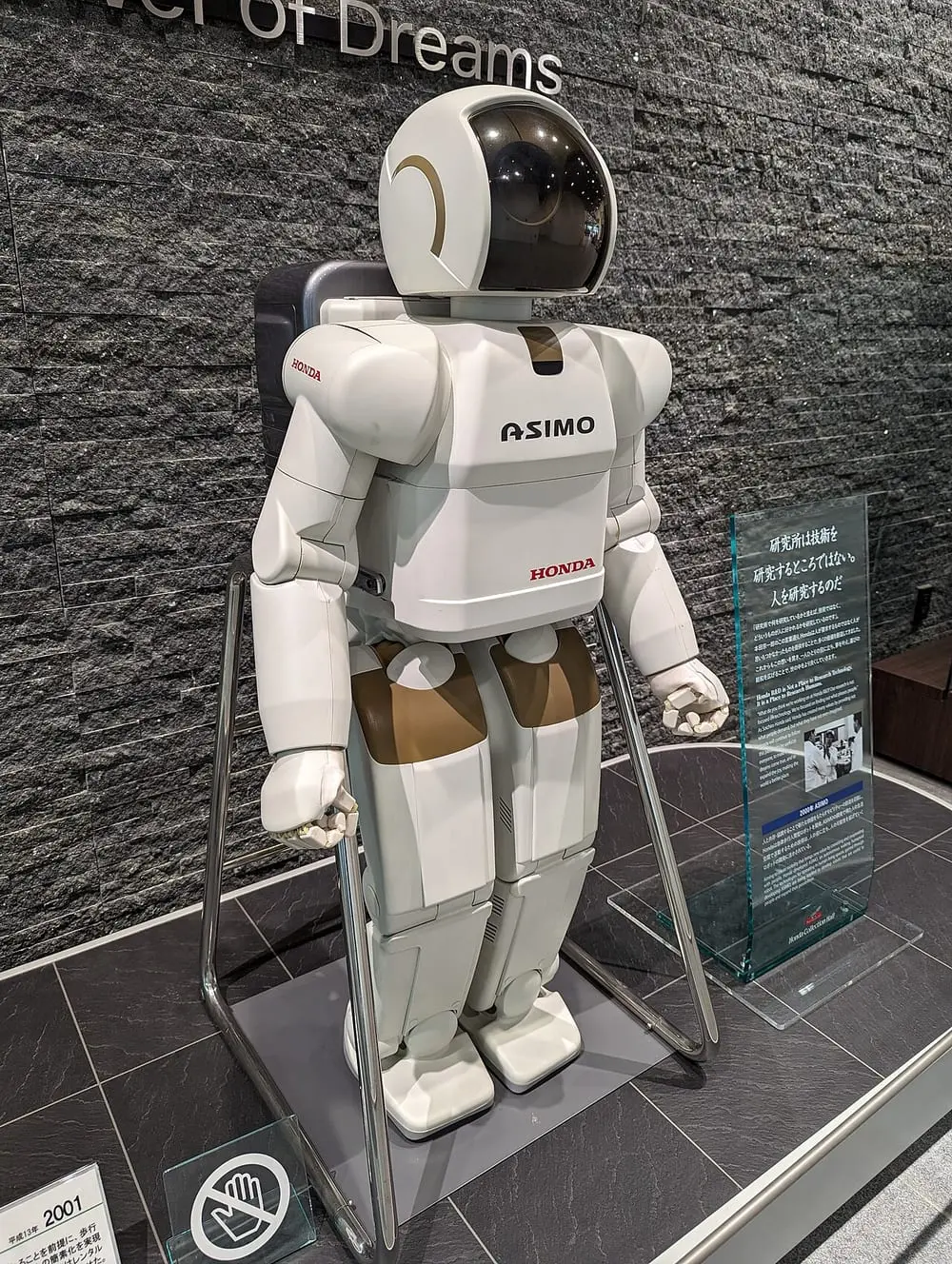
ASIMO — Honda's Walking Humanoid of 2000
Metadata
- Date
- Decade
- 2000s
- Tier
- T1
- Timelines
- A History of Humanoid and AI Robots
- Sources
- 07
- Connections
- 01
- Tags
- #research#japan#consumer
ASIMO is the humanoid robot Honda announced on 20 November 2000, demonstrating it the same day at its Tokyo headquarters. At 120 cm and 43 kg it was far smaller and lighter than its prototype predecessor P3, and new walking control, which predicted its next move and shifted its centre of gravity in advance, gave it a smooth gait close to a person's. The name stands for Advanced Step in Innovative Mobility. It was the machine that brought Japan's research into humanoid robots before the general public, in a company's hands.
Fourteen years from 1986
Honda began researching walking robots in 1986. According to the company's development history, the first, E0, walked by moving its legs alternately, but took about 15 seconds per step and could walk only in a straight line. With E1 to E3 (1987–1991) engineers studied how people and animals walk and wrote programs for faster walking, and with E4 to E6 (1991–1993) they developed three posture-control technologies for stable walking.
| Year | Model | Main points (from Honda's development history) |
|---|---|---|
| 1986 | E0 | Research machine for walking on two legs; about 15 seconds per step, straight lines only |
| 1993 | P1 | First humanoid form with torso and arms; 1,915 mm, 175 kg; external power and computer |
| December 1996 | P2 | Computers and batteries inside the torso, running without wires; 1,820 mm, 210 kg; walked, climbed stairs, pushed carts |
| September 1997 | P3 | Reduced to 1,600 mm and 130 kg |
| 2000 | ASIMO | 1,200 mm, 43 kg; could handle ordinary stairs and slopes |
Honda's history says it announced P2 in December 1996 as the world's first humanoid robot to walk on two legs. The heart of that claim is that it walked on batteries and computers inside its own body, with no cable attached.
ASIMO's specifications
The main figures in the 2000 announcement were as follows.
| Item | Value |
|---|---|
| Height | 1,200 mm (P3: 1,600 mm) |
| Weight | 43 kg (P3: 130 kg) |
| Degrees of freedom | 26 in total (head 2, arms 10, hands 2, legs 12) |
| Walking speed | 0–1.6 km/h |
| Power | 38.4 V, 10 Ah nickel-metal hydride battery |
It was made smaller so that it could move alongside people in the spaces where they live. In the announcement Honda said it hoped to create a partner for people, a new kind of robot with a useful role in society.
A decade of added abilities
Honda's development history records what ASIMO gained year by year.
- 2001 — Introduced into the rental business; more flexible walking and an improved interface with people
- 2002 — Read human postures and gestures, recognised faces and addressed people by name; network integration
- 2004 — Faster movement, continuous autonomous movement, human-like running, pushing carts and carrying trays
- 2005 — Walked hand in hand with a person and ran in a circle at 6 km/h; a total control system let it work as a receptionist, guide or delivery robot
- 2007 — Several units shared tasks over a network, weighing distance and remaining battery, and charged themselves
- 2011 — Autonomous behaviour control; ran at 9 km/h, hopped on one leg, walked on uneven ground, poured water and used sign language
All of this was an accumulation of techniques for performing carefully engineered movements reliably within set surroundings. It was still some way from a general-purpose machine that makes sense of its surroundings by itself and carries out tasks it was never taught.
Twenty years at Miraikan
The place where the most people saw ASIMO was the National Museum of Emerging Science and Innovation (Miraikan) in Tokyo. According to the museum, ASIMO was taken on as an "interpreter" (now called a science communicator) in January 2002, and by the end of 2021 it had given 15,466 demonstrations before an estimated two million visitors. Its demonstrations ended on 31 March 2022, and its stage show at Honda Welcome Plaza Aoyama ended at the same time.
What ASIMO left behind
In September 2022, when Tesla walked its Optimus prototype across a stage, CNN used ASIMO as the yardstick: developed over nearly 20 years, the child-sized ASIMO could walk untethered, run and climb stairs. Even after its retirement, ASIMO remains the measure against which new challengers' steps are judged.
In a 2025 paper the International Federation of Robotics (IFR) called Japan a pioneer in humanoids, citing ASIMO in 2000, and wrote that robots in Japan are seen as companions. ASIMO's path, a human form moving with people in human spaces, extended the Japanese research that began with Waseda's WABOT-1.
The trends of the 2010s and after came from elsewhere. In the United States the hydraulic Atlas was built for a disaster-response competition, and in the 2020s learning movements from large amounts of data became the main approach, as the electric Atlas and Figure began to enter factories. The wider story is in the humanoid and AI robots timeline.
Questions this page answers
- When was ASIMO unveiled?
- On 20 November 2000, when Honda announced it and demonstrated it at its Tokyo headquarters. It stood 120 cm tall and weighed 43 kg, far smaller and lighter than its predecessor P3.
- What does the name ASIMO mean?
- According to Honda's announcement, it stands for Advanced Step in Innovative Mobility.
- Has ASIMO retired?
- Its demonstrations at Miraikan ended on 31 March 2022. Miraikan says it had performed there since January 2002, 15,466 times by the end of 2021, before about two million visitors. The stage show at Honda Welcome Plaza Aoyama ended at the same time.
- When did Honda start building walking robots?
- In 1986. The first, E0, took about 15 seconds per step and could walk only in a straight line. P1 in 1993 added a torso and arms, and P2, shown in December 1996, carried its computers and batteries in its torso and walked without cables.
Sources
PrimaryHonda Debuts New Humanoid Robot "ASIMO" — Honda Motor Co., Ltd., November 20, 2000
Announcement date and headquarters demonstration, predicted movement control, 120 cm / 43 kg against P3's 160 cm / 130 kg, 26 DOF, 0–1.6 km/h, 38.4 V / 10 Ah Ni-MH battery, the 1986 start, the meaning of the name
Primary新型人間型ロボット「ASIMO」を発表 — 本田技研工業、2000年11月20日
Overall height 1,200 mm and the breakdown of degrees of freedom (head 2, arms 10, hands 2, legs 12)
PrimaryHistory of Robotics Development — Honda Global
From E0 (1986) through the specifications of P1, P2 and P3; the 2001 rental business; abilities added in 2002, 2004, 2005, 2007 and 2011
Joining in January 2002, the end of demonstrations on 31 March 2022, 15,466 demonstrations by the end of 2021, about two million visitors
SecondaryASIMOが卒業。90種類のロボが展示される「きみとロボット」展などが未来館で開催 — PC Watch、2022年3月18日
The graduation event and the end of the show at Honda Welcome Plaza Aoyama
SecondaryTesla robot slowly walks on stage at AI Day — Matt McFarland, CNN Business, September 30, 2022
ASIMO as the point of comparison for Optimus (untethered walking, running, stairs)
Japan as a pioneer, and the Japanese view of robots as companions
Last updated: