T1#consumer#japan#market
Pepper — SoftBank's Humanoid Sold on the Promise of Reading Emotions
Metadata
- Date
- Decade
- 2010s
- Tier
- T1
- Timelines
- A History of Humanoid and AI Robots
- Sources
- 10
- Connections
- 01
- Tags
- #consumer#japan#market
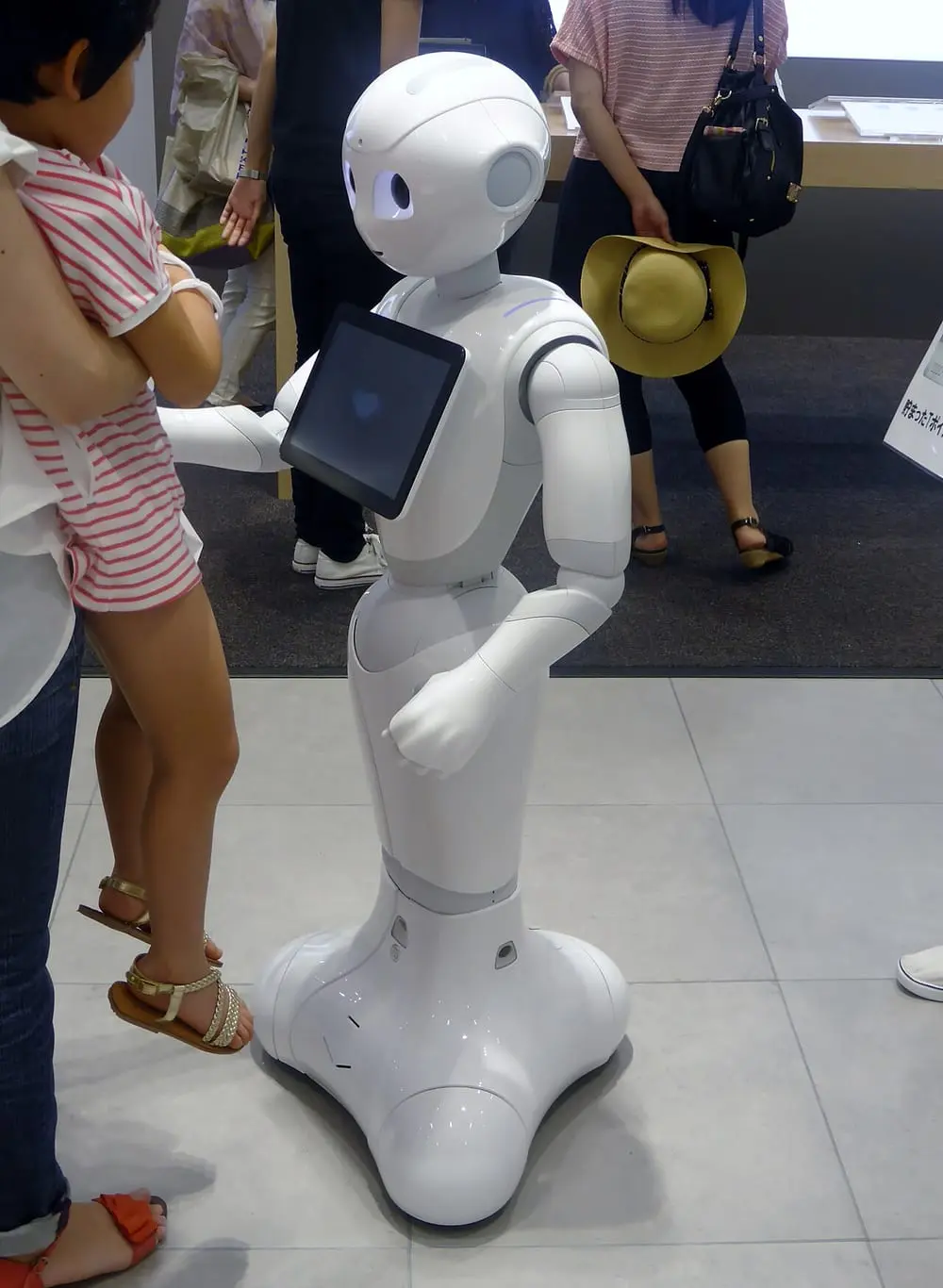
Pepper is a humanoid robot that SoftBank Mobile unveiled on 5 June 2014. It was developed jointly with France's Aldebaran Robotics, and the announcement billed it as "the world's first personal robot that can read emotions". The "world's first" is SoftBank's claim. From the next day it greeted customers at SoftBank's Omotesando and Ginza stores; 300 developer units went on sale on 27 February 2015, and general sales began on 20 June 2015.
The body cost 198,000 yen before tax. Buying online, however, required 36-month subscriptions to both a monthly basic plan and an insurance pack. The 1,000 units set aside for June sold out one minute after orders opened.
From unveiling to sale
| Date | Event |
|---|---|
| 5 June 2014 | SoftBank Mobile and Aldebaran unveil Pepper, with sales planned for February 2015 at 198,000 yen |
| 6 June 2014 | In-store demonstrations begin at SoftBank Omotesando and Ginza |
| September 2014 | A developer event planned, with an SDK for robot apps |
| 27 February 2015 | The first production run of 300 units goes on sale to developers |
| 18 June 2015 | General sale date and pricing announced; the same day, Alibaba and Foxconn agree to invest in the robotics business |
| 20 June 2015 | General sales begin; the 1,000 June units sell out in one minute |
| 31 July 2015 | Orders open for the 1,000 July units |
The February 2015 launch originally announced turned into a developer pre-release, and general sales slipped to the summer. In February, K-tai Watch reported that further sales were planned for around summer 2015.
The machine
SoftBank's announcement listed these planned specifications.
| Item | Specification |
|---|---|
| Size | 1,210 mm high × 425 mm deep × 485 mm wide |
| Weight | 28 kg |
| Movement | Wheels; up to 3 km/h, steps up to 1.5 cm |
| Battery | Lithium-ion, 30.0 Ah / 795 Wh; 12+ hours of operation (in-store use) |
| Head sensors | 4 microphones, 2 RGB cameras, 1 3D sensor, 3 touch sensors |
| Leg sensors | 2 sonar, 6 laser, 3 bumper, 1 gyro |
| Display | 10.1-inch touch display on the chest |
| Motors | 20 |
Unlike ASIMO or Atlas, Pepper did not walk on two legs. It set a human-like upper body on a wheeled base and put its effort not into walking but into facing people and talking to them.
According to PC Watch, Foxconn handled manufacturing, and its chief Terry Gou attended the unveiling. Aldebaran's founder Bruno Maisonnier, whose company the SoftBank Group had invested in, was involved in the development.
Selling emotion
What Pepper sold was not its specifications but emotion. SoftBank said Pepper could gauge people's feelings from their facial expressions and tone of voice, and at the unveiling it scored Masayoshi Son's smile. Emotional data learned by each robot was to be pooled in a cloud database and shared with other Pepper units, and a company to run that data, Cocoro SB, was announced. In the release Son said: "Using emotion engines and Cloud AI, which evolves with collective wisdom, we're making this happen."
A year later, SoftBank's Japanese release of 18 June 2015 announcing general sales was headed with a new phrase: a personal robot that, as a world first, has emotions of its own. From a robot that reads people's emotions to one that has its own — both were the company's claims, not capabilities verified by anyone outside.
The pricing: a cheap body, paid off monthly
General-sale pricing, all before tax:
| Item | Price |
|---|---|
| Body | 198,000 yen |
| Pepper basic plan | 14,800 yen × 36 months |
| Pepper insurance pack | 9,800 yen × 36 months |
| Processing fee | 9,800 yen |
Online buyers had to sign up for both the basic plan and the insurance pack, so the three-year total far exceeded the price of the body. Even so, when orders opened at 10 a.m. on 20 June the 1,000 June units were gone in a minute, and orders for another 1,000 opened on 31 July. The June release also announced a business model, Pepper for Biz, for that autumn.
On the same day, 18 June, SoftBank announced that Alibaba and Foxconn would each invest 14.5 billion yen in the intermediate holding company for its robotics business, leaving SoftBank with 60 percent and each partner with 20. The three said they would take Pepper to global markets.
Production stops
On 28 June 2021 Reuters, citing sources and documents, reported that Pepper production had stopped the previous year. According to one source, only about 27,000 units were built. Three sources said limited functionality and unreliability had hurt sales. Reuters also reported plans to cut about half of 330 positions at the robotics unit in France.
Bloomberg reported the next day, in a story carried by Fortune, that assembly had halted in August as inventory piled up, and a SoftBank spokeswoman said production might resume in future. In a follow-up on 21 July, Reuters reported, citing documents, that production at a Foxconn plant in China had stopped the previous year and that SoftBank had fewer than 2,000 Pepper units left.
In the same period SoftBank also owned another humanoid maker: Boston Dynamics came under SoftBank in 2017 and moved to Hyundai Motor Group in 2021 (see the Atlas article).
For the wider history of humanoids, see the humanoid and AI robots timeline.
Questions this page answers
- When was Pepper unveiled and released?
- It was unveiled on 5 June 2014. Three hundred developer units went on sale on 27 February 2015, and general sales opened online at 10 a.m. on 20 June 2015.
- How much did Pepper cost?
- The body cost 198,000 yen before tax. Buying online required a basic plan at 14,800 yen a month for 36 months and an insurance pack at 9,800 yen a month for 36 months, plus a 9,800 yen processing fee, all before tax.
- Could Pepper really understand emotions?
- SoftBank billed it as the world's first personal robot that reads emotions, gauging feelings from faces and voices. That was the company's claim. In 2021 Reuters, citing sources, reported that limited functionality and unreliability had held back sales.
- Has Pepper production ended?
- In June 2021 Reuters, citing sources and documents, reported that production had stopped the previous year, with about 27,000 units built. Bloomberg reported that assembly had halted as inventory piled up, and a SoftBank spokeswoman said production might resume in future.
Sources
Announcement date, joint development, the 'world's first' claim, 198,000 yen and the February 2015 target, in-store demonstrations, specifications, the SDK
Primary世界初となる自分の感情を持ったパーソナルロボット「Pepper」を6月20日より販売開始 — ソフトバンク、2015年6月18日
General sale date and time, 1,000 units for June, the price and monthly plans, the planned Pepper for Biz
PrimaryPepperの7月販売分1,000台、7月31日より申し込み受け付け開始 — ソフトバンク、2015年7月3日
The 1,000 June units sold out in one minute
Alibaba and Foxconn each investing 14.5 billion yen, for a 60:20:20 split
Secondaryソフトバンク、感情を理解して自律動作するロボット「Pepper」を発表 — PC Watch、2014年6月5日
Manufacturing by Foxconn, pooling emotion data in the cloud, the founding of Cocoro SB, movement on wheels
Production stopped the previous year, about 27,000 built, job cuts in France, reasons for weak sales
SoftBank's account of halting assembly as inventory piled up, and the possibility of resuming
Production stopped at a Foxconn plant in China, fewer than 2,000 units left
Last updated: