T1#blackberry#rim#push-email#qwerty
BlackBerry 850 Launches — Hardware QWERTY and Push Email Take Over the Enterprise
Metadata
- Date
- Decade
- 1990s
- Tier
- T1
- Sources
- 05
- Connections
- 00
- Tags
- #blackberry#rim#push-email#qwerty#enterprise
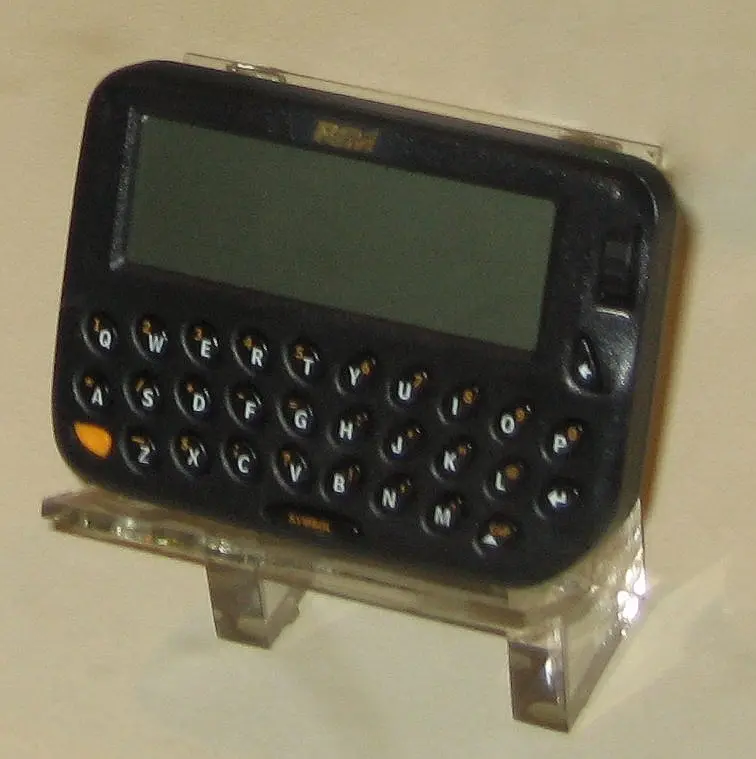
On 19 January 1999, the Canadian firm Research In Motion (RIM) — headquartered in Waterloo, Ontario, founded in 1984 by Mike Lazaridis — announced a product named the BlackBerry 850. The story goes that Lexicon Branding, the marketing firm running RIM's internal naming strategy, proposed the name "BlackBerry" on observing that the keyboard's keys resembled the drupelets of the blackberry fruit.
Strictly speaking, the BlackBerry 850 was not a phone. It was a two-way pager form factor with a hardware QWERTY keyboard (optimised for thumb typing) and a proprietary push email delivery system built by RIM. It ran on a single AA cell for around three weeks, used an Intel 386-class 32-bit processor and a bespoke operating system. Push email — server-to-device delivery of new messages, with no user action required — was a meaningfully novel implementation at the time.
Why Corporate Executives Fell for It
Between roughly 1999 and 2003 in the US corporate environment, BlackBerry rapidly became the standard equipment of the executive class.
- Immediate mail delivery. Mobile mail on rival platforms — including the contemporary i-mode in Japan — was overwhelmingly polled, with delays from a few minutes to tens of minutes. RIM's push delivery vibrated the device almost the instant mail arrived. In sectors where the speed of email response was a second-by-second competition — sales, finance, legal — that gap mattered.
- Hardware QWERTY. Key layout and spacing were designed around thumb typing for long passages of text and were considerably faster and more accurate than any software keyboard of the time. BlackBerry users learnt to reply at length to mail from a train seat, between meeting sessions, or in a taxi.
- Enterprise-grade security and server-side management. With BlackBerry Enterprise Server (BES) installed inside the corporate network, all device traffic was AES-encrypted and the IT administrator could remotely wipe devices. For finance, law firms, and government, this was a non-negotiable requirement.
When the BlackBerry 6210 (Quark) integrated voice telephony in 2003, the migration from "mail device" to "smartphone" began. The BlackBerry Pearl 8100 expanded into the consumer market in 2007, and the global subscriber base peaked at around eighty million in 2012.
"CrackBerry"
The compulsive quality of BlackBerry use was a recurring object of media ridicule. The image of the executive who could not put down the device — replying to email through dinner — became part of the texture of US corporate life in the 2000s. The coinage "CrackBerry" was named Word of the Year by Webster's New World College Dictionary in 2006.
In January 2009, President Obama's reluctance to surrender his BlackBerry on inauguration — leading the NSA to provide a specially encrypted variant for continued presidential use — became an emblem of the device's cultural standing.
Why It Collapsed
The collapse of BlackBerry begins on 29 June 2007, with the release of the original iPhone.
At first RIM's leadership did not treat the iPhone as a threat. Multi-touch lacked the speed and accuracy of a physical keyboard; battery life was short; the security model was not enterprise-grade — so the judgement went. The same assessment continued through the release of Android 1.0 in 2008.
The market chose another logic.
- Touchscreen plus App Store. A hardware keyboard — a tool that made email replies faster — began to look like a local optimum in front of a proposal in a different category entirely: applications that reconstruct the user's daily life.
- From corporate purchase to BYOD. Executives bought iPhones personally and asked to use them at work; IT departments scrambled to build MDM (Mobile Device Management) in retrospect. BlackBerry's "IT-driven" model was inverted by an "individual-driven BYOD" model.
- Failed modernisation of the OS. RIM pursued BBOS 10 / BlackBerry 10, but the 2013 release was already too late. The application ecosystem never coalesced, and developers walked away.
In 2013, RIM renamed itself BlackBerry Limited. In September 2016, the company announced full withdrawal from its own handset design. The BlackBerry brand was licensed to TCL in China and other licensees; RIM itself migrated into enterprise security software (BlackBerry Cylance and similar lines).
Push Mail Lives On as Intune
What BlackBerry left behind was the premise itself: that a mobile device can carry the enterprise's business information. Push mail, server-managed mobile endpoints, encrypted business traffic — all of these live on inside the modern iPhone and Android in the shape of Microsoft Intune or Apple Business Manager.
The hardware QWERTY keyboard as a physical form has gone extinct outside of niche fan markets. But the embodied act of "thumb typing" and the working habit of "replying to mail while moving" — these were arguably completed once by BlackBerry and then inherited by the iPhone generation through the software keyboard.
Related Events
The next month of 1999 saw NTT DoCoMo launch i-mode in Japan; two parallel implementations of "reading and sending mail on a mobile device" began running on opposite sides of the world. The vocabulary of enterprise security and push mail that BlackBerry defined was later re-implemented in another physical form and ecosystem with the original iPhone of 2007, which would push BlackBerry off the market. For the wider lineage of mobile handsets, see the history of mobile phones and smartphones.
Questions this page answers
- When did BlackBerry peak?
- In 2012, at about eighty million subscribers worldwide. Pushed back by the iPhone and Android from 2007, RIM exited its own handset business in 2016 and turned the brand into a licensing operation.
Sources
TertiaryBlackBerry — Wikipedia
Last updated: