T1#nokia#symbian#s60#smartphone
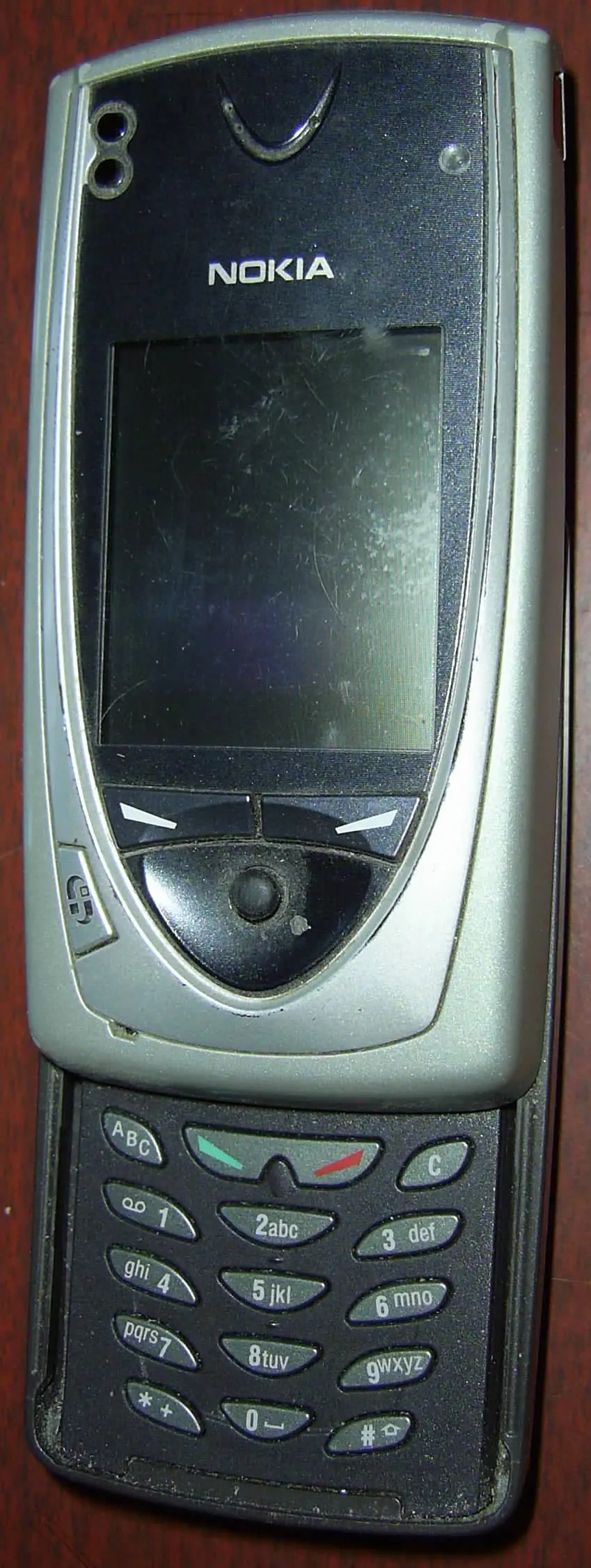
Nokia 7650 Launches — Symbian S60 Opens the Smartphone Era
Metadata
- Date
- Decade
- 2000s
- Tier
- T1
- Sources
- 07
- Connections
- 02
- Tags
- #nokia#symbian#s60#smartphone#finland
On 26 June 2002, the Finnish company Nokia shipped a device branded the Nokia 7650 to the European market. Nokia at the time accounted for more than 35% of the world's mobile-handset volume — the absolute incumbent — and the 7650 was the first mass-produced device the king itself called a "smartphone".
The announcement had come more than half a year earlier, in Barcelona on 19 November 2001, where CEO Jorma Ollila called it the company's most important launch of the year.
The specification was, by the standards of 2002, ambitious. A slide-up body (114×56×26mm closed, 154g), a 176×208-pixel colour TFT screen (4,096 colours), a 104 MHz ARM9-class processor, 4 MB of RAM (3.4 MB usable) and 16 MB of ROM, GPRS (2.5G) data, and a VGA (0.3-megapixel) rear camera. It was Nokia's first camera phone and its first with MMS, retailing in Europe at around 600 euros.
What makes the 7650 historically important, however, is the operating system rather than the hardware.
Symbian and Series 60
Symbian OS originated as "EPOC", an OS for personal digital assistants developed by Psion in the UK. In 1998 it was transferred to Symbian Ltd., jointly funded by Nokia, Ericsson, Motorola, and Psion. It was designed to run multitasking, pre-emptive scheduling, memory protection, and third-party applications under the resource constraints of mobile handsets.
In 2001, Nokia built a user-interface layer on top of Symbian called "Series 60" (S60): a standard UI driven by a five-way key, application install and management, telephony APIs, Bluetooth, and a Java MIDP runtime. Nokia licensed it to other vendors; Sony Ericsson, Samsung, LG, and Panasonic shipped S60 handsets on the same base.
The Nokia 7650 is the first mass-produced device to run the S60 platform. Earlier Symbian devices — Ericsson R380 in 2000, Nokia 9210 in 2001 — predate it; what 7650 established was the S60 UI standard and the application-compatibility ecosystem.
The Symbian Kingdom
The 7650's commercial success pushed Symbian to the top of the European "handheld device market" in Q3 2002, displacing Palm OS and Windows CE. For the rest of the decade, Symbian very nearly monopolised the word "smartphone" itself as an OS designation.
The share peak came before the iPhone, not after it: 2006, when Symbian held something close to seven-tenths of the global smartphone OS market (counts range from roughly 67% to 73% depending on the analyst). It still held over 60% through 2007, and Nokia alone accounted for roughly half of all smartphone sales in the world.
Cumulative shipments passed 100 million in November 2006. They did not reach 250 million until July 2009 — well after Symbian's share had begun to slide. Unit volume kept climbing while the share collapsed, for the simple reason that the market underneath was growing faster still. The N series (multimedia devices), the E series (business devices), and devices like the Nokia N95 (2007) — integrating GPS, a 5-megapixel camera, and Wi-Fi — defined what "state-of-the-art smartphone" meant at the time.
Tom Tom's car-navigation app, Skype Mobile, Opera Mobile, and several thousand third-party applications circulated on Symbian. Before the term "app store" had been standardised, Symbian Signed already existed as a certified application distribution channel.
An Ageing OS and a Pendulum Strategy
When the original iPhone arrived on 29 June 2007, the fate of Nokia and Symbian reversed. Android 1.0 on the HTC Dream followed in September 2008, and Google entered the same category.
The cause of the collapse was not singular.
- An ageing OS. Symbian was designed for an era of severe resource constraints, and many layers — memory management, interrupt handling, the application model — had aged. The migration to a touchscreen-first design (Symbian^3 and others) was slow and could not match the modern architectures of iOS and Android.
- Poor developer experience. Symbian C++ had a steep learning curve, required an idiosyncratic "leave/cleanup stack" idiom for memory management, and offered lower developer productivity than Objective-C on iOS or Java on Android.
- A pendulum strategy. In 2010 Nokia announced migration to MeeGo (a Linux-based OS co-developed with Intel); in February 2011, after the famous "burning platform" memo from CEO Stephen Elop, Nokia pivoted en masse to Windows Phone. The Lumia line bet on Microsoft's OS, abandoning Symbian. But Windows Phone never gained an application ecosystem either, and Nokia's market share fell precipitously.
- Misreading the ecosystem economy. The new dynamic that Apple built with the App Store and Google with Play — three-sided coordination between developers, OEMs, and carriers around the platform operator — was never something Nokia learnt to do.
In September 2013, Microsoft announced acquisition of Nokia's handset business for US$7.2 billion (closed 25 April 2014). Symbian ended formally when Nokia terminated software development and maintenance support with effect from 1 January 2014; the last official Symbian device had been the Nokia 808 PureView in 2012. Microsoft itself could not make Windows Phone work either, and on 18 May 2016 it sold the feature-phone business — some 4,500 employees with it — to Foxconn subsidiary FIH Mobile and the Finnish start-up HMD Global for US$350 million, effectively exiting mobile handsets.
The First Vocabulary of "Smartphone"
What Symbian and the Nokia 7650 defined was the first vocabulary of the smartphone category itself. A multitasking OS, third-party applications, integration of communication and image capture and internet browsing, an across-vendor platform standard (S60). All of these were concepts inherited by iOS and Android — and even after Symbian's decline, they remain fossilised inside the meaning of the word "smartphone".
That a small country — Finland — was the centre of the world's mobile industry for the better part of fifteen years between the late 1990s and the late 2000s remains, even after Nokia's collapse, an exceptional event in industrial history.
Related Events
Three years before the Nokia 7650, the BlackBerry 850 of January 1999 and the launch of i-mode in February 1999 had set up the three geographical origins (North America, Japan, Europe) of "data on a mobile device". The smartphone category that Symbian defined was later supplanted by a new generation of operating systems with the original iPhone in 2007 and Android 1.0 in 2008. For the wider lineage of mobile devices, see the history of mobile phones and smartphones.
Questions this page answers
- When was the Nokia 7650 released?
- 26 June 2002. It was the first mass-produced device running Symbian OS on the Series 60 (later S60) platform, and also Nokia's first camera phone.
- When did Symbian's market share peak?
- In 2006, at close to seven-tenths of the global smartphone OS market — figures between 67% and 73% are reported. The 100-millionth device shipped that November, and the 250-millionth in July 2009.
- What became of Symbian and Nokia's handset business?
- The iPhone and Android broke Nokia's position; it sold the handset business to Microsoft in April 2014. In May 2016 Microsoft sold the feature-phone business on to FIH Mobile and HMD Global, ending the lineage.
Sources
TertiaryNokia 7650 — Wikipedia
Last updated: