T1#research#military
Shakey — SRI's Mobile Robot That Planned Its Own Actions
Metadata
- Date
- Decade
- 1960s
- Tier
- T1
- Timelines
- A History of Artificial Intelligence
- Sources
- 06
- Connections
- 00
- Tags
- #research#military
Shakey was a mobile robot built by the Artificial Intelligence Center of the Stanford Research Institute (SRI, now SRI International) between 1966 and 1972. It looked at its surroundings with a television camera and a rangefinder, worked out what it should do, and then carried out the plan on wheels. SRI describes it as the first mobile robot with the ability to perceive and reason about its surroundings, and the IEEE, which recognised the work as a Milestone in 2017, put "the world's first mobile intelligent robot" on its plaque. Both are the assessments of the bodies making them. What outlived the robot were the algorithms written for it: the A* path-finding search, the STRIPS planner and an improved Hough transform for finding straight lines in images, which went on to turn up in driving directions, video games and Mars rovers.
How the project began — March 1966
According to the IEEE Milestone record, the project was the idea of SRI's Charles A. Rosen, who spent about two years promoting it before securing initial funding from ARPA (now DARPA), an agency of the Department of Defense. Work began in March 1966, and Nils J. Nilsson, Bertram Raphael and Peter E. Hart went on to lead it.
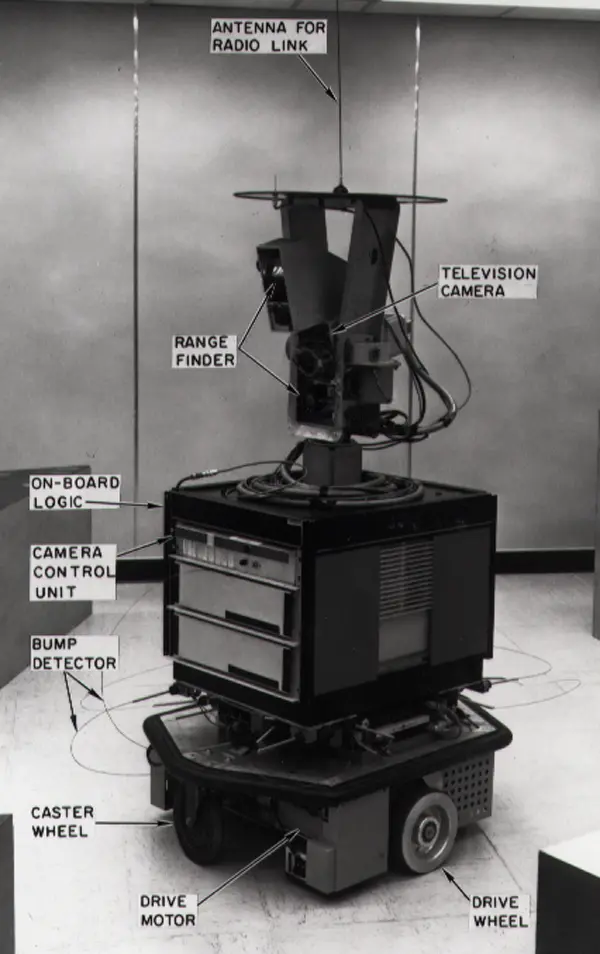
The Computer History Museum (CHM), which holds the robot, describes Shakey as carrying cameras and touch sensors while being controlled by a large remote computer. This was not an era in which the brain could ride on the robot; Shakey was a body linked to a computer by radio. SRI's own annotations on the photograph on this page point to the antenna for the radio link, the television camera, the rangefinder, the camera control unit, the bump detectors and the drive wheels. CHM relates that the name came from the way the robot shook as it moved.
| Item | Detail |
|---|---|
| Developer | Stanford Research Institute (SRI), Artificial Intelligence Center |
| Period | March 1966 – 1972 |
| Funding | ARPA (Department of Defense) |
| Key researchers | Charles A. Rosen (initiator), Nils J. Nilsson, Bertram Raphael, Peter E. Hart |
| Senses | Television camera, rangefinder, bump detectors |
| Main spin-offs | A* search (1968), STRIPS (1971), revised Hough transform (1972) |
| Today | On display at the Computer History Museum, Mountain View, California |
Three techniques that came out of Shakey
A* search (1968). To cross a room around obstacles, a robot has to pick waypoints and find the cheapest route through them. In July 1968 Hart, Nilsson and Raphael published "A Formal Basis for the Heuristic Determination of Minimum Cost Paths" in the IEEE Transactions on Systems Science and Cybernetics. The paper folded heuristic information about the problem into a formal mathematical theory of graph search and showed that a class of search strategies finds minimum-cost paths. The IEEE record notes that A* is used in driving directions, path-finding in video games and route planning for Mars rovers.
STRIPS (1971). Planning means breaking a goal such as "go to the next room and push the box to the doorway" into a sequence of actions the machine can carry out. In 1971 Richard Fikes and Nilsson described STRIPS (Stanford Research Institute Problem Solver) in the journal Artificial Intelligence. According to the IEEE record, STRIPS described each action by its preconditions, a delete list and an add list, and was paired with PLANEX, which monitored plan execution and recovered from errors. The National Research Council's history counts STRIPS among the results that endured.
A better Hough transform (1972). To pick out straight lines, such as the edge where floor meets wall, in camera images, Hart and Richard O. Duda in 1972 reworked the method Paul Hough had patented in 1962 into a form whose transform space does not run off to infinity.
How newspapers and magazines saw it
SRI's records show that the New York Times covered Shakey on 10 April 1968, alongside robot efforts at MIT and Stanford University. In 1970 Life magazine called Shakey the "first electronic person", and the November 1970 issue of National Geographic carried its picture in an article on current and future uses of computers. A cart carrying a box and a camera became, for general readers, a concrete image of a thinking machine.
In practice, by SRI's account, Shakey worked on tasks such as planning, route-finding and rearranging simple objects. The gap between the picture the press painted and what the machine could actually do would matter when the funding argument came.
The funding winds and the "first AI winter"
Funding a Revolution, the National Research Council's 1999 history of government support for computing research, says SRI committed itself to building an AI-driven robot, Shakey, as the means to its research objective, and that the work required basic research in planning, natural-language processing and machine vision. The same history judges that SRI's results, such as STRIPS and its work in machine vision, endured, while noting that changing expectations from the funder brought the programme substantial criticism.
According to the same book, the AI survey that the British mathematician James Lighthill published in 1973 singled out robotics research for especially sharp criticism. That report and a US counterpart led DARPA to move money away from robotics towards mission-oriented research, hurting institutions such as SRI that had committed heavily to the area. The wider story is on the first AI winter page. Basic research that began on military money was cut back when military priorities changed, and the second half of Shakey's life is a clear case of it.
What remained
Shakey was donated to The Computer Museum in Boston in 1983 and now belongs to CHM. It was elected to Carnegie Mellon University's Robot Hall of Fame in 2004, and the IEEE Milestone plaque was dedicated in Menlo Park on 16 February 2017.
The robot went into a museum, but A* lives on in route guidance and in how game characters move, and the STRIPS way of describing actions lives on in automated-planning research. Seeing the surroundings with a camera, planning a route and moving under its own control were the problems Shakey set out to solve, and they are the same problems later faced, at very different scales, by the robot vacuum (Roomba) and by the line of autonomous-driving efforts that runs from the DARPA Grand Challenge to Waymo's driverless service. How much of that counts as Shakey's direct descendants depends on how one draws the line. At the least, the range of uses the IEEE lists for A* shows that the project's influence reached well beyond the laboratory.
Questions this page answers
- What was Shakey?
- A mobile robot built by the Stanford Research Institute (SRI) between 1966 and 1972. It saw its surroundings with a television camera and rangefinder, a computer linked by radio planned its actions, and it carried them out on wheels. SRI describes it as the first mobile robot able to perceive and reason about its surroundings.
- Did A* search come from Shakey?
- Yes. Peter Hart, Nils Nilsson and Bertram Raphael developed it to find routes around obstacles for Shakey and published it in an IEEE journal in July 1968. The IEEE record notes that A* is used in driving directions, video-game path-finding and Mars rover route planning.
- Why was Shakey's research scaled back?
- According to the National Research Council's history, the 1973 Lighthill report singled out robotics for especially sharp criticism, and DARPA moved money from robotics to mission-oriented research, which hurt SRI, an institution heavily committed to the area.
- Where is Shakey today?
- It was donated to The Computer Museum in Boston in 1983 and is now held and displayed by the Computer History Museum in Mountain View, California.
Sources
Plaque wording, the 16 February 2017 dedication, Rosen's initiative and ARPA funding, the March 1966 start, Nilsson, Raphael and Hart, A* (1968) and its uses, STRIPS and PLANEX, the revised Hough transform
PrimaryShakey the Robot — SRI International
SRI's description as the first mobile robot able to perceive and reason about its surroundings, 1966–1972, the 1968 New York Times story, Life and National Geographic in 1970, the 2004 Robot Hall of Fame
SecondaryRevolution: Artificial Intelligence & Robotics — Shakey — Computer History Museum
Cameras and touch sensors, control by a large remote computer, A* and STRIPS, the origin of the name, the 1983 donation
SRI's commitment to Shakey, the assessment of STRIPS and machine vision, Lighthill's criticism of robotics and DARPA's shift in funding
Last updated: