T1#open-source#market
pgvector Comes of Age — Putting AI Vector Search inside the RDB
Metadata
- Date
- Decade
- 2020s
- Tier
- T1
- Timelines
- A History of Databases
- Sources
- 08
- Connections
- 06
- Tags
- #open-source#market
On 3 May 2023, AWS announced pgvector support in Amazon RDS for PostgreSQL 15.2 and later. Supabase had already shipped it at Launch Week 7 in April; Google Cloud SQL and AlloyDB followed on 27 June, Amazon Aurora PostgreSQL in July, and Azure Database for PostgreSQL within the same year. It took a matter of months for the major managed PostgreSQL services to line up behind a single extension.
Six months after ChatGPT's release in November 2022, pgvector was beginning to give a clear answer to the LLM-era industry debate: specialised vector database, or PostgreSQL extension?
What a Vector Database Is — Essential RAG Infrastructure
LLMs can convert text into embeddings: high-dimensional vectors (typically 768 to 3,072 floating-point dimensions). OpenAI's text-embedding-3-small produces 1,536 dimensions; text-embedding-3-large produces 3,072. Semantically similar text lands at nearby coordinates in this high-dimensional space.
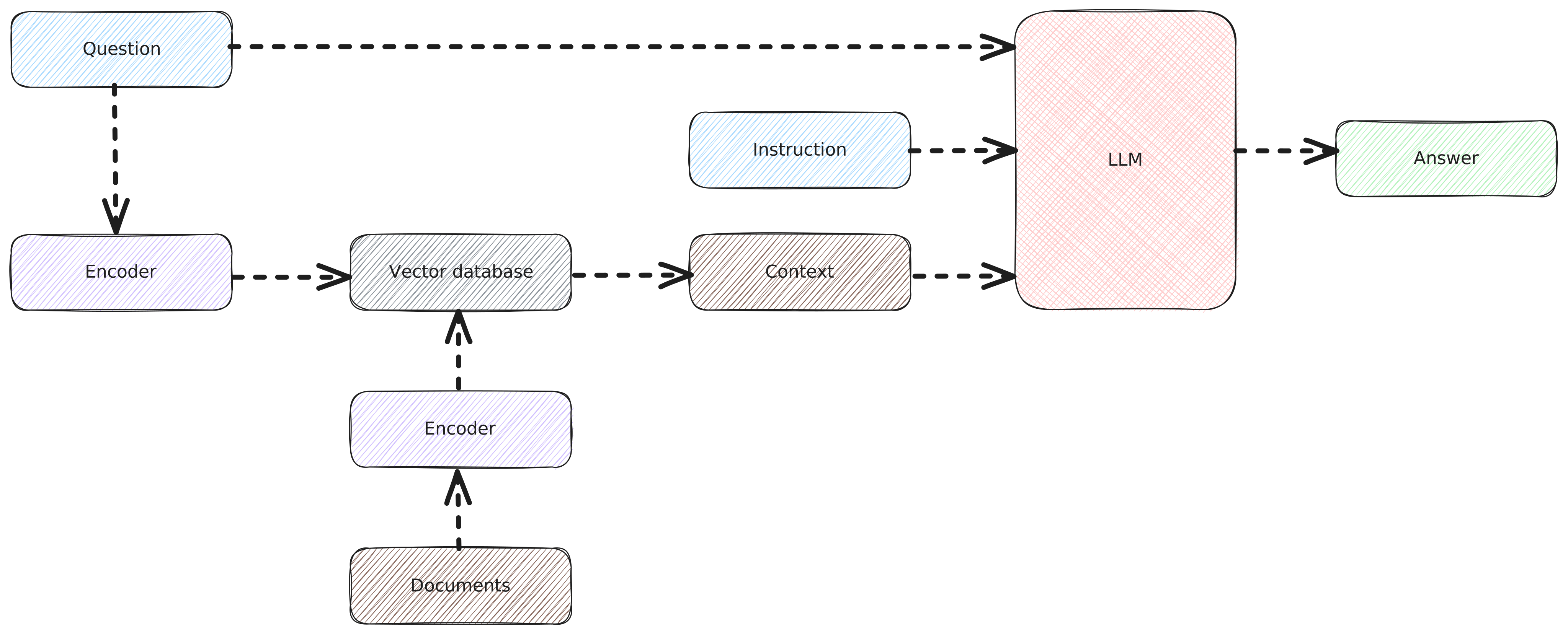
LLM applications—and Retrieval-Augmented Generation (RAG) in particular—store such embeddings in bulk, embed a user's question into the same space, and search for nearby vectors. The retrieved documents are placed into the LLM's prompt so that fresh information, internal documents, or domain knowledge outside the model's training can shape its answers.
What makes this work is Approximate Nearest Neighbour (ANN) search: fast retrieval of the closest vectors to a query out of millions or billions. The three standard distance functions are cosine similarity, L2 (Euclidean) distance, and inner product. The mainstream ANN algorithms are HNSW (Hierarchical Navigable Small World) and IVFFlat (Inverted File with Flat lists).
pgvector's Origins — Andrew Kane, 2021
pgvector is a PostgreSQL extension published on GitHub by Andrew Kane (GitHub: ankane) on 20 April 2021. Kane is a well-known OSS author in the Ruby community who has maintained a long list of machine-learning libraries.
The README of the first release, v0.1.0, already looks much like today's: a vector type, the <-> (L2), <#> (inner product), and <=> (cosine) operators, and CREATE INDEX ... USING ivfflat. The story that early pgvector could only do a full scan is wrong—IVFFlat shipped in the very first release.
The decisive turn came on 28 August 2023, when pgvector v0.5.0 added the HNSW index type. HNSW (Hierarchical Navigable Small World) is the de facto algorithm of the vector-DB world; Pinecone, Weaviate, Milvus, and Qdrant all use it. With HNSW in pgvector, the performance gap to dedicated vector databases narrowed sharply, and the managed services moved fast: Amazon Aurora PostgreSQL announced v0.5.0 support in October 2023. Development has continued since—parallel HNSW index builds in v0.6.0 (January 2024), the halfvec and sparsevec types plus binary quantisation in v0.7.0 (April 2024), iterative index scans in v0.8.0 (October 2024).
The 2023 Landscape — Specialised vs Extension
After ChatGPT's shock, the vector-DB market grew rapidly. Specialised vector databases included:
- Pinecone (2019-, managed SaaS only) — a US$100 million Series B led by Andreessen Horowitz on 27 April 2023, at a $750 million valuation; the pioneer that made "RAG = Pinecone" a default mental model.
- Weaviate (2019-, OSS + managed) — from the Netherlands; GraphQL-based API and hybrid search as strengths.
- Milvus (2019-, donated to LF AI & Data; commercialised by Zilliz) — Chinese origin; strong on very large-scale workloads.
- Qdrant (2021-, Rust, OSS + cloud) — Berlin-based; speed-focused newcomer.
- Chroma (2022-, OSS) — developer-experience focused; close ties with LangChain.
Against these, pgvector hit a different need: "don't add another system to operate". If your application already runs on PostgreSQL, standing up a separate database purely for vector search is operational overhead. Transactions, joins, a consistent type system—keeping all of it inside PostgreSQL is simpler. That practical calculation pulled pgvector up rapidly.
2023 — The Managed-PostgreSQL Consensus
Within a few months of 2023, the managed PostgreSQL services all carried pgvector.
- April 2023: Supabase, at Launch Week 7 (10-14 April).
- 3 May 2023: Amazon RDS for PostgreSQL (15.2 and later).
- 27 June 2023: Google Cloud SQL for PostgreSQL and AlloyDB for PostgreSQL.
- July 2023: Amazon Aurora PostgreSQL.
- 2023: Azure Database for PostgreSQL Flexible Server.
- October 2023: Amazon Aurora PostgreSQL adds v0.5.0 with HNSW.
If you were running a managed PostgreSQL, you did not need a separate database for vector search. By late 2023 that had become the working assumption across the industry.
"Add AI Capability to the Database" as an Architecture
pgvector's success is not merely about one extension. It established "add AI capability to the existing RDB" as a viable architectural choice, in opposition to the Pinecone-style "build a new database for AI" approach.
The same current has continued in 2024 and beyond. MySQL added a VECTOR type in 9.0.0 on 1 July 2024. Oracle Database 23ai puts AI Vector Search among its headline features. Microsoft took a native vector type in Azure SQL Database from public preview to general availability, and SQL Server 2025 ships the VECTOR type and VECTOR_DISTANCE as released features with DiskANN-based vector indexing in preview. Snowflake's Cortex Search exposes vector search through SQL. Every major DBMS has moved toward keeping vector search in-house.
That does not mean Pinecone, Weaviate, and the rest disappear. At billion-scale vectors, in heavy multi-tenant settings, with unusual distance functions, or with GPU acceleration, specialised products keep the edge. But for the majority of "ordinary RAG applications", the verdict is settling toward "PostgreSQL plus pgvector is enough".
A 1986 Design Bet Pays Off
The mainstreaming of pgvector is the first concrete case in which the LLM wave reshaped existing data infrastructure. After ChatGPT, the industry faced a binary choice: build new AI-specific infrastructure, or extend what already exists. In the concrete area of vector search, pgvector answered: extend it.
For PostgreSQL it is also the payoff on a design bet. Implementation of POSTGRES began at Berkeley in 1986, and the framework it laid down—user-defined types, user-defined operators, pluggable index access methods—is exactly what pgvector uses. Thirty-seven years later, a data type nobody had anticipated arrived without a single change to the core. That pgvector ships under the PostgreSQL License, the same licence as PostgreSQL itself, is part of why every managed service could adopt it at once.
Sources
Last updated: