T1#market
Deep Blue Defeats Garry Kasparov
Metadata
- Date
- Decade
- 1990s
- Tier
- T1
- Sources
- 05
- Connections
- 01
- Tags
- #market
The deciding game of the 1997 match lasted nineteen moves. On 11 May, with the score level at 2½–2½, Garry Kasparov played the Caro–Kann Defence as Black, Deep Blue sacrificed a knight early, and Kasparov resigned before move 20. It was the shortest game of either match, and it ended the first match a reigning world champion had lost to a computer.
The machine that won it was not the machine Kasparov had beaten fifteen months earlier. Most of the story of 1997 is in what changed in between.
Deep Blue Before IBM: ChipTest and Deep Thought
The project began as graduate work at Carnegie Mellon University in the 1980s. ChipTest and its successor Deep Thought were built around a single-chip chess move generator, and IBM credits Feng-hsiung Hsu with developing ChipTest. According to the team's own history, ChipTest searched around 500,000 positions per second and Deep Thought around 700,000. In 1988 Deep Thought became the first chess machine to beat a grandmaster in tournament play.
In 1989–90 part of the team — Thomas Anantharaman, Murray Campbell and Hsu — moved to the IBM T.J. Watson Research Center, and Joe Hoane replaced Anantharaman in late 1990. Their intermediate machine, Deep Thought 2, won the ACM Computer Chess Championships of 1991 and 1994. IBM also credits Jerry Brody and project manager C. J. Tan as members of the core team.
Philadelphia, February 1996
The first match with Kasparov ran from 10 to 17 February 1996. The version that played it, which the team later called Deep Blue I, ran on a 36-node IBM RS/6000 SP with 216 chess chips, searching 50 to 100 million positions per second overall.
Deep Blue won game 1. IBM counts it as "the first victory by a computer against a reigning world champion under regular time controls." Kasparov then won games 2, 5 and 6 and drew games 3 and 4, taking the match 4–2. The team's 2002 paper calls the score "fairly decisive", and notes that the match was level at 2–2 after four games.
What Changed for 1997
The team's paper, "Deep Blue" by Campbell, Hoane and Hsu in Artificial Intelligence (2002), lists the changes made for the rematch, and they are more specific than the usual summary that the machine "got faster".
| Deep Blue I (1996) | Deep Blue II (1997) | |
|---|---|---|
| Host computer | 36-node IBM RS/6000 SP | 30-node IBM RS/6000 SP, a newer generation |
| Chess chips | 216 | 480 (16 per node) |
| Evaluation features | around 6,400 | over 8,000 |
| Speed per chip | about 1.6–2 million positions/s | 2–2.5 million positions/s |
The new chip was a redesign, not a re-spin. Many of its added evaluation features responded to specific problems seen in the 1996 games and in practice games against grandmaster Joel Benjamin, who became the team's grandmaster consultant after Deep Blue Jr. lost a short match to him. The paper says that between the two matches the team "spent the vast majority of our time" designing, testing and tuning the evaluation function — the search itself they judged already adequate. The opening book of about 4,000 positions was prepared by hand, mainly by Benjamin, with grandmasters Nick De Firmian, John Fedorowicz and Miguel Illescas.
Overall speed in 1997 depended on the position: about 100 million positions per second in sharp tactical positions, close to 200 million in quieter ones. The Computer History Museum summarises the year more briefly: the team tested the machine against several grandmasters and doubled the performance of the hardware.
New York, May 1997: The Six Games
The rematch was played at the Equitable Center in New York, from 3 to 11 May 1997. The winner's prize was $700,000 and the loser's $400,000.
| Game | Date | White | Result | Moves |
|---|---|---|---|---|
| 1 | 3 May | Kasparov | Kasparov won | 45 |
| 2 | 4 May | Deep Blue | Deep Blue won | 45 |
| 3 | 6 May | Kasparov | Draw | 48 |
| 4 | 7 May | Deep Blue | Draw | 56 |
| 5 | 10 May | Kasparov | Draw | 49 |
| 6 | 11 May | Deep Blue | Deep Blue won | 19 |
The Computer History Museum's account of the match turns on game 2: Kasparov "missed an opportunity in the second game and lost", never recovered his composure, and played defensively for the rest of the match. After that game Kasparov accused IBM of cheating, suggesting that a human grandmaster had been behind moves he thought too subtle for a machine. The accusation outlived the match as its most argued-over episode.
Was Deep Blue Artificial Intelligence?
The question was asked at the time and is easier to answer now. The 2002 paper attributes the result to a combination of factors: the large searching capability, a non-uniform search with many extensions, the complex evaluation function, and — in supporting roles — endgame databases, the extended opening book and evaluation tuning. It is explicit that "the large majority of the features and weights in the Deep Blue evaluation function were created/tuned by hand." Automated analysis was used in two places, one of them a comparison-training method that showed the hand-set pawn-shelter weights were too low.
The endgame databases, often mentioned as one of the 1997 improvements, barely mattered: the paper says only game 4 approached a position that needed them.
So Deep Blue was brute-force search guided by expert knowledge encoded in silicon, not a learning system. That is the sharpest contrast with AlphaGo's victory over Lee Sedol in 2016, where the judgement of a position was learned by neural networks rather than written by people. The Computer History Museum frames the open question in the same terms: Deep Blue beat the best human player "using large amounts of calculation" — and the museum then asks whether it was a thinking machine.
After the Match
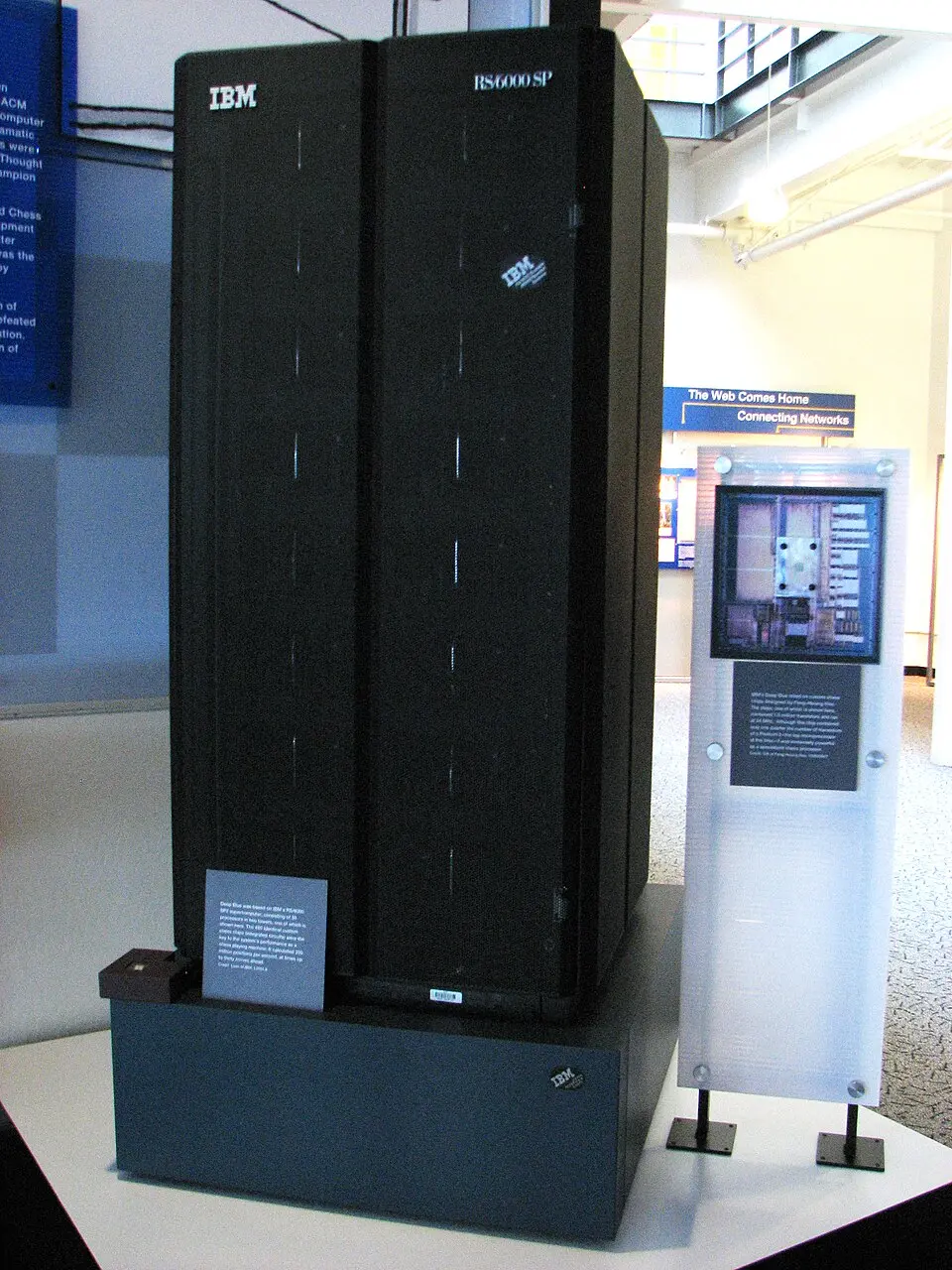
IBM says Deep Blue was retired after the victory. The machine was built from two racks; one is held by the Smithsonian's National Museum of American History, and the Computer History Museum acquired the other in 1997. For the team, the match earned the Fredkin Prize, which had been offered for defeating the human world champion in a regulation match.
The match sits on the AI timeline between the symbolic decades and the return of neural networks in the 2010s.
Questions this page answers
- When did Deep Blue beat Kasparov?
- On 11 May 1997, in the final game of a six-game match in New York, which ended 3.5-2.5. IBM describes it as the first time a computer defeated a reigning world champion under standard tournament time controls.
- What happened in their 1996 match?
- Kasparov won it 4-2 in Philadelphia in February 1996. Deep Blue did take game 1 there, which IBM counts as the first game a computer won against a reigning world champion under regular time controls.
- Did Deep Blue use machine learning?
- Hardly at all. According to the team's 2002 paper, the large majority of the evaluation function's features and weights were created and tuned by hand; automated analysis was used in only two places, such as tuning weights for pawn shelter. Its strength came from search on 480 custom chips at up to 200 million positions per second.
Sources
PrimaryDeep Blue — IBM Heritage
Deep Blue I (1996: 36 nodes, 216 chips) versus II (1997: 30 nodes, 480 chips), evaluation features 6,400 to over 8,000, hand tuning, Joel Benjamin's role
Last updated: