T1#research#standard#regulation#market
NSFNET — The Decade in Which a Research Network Became the Public Internet
Metadata
- Date
- Decade
- 1980s
- Tier
- T1
- Sources
- 06
- Connections
- 02
- Tags
- #research#standard#regulation#market
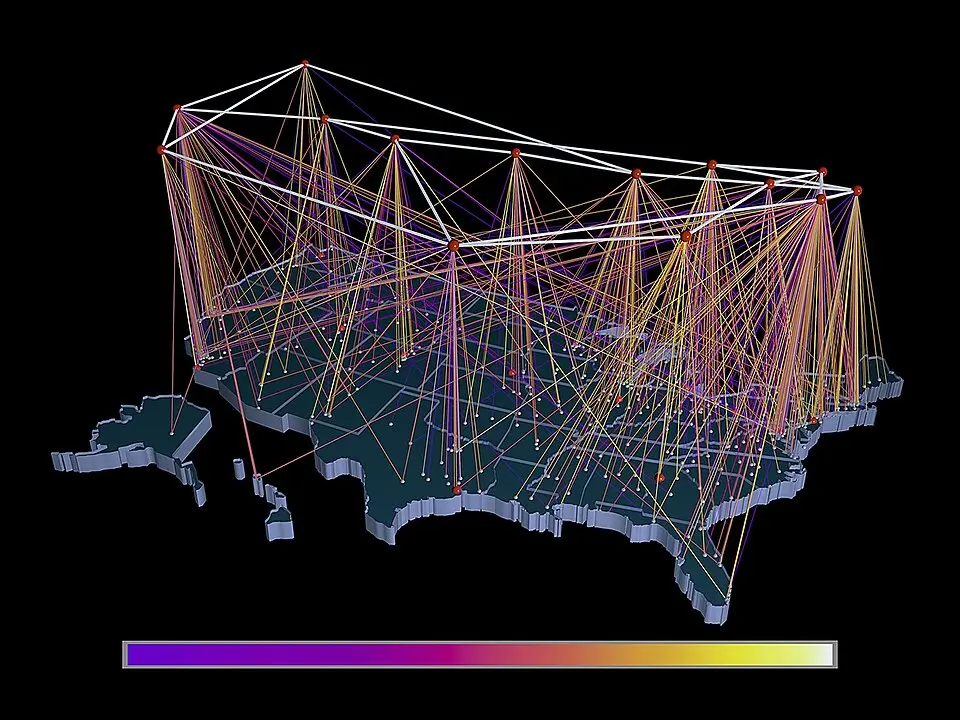
ARPANET was a Department of Defense research network. Today's internet is public infrastructure. The bridge between them took ten years to build and was called NSFNET — the backbone the US National Science Foundation began in the mid-1980s and switched off itself at midnight on 30 April 1995.
Merit Network's own account describes the handover in a single line: "The National Science Foundation inherited the responsibility for nurturing the U.S. Internet from the Advanced Research Projects Agency (ARPA)." Discharging that responsibility turned out to mean not building a network but eventually dismantling its own.
56 kbps and Six Sites (1985-86)
The first NSFNET was a 56 Kbps backbone built on LSI-11 Fuzzball routers, linking the six nationally funded supercomputer sites: the five NSF centres and the National Center for Atmospheric Research. The purpose was narrow and concrete — get researchers to the computers.
The start date is genuinely inconsistent across sources. Merit writes that the 56 Kbps backbone "went into production in 1985"; NSF's own account says NSFNET was "launched in 1986". The programme itself is dated 1985-86, so this is less a contradiction than a question of what counts as beginning. This article does not resolve it.
The network filled up almost immediately. In Merit's words, "[s]oon after the network's inception, the need for more advanced networking technology was indicated when rapid growth in traffic precipitated serious network congestion."
T1, then T3 (1987-92)
In 1987 NSF put a faster service out to competitive solicitation, and in the autumn selected Merit Network, Inc. together with its partners MCI, IBM and the State of Michigan. Eight months after the award the partnership delivered a T1 (1.544 Mbps) backbone serving 13 sites: Merit, NCAR, BARRNet, MIDnet, Westnet, NorthWestNet, SESQUINET, SURAnet and the NSF supercomputer centres — with NYSERNet and JVNCnet also served, being collocated at centres.
Each backbone node, a Nodal Switching Subsystem, was nine IBM RTs joined by two token rings. Fourteen physical T1 circuits carried a virtual topology in which each virtual path was worth a third of a T1. A 1989 re-engineering gave every site redundant connections and upgraded the routers to full T1 switching. By then backbone traffic had passed 500 million packets a month — a 500% rise in one year, on a curve that doubled every seven months.
In late May 1990 Merit's cooperative agreement was modified to cover a T3 (45 Mbps) upgrade. NSF decided to grow the backbone from 13 nodes to 16, adding Cambridge (NEARNET), Argonne National Lab and Atlanta (SURAnet). The core equipment moved out of the universities and supercomputer sites into MCI's points of presence, and the RTs gave way to RS/6000s with a card-to-card forwarding architecture. Organisationally, ANS (Advanced Network and Services) was announced in September 1990 and began operating the service as a subcontractor to Merit.
Through 1991 the T1 and T3 networks ran in parallel. Tuning the new technology proved hard enough that full production status slipped to late in the year, when all sixteen sites were connected to ANSnet's national T3 infrastructure. Several sites were using T3 as their primary path by November 1991 and the remaining traffic moved in early 1992. Merit's assessment: the new network "exceeded the T1 structure in stability by a factor of ten, with fewer outages and errors in all categories."
The Clause That Kept Commerce Out
The rules mattered more than the routers.
The NSFNET backbone carried an Acceptable Use Policy. The June 1992 text states the general principle: "NSFNET Backbone services are provided to support open research and education in and among US research and instructional institutions, plus research arms of for-profit firms when engaged in open scholarly communication and research." The first entry under unacceptable uses reads: "Use for for-profit activities, unless covered by the General Principle or as a specifically acceptable use."
You could not do business over the backbone. Commercial internet providers had existed since the late 1980s, but their traffic could not cross NSFNET. The T3 upgrade, Merit noted, "precipitated a greatly-needed, though contentious, community dialogue about the evolution and commercialization of the U.S. Internet" — because by then "Internet Service Providers were springing up all over the country".
There Is No Day the Internet Went Commercial
There is no single date. There is a sequence.
23 October 1992. Public Law 102-476, the Scientific and Advanced-Technology Act of 1992, was approved. Section 4 added one subsection to the National Science Foundation Act of 1950: "In carrying out subsection (a)(4), the Foundation is authorized to foster and support access by the research and education communities to computer networks which may be used substantially for purposes in addition to research and education in the sciences and engineering, if the additional uses will tend to increase the overall capabilities of the networks to support such research and education activities." One sentence, and the AUP lost its statutory footing.
1992. The National Science Board extended Merit's cooperative agreement eighteen months beyond its October 1992 expiry so that NSF could design a successor architecture — one that accommodated commercial providers and let NSF step back from operating a network at all. A draft solicitation went out for comment that year; the real one followed in May 1993.
Early 1994. The awards landed: the Routing Arbiter service to Merit and USC's Information Sciences Institute, the vBNS to MCI, and the Network Access Points to Sprint, MFS Datanet and Bellcore (representing Ameritech and PacBell). Merit received a transition extension running from May 1994 to April 1995.
1994-95. The first NAP into production was MAE-East in Washington, D.C., which MFS had been operating since 1992 and which had served as the model in NSF's solicitation; it was upgraded from 10 Mbps Ethernet to FDDI in the autumn of 1994. The Sprint NAP was running by the end of that summer. The PacBell and Ameritech ATM NAPs raised enough doubt about switch buffer sizes and ADSU performance that both fell back to interim FDDI LANs, in production from March 1995.
NSF's schedule had the regional networks off NSFNET by 31 October 1994. Merit's record is blunt: "As it turned out, none of the networks made it."
Midnight, 30 April 1995, in Each Time Zone
On 28 February 1995 Merit's Elise Gerich sent ANS the formal sixty-day notice terminating NSFNET backbone service at nineteen locations. Every entry carried the same date and a different clock: 30 April 1995, midnight — Pacific at Palo Alto, Eastern at Ann Arbor, Mountain at Boulder.
By mid-April only seven regionals had fully severed their ties. To find unreachable destinations before the deadline, Merit announced a rehearsal: all remaining peering sessions would be dropped on Friday 21 April. In the early hours of that day the rehearsal itself had to slip, because the volume of routing configuration changes had grown large enough that files were truncating during production and coming out corrupt. The last problem the transition caused was the size of the transition.
On 25 April the peering sessions on fifteen ENSSs were commented out of the configuration files and the service was, in Merit's phrase, "for all intents and purposes, terminated". The following Sunday at midnight a dozen or so Merit and ANS staff gathered in the University of Michigan network operations centre and shut the ENSSs down one at a time, in each time zone as it came. Merit's account quotes an ANS engineer: "mostly the NSFNET went away silently... or rather, with only the sound of drives and fans spinning down in distant machine rooms."
Built With Public Money, Then Given Away
By NSF's own reckoning, NSFNET connected around 2,000 computers in 1986 and more than 2 million by 1993. It was the first national 45-megabit-per-second internet network, and "[a]s the first network available to every researcher" it became the de facto US backbone.
And then NSF retired it. internetMCI and SprintLink absorbed the regionals as customers; the Policy Routing Database gave way to the Routing Arbiter Database and the other registries of the Internet Routing Registry. The World Wide Web went mainstream immediately afterwards, onto a public internet that had been finished barely in time.
A network the government built and the government gave away. You can read it as a model privatisation, or as proof that nothing would have existed without a decade of public money first. Both readings come out of the same primary sources.
Questions this page answers
- When did the internet become commercial?
- No single date marks it; only a sequence does. NSFNET's Acceptable Use Policy barred use for for-profit activities as a general matter, and Public Law 102-476, approved on 23 October 1992, amended the NSF Act to permit networks used substantially for other purposes. Awards for the Network Access Points and the vBNS followed in 1994, and the backbone was switched off on 30 April 1995.
- How fast was NSFNET?
- The first backbone ran at 56 kbps and linked six sites — five NSF supercomputer centres and NCAR. After NSF chose Merit Network with MCI, IBM and the State of Michigan in autumn 1987, a T1 (1.544 Mbps) backbone served 13 sites eight months later, and a T3 (45 Mbps) backbone served 16 by late 1991.
- When was NSFNET shut down?
- On 30 April 1995. The backbone went dark at midnight in each time zone in turn.
Sources
Last updated: