T1#research
The World Wide Web Proposed — CERN
Metadata
- Date
- Decade
- 1980s
- Tier
- T1
- Sources
- 08
- Connections
- 02
- Tags
- #research
On 12 March 1989, Tim Berners-Lee, a software engineer at CERN, the European Organization for Nuclear Research, handed his manager Mike Sendall a document titled Information Management: A Proposal.
Its first sentence: "This proposal concerns the management of general information about accelerators and experiments at CERN." It proposed a distributed hypertext system to solve a problem CERN's researchers had long been living with: scientists rotated through CERN constantly, and the instrument specifications, papers, and lab notes were scattered across personal files, mainframes, and ad-hoc databases. No one held the whole picture. The estimated time to build it: six months.
After Sendall finished reading, he wrote a short comment in the margin.
Vague, but exciting
CERN itself calls the phrase the classic understatement of the century.
Why CERN
Why, of all places, did the Web emerge in a physics lab outside Geneva?
Two reasons.
One: CERN sat at the centre of an extraordinarily distributed intellectual collaboration. The LEP collider — ancestor of the LHC — circulated its first beam on 14 July 1989, and its four experiments (ALEPH, DELPHI, L3, OPAL) drew some 1,500 physicists in total. In CERN's own words, the laboratory is "not an isolated laboratory, but rather the focal point for an extensive community that includes more than 17 000 scientists from over 100 countries" — scientists who mostly stay employed by their home universities and rotate through CERN for a few years at a time. Information that lived in one person's head and disappeared with them was already a real, daily problem.
Two: CERN ran a large fleet of computers with multiple operating systems coexisting—VMS, UNIX, Mac OS, others. A system that could link from anywhere to anywhere, across document formats and machines, was not a thought experiment at CERN. It was an operational requirement.
Implementation on the NeXTcube
The Web never became an official CERN project. What Sendall did was agree to Berners-Lee acquiring one of the NeXT machines (the workstation from Steve Jobs's post-Apple company) and then suggest he use it for the hypertext idea. Berners-Lee described it this way in the obituary he wrote for Sendall in 1999:
It was Mike who went along with my idea of getting one of the "NeXT" machines, and Mike who suggested that I could go ahead and use it to play with the idea of that global hypertext thing I had been talking about.
On 12 November 1990, with help from Robert Cailliau, a more formal management proposal followed: WorldWideWeb: Proposal for a HyperText Project. By the end of that same year, Berners-Lee had implemented four things:
- HTTP — the HyperText Transfer Protocol, by which client and server exchange hypertext documents.
- HTML — the HyperText Markup Language, in which documents and links are written.
- URL — a uniform way of naming any resource on the network.
- WorldWideWeb — the world's first web browser (which was also an editor).
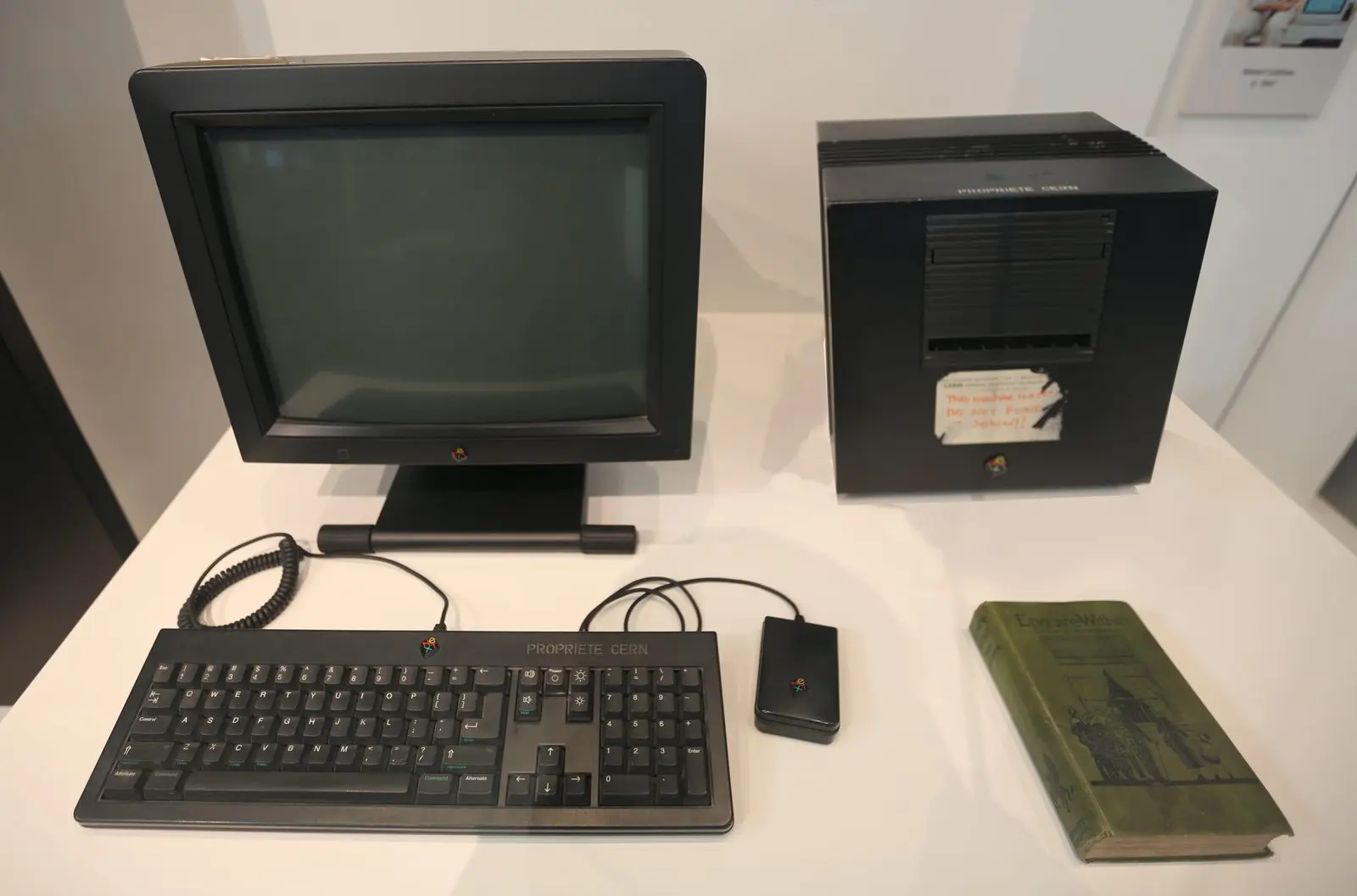
The world's first web server, info.cern.ch, was that NeXTcube. Berners-Lee developed on it directly and kept it in his office; to stop anyone switching it off, it carried a hand-written label in red ink: "This machine is a server. DO NOT POWER IT DOWN!!" The machine, label and all, is preserved and displayed at CERN.
The Decision Not to Commercialise
On 30 April 1993, CERN declared that the source code of WorldWideWeb would be available royalty-free — making it free software. What was released was not a specification but the implementations: the browser, the server, and the developer library (libwww).
The decision had a direct foil. Gopher was, at that moment, ahead of the Web for information retrieval on the internet, and in 1993 its developer, the University of Minnesota, declared Gopher proprietary and subject to licence fees. CERN swung the other way immediately after watching users recoil from a protocol with strings attached. The Web's displacement of Gopher was not purely a matter of technical merit.
Berners-Lee himself opposed commercialisation consistently. He moved to MIT in 1994 and founded the W3C, the World Wide Web Consortium, to lead Web standardisation. Knighted by the Queen in 2004; ACM Turing Award in 2016.
From 500 Servers to Six Billion People
By the end of 1993 there were just over 500 known web servers; by the end of 1994, 10,000 servers and 10 million users. That is the scale CERN's own records preserve. The ITU estimates that about six billion people — roughly three quarters of humanity — used the internet in 2025. Netcraft's June 2026 survey received responses from 1,489,396,284 sites across 304,146,307 domains; that site count is hostnames, and only a fraction of them are actively maintained.
The first web page Berners-Lee wrote at CERN is still served from http://info.cern.ch/hypertext/WWW/TheProject.html, readable from anywhere in the world.
Mike Sendall died on 15 July 1999 after a struggle with cancer. Berners-Lee wrote the obituary himself. "Vague, but exciting" survives as perhaps the most understated sign-off in the history of computing.
Sources
Last updated: