T1#award
The Integrated Circuit
Metadata
- Date
- Decade
- 1950s
- Tier
- T1
- Sources
- 11
- Connections
- 00
- Tags
- #award
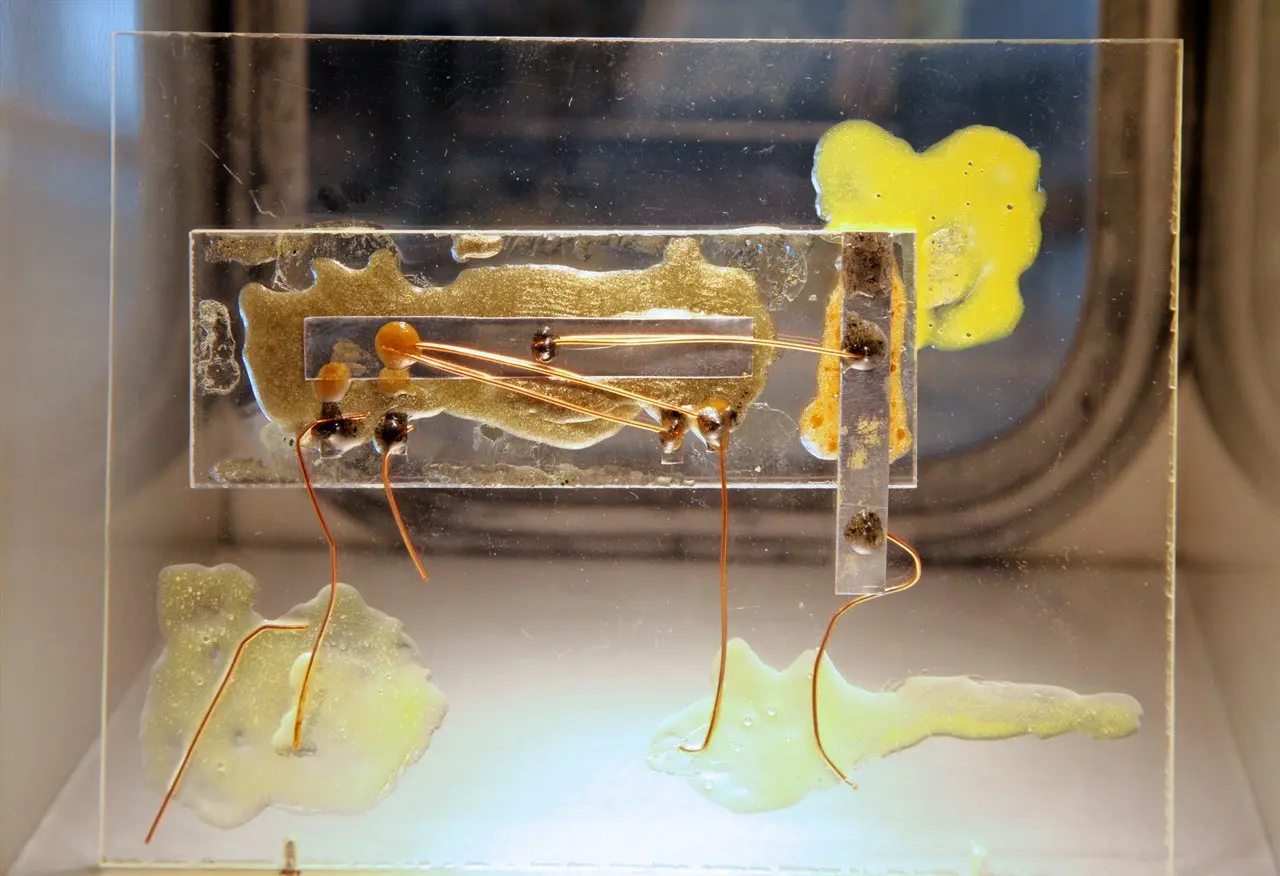
The integrated circuit (IC) puts circuit elements — transistors, resistors, capacitors — inside a single piece of semiconductor, so that a whole circuit becomes one part. Two people are named as its inventors. Jack Kilby of Texas Instruments (TI) first ran an oscillator built into a small piece of germanium on 12 September 1958. Robert Noyce of Fairchild Semiconductor recorded on 23 January 1959 a way to connect devices by laying metal lines over the oxide on silicon. The first was the first integrated circuit to work; the second gave it a form that could be manufactured. The accurate answer to "who invented it" is those two dates.
The tyranny of numbers
In his Nobel lecture of 2000, Kilby began with the problem electronics faced. The ENIAC of 1946 used more than 17,000 vacuum tubes. Even after the transistor replaced the tube, systems still had to be assembled and wired from tens or hundreds of thousands of separate parts, which made them too big, too heavy and too unreliable. The early backers of miniaturisation were the US military and space agencies.
In the early 1950s Geoffrey Dummer of Britain's Royal Radar Establishment suggested that all electronics could be made as a single block. Kilby called it a remarkable statement, but noted that Dummer gave no proposal for how to do it, and that a device he commissioned from a British manufacturer in 1956 did not succeed.
Summer 1958: a new hire at TI
Kilby joined TI in May 1958. With no vacation due that year, he worked through what TI called the "mass vacation", when about 90 percent of the workforce was away, and had time to think. On 24 July he wrote in his lab notebook what would come to be known as "The Monolithic Idea": if resistors, capacitors and transistors were all made of the same semiconductor material, they could be included in a single chip.
His supervisor, Willis Adcock, was "enthused, but skeptical", and asked for proof that circuits could be made entirely from semiconductors. Kilby first built one from separate silicon elements and demonstrated it to Adcock on 28 August. That was an assembly of discrete parts, not an integrated circuit.
12 September 1958: the first oscillator
Next Kilby used wafers of germanium mesa transistors that TI already made, already diffused and with contacts in place, and chose a circuit whose two structures could use the existing contacts. The first attempt was a phase-shift oscillator, a favourite demonstration circuit of the time.
| Date | 12 September 1958 (first three units completed) |
| Material | Germanium |
| Circuit | Phase-shift oscillator (one transistor plus a distributed resistor-capacitor network) |
| Size | About 0.12 by 0.4 inches per Kilby's lecture; the IEEE plaque gives 7/16 by 1/16 inch (11.1 by 1.6 mm) |
| Connections | Fine gold "flying-wires", attached by hand |
| Result | When power was applied, the first unit oscillated at about 1.3 MHz |
| Next | A flip-flop version completed on 19 September |
IEEE recognised the work as an IEEE Milestone in 2009; its plaque says Kilby demonstrated the first working integrated circuit to managers at TI that day. Because the lecture and the plaque give different dimensions, both are shown above.
1959: announcement, and Noyce's planar version
TI announced the concept as the "Solid Circuit" in March 1959, and Kilby's patent, "Miniaturized Electronic Circuits", was filed on 6 February 1959 (US Patent 3,138,743, granted 23 June 1964). The first product was the Type 502 Binary Flip-Flop of March 1960; according to the Computer History Museum it cost $450 and only dozens shipped, for evaluation. Hand-attached flying wires were not a production method.
The answer came from Fairchild. Jean Hoerni had recorded on 1 December 1957 a way of protecting p-n junctions at the surface of silicon with an oxide layer — the planar process. On 23 January 1959 Noyce wrote in his notebook that the oxide could serve as an insulator, so metal lines laid on top of it could interconnect several transistors on a wafer into one circuit. His patent was filed on 30 July 1959 and granted on 25 April 1961 as US Patent 2,981,877. A Fairchild team produced the first working monolithic ICs in May 1960, isolating the devices with the p-n junction method patented by Kurt Lehovec of Sprague Electric.
| Kilby (TI) | Noyce (Fairchild) | |
|---|---|---|
| Decisive date | 12 September 1958 (working circuit) | 23 January 1959 (notebook entry) |
| Semiconductor | Germanium | Silicon |
| Interconnection | Hand-attached gold wires | Metal lines over the oxide |
| US patent filed | 6 February 1959 | 30 July 1959 |
| US patent granted | 23 June 1964 | 25 April 1961 |
Kilby acknowledged in his lecture that Noyce showed the desirability of the planar process with metal leads over the oxide. The two companies fought over the patents for years; the Computer History Museum records that the courts eventually ruled for Noyce, by which time the firms had already settled on a cross-licence.
Five years of doubt, and after
It is hard to believe today, Kilby wrote, but when the idea was announced in 1959 there was "tremendous criticism". Yields would be too low to be profitable; the best resistors and capacitors were not made from semiconductors; transistor specialists did not want their devices mixed up with everything else on a chip — all, he admitted, basically true at the time. The turning point came from two highly visible programmes of the 1960s, the Apollo moon mission and the Minuteman missile.
What followed outran his own expectations. In 1958, he noted, a single transistor cost about $10; by the time of the lecture the same money bought a chip with more than 100 million transistors. Moore's law named that rate of growth, and in 1971 came a one-chip CPU, the Intel 4004.
The 2000 Nobel Prize, and the Kilby patent in Japan
The Nobel Prize in Physics 2000 went half to Kilby, "for his part in the invention of the integrated circuit", with the other half shared by Zhores Alferov and Herbert Kroemer for semiconductor heterostructures.
The same year, a ruling in Japan also carried Kilby's name. TI asserted Japanese Patent No. 320275 (titled, in translation, Semiconductor Device) against Fujitsu's memory chips, including DRAMs, and Fujitsu sued for a declaration that no damages claim existed. On 11 April 2000 the Third Petty Bench of the Supreme Court of Japan dismissed TI's appeal, holding that a claim based on a patent with an evident ground for invalidity is, absent special circumstances, an abuse of rights. Known as the Kilby decision, it accepted that a court hearing an infringement case may decide whether such grounds exist without waiting for an invalidation ruling to become final.
Related people include Gordon Moore; the machines and parts of the period are on the hardware timeline and the overview timeline.
Questions this page answers
- Who invented the integrated circuit?
- Two people are credited. Jack Kilby of Texas Instruments first ran an oscillator built into germanium on 12 September 1958, and Robert Noyce of Fairchild Semiconductor recorded on 23 January 1959 the manufacturable approach of laying metal lines over the oxide on silicon.
- What was Kilby's first integrated circuit like?
- A phase-shift oscillator built into a small piece of germanium, with one transistor and a resistor-capacitor network joined by hand-attached gold wires. It oscillated at about 1.3 MHz when powered. Kilby's lecture gives its size as about 0.12 by 0.4 inches; the IEEE plaque gives 7/16 by 1/16 inch.
- How did Kilby's and Noyce's approaches differ?
- Kilby used germanium and connected the elements with gold wires. Noyce built on Jean Hoerni's planar process, using the oxide on silicon as an insulator under metal lines. Hand-attached wires did not suit production; Noyce's approach became the basis of manufacturing.
- Did Kilby receive a Nobel Prize?
- Yes. Half of the 2000 Nobel Prize in Physics went to Kilby for his part in the invention of the integrated circuit; the other half was shared by Zhores Alferov and Herbert Kroemer.
Sources
Joining TI in May 1958, the Monolithic Idea of 24 July, the 28 August demonstration, the 12 September oscillator (about 0.12 by 0.4 inches, about 1.3 MHz), the 19 September flip-flop, the criticism, and Apollo and Minuteman
Primary最高裁判所第三小法廷 平成12年4月11日判決 平成10(オ)364 債務不存在確認請求事件 — 裁判所 裁判例検索
Patent No. 320275, the holding that a claim on a patent with an evident ground for invalidity is an abuse of rights, and the dismissal of the appeal
The flying-wires, the March 1959 Solid Circuit announcement, and the Type 502 of March 1960
Noyce's patent (filed 30 July 1959, granted 25 April 1961), the first monolithic ICs of May 1960, and the patent fight and cross-licence
Noyce's notebook entry of 23 January 1959 and Hoerni's disclosure of 1 December 1957
The plaque wording (demonstration to managers, 7/16 by 1/16 inch) and the 2009 dedication
TertiaryIntegrated circuit — Wikipedia
Last updated: