T1#research#award#energy
The Point-Contact Transistor — Bell Labs
Metadata
- Date
- Decade
- 1940s
- Tier
- T1
- Sources
- 04
- Connections
- 01
- Tags
- #research#award#energy
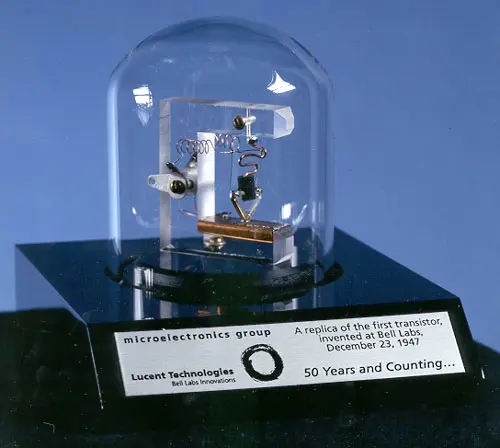
On 16 December 1947, at Bell Telephone Laboratories (AT&T) in Murray Hill, New Jersey, John Bardeen and Walter Brattain amplified an electrical signal in a solid-state device for the first time: two gold-foil contacts held in extreme proximity by a plastic wedge, pressed against a slab of high-purity germanium. Brattain's notebook records a voltage gain of 15 that day. A week later, on 23 December, the two demonstrated the device to the laboratory's managers and colleagues — a whisper into a microphone came out loud from the loudspeaker at the far end of the circuit, and unlike a vacuum tube it needed no warm-up.
That small device—later named the transistor—was the starting point of every piece of electronics built in the second half of the twentieth century.
Replacing the Tube
Until then, the only way to amplify an electronic signal was the vacuum tube. Since Lee de Forest filed for the triode—the Audion—in 1906, electronic amplification had belonged to the tube for forty years. Radio, television, computers—the ENIAC (completed 1945) used nearly 18,000 of them. Even run well below their rated voltages to prolong their life, roughly one tube failed every day or two, and hunting it down was the central chore of operating the machine. The heat was enormous, the power draw vast.
A solid-state replacement had been pursued at several institutions since before the war. At Bell Labs, a small group under Shockley had been systematically studying the electrical properties of semiconductors—initially silicon, then germanium.
The breakthrough came from Bardeen's organisation of the theory of surface states—which explained why the field-effect amplifier Shockley had conceived in 1945 refused to work—Brattain's experimental confirmation of it, and the manual technique developed in the final days for placing two gold contacts onto a germanium surface in extreme proximity.
"Trans-Resistor"
The name was settled by an internal ballot. Semiconductor Triode, Crystal Triode, Surface States Triode, and Iotatron were among the candidates; the winner was transistor, submitted by the Bell Labs engineer John R. Pierce. The technical memorandum of 28 May 1948 justified it by noting that the device belongs to the varistor family and has the transconductance, or transfer impedance, of a device with gain—so it takes the ending of varistor and thermistor with trans- in front. Pierce himself later recalled starting from the device's transresistance. The lab kept the invention quiet until the press conference of 30 June 1948.
The first transistors were primitive by today's standards. Point-contact devices were unstable and not suited to mass production. The junction transistor, which Shockley conceived independently in early 1948, became the design that could be commercially manufactured; the first grown-junction devices were fabricated in 1951 and production followed in the early 1950s.
The Three
In 1956, Bardeen, Brattain, and Shockley shared the Nobel Prize in Physics. The relationship among them was not, however, easy.
Shockley had not been directly involved in the point-contact device itself; the field-effect approach he had proposed in 1945 did not yet work. He nonetheless made himself the public face of the announcement, and Bardeen and Brattain resented it for years. Both eventually left Bell Labs.
Shockley founded Shockley Semiconductor Laboratory in 1955 as a division of Beckman Instruments and began operating in Mountain View, California, in 1956. The young researchers he hired could not bear his management style; in 1957 eight of them left together and founded Fairchild Semiconductor. Out of Fairchild came Charlie Sporck, who took over National Semiconductor in 1967; Robert Noyce and Gordon Moore, who founded Intel in 1968; and Jerry Sanders, who founded AMD in 1969. The geographic concentration later called Silicon Valley began on the patch of land Shockley had picked.
Eighty Years of Miniaturisation
The first transistor stood about half an inch high—a handmade assembly of germanium, gold foil, and a plastic wedge—and amplified by roughly a hundred times.
In 2026 TSMC's leading node in volume production is the 2-nanometre class N2, which entered volume production in the fourth quarter of 2025. The "2nm" is a generation label, not a physical dimension: even on the previous N3, gate pitch runs 45–48 nanometres and physical gate length sits in the high single-digit nanometres. At the package level, NVIDIA's Blackwell GPU carries 208 billion transistors across two dies, by the company's own figure. That is roughly eleven orders of magnitude above the single device of 1947.
Moore's Law, the empirical rule, predicted a doubling every twelve months in 1965 and every twenty-four after Moore's 1975 revision. The "eighteen months" so often quoted was never Moore's figure; it was David House of Intel, describing the doubling period for overall chip performance once rising clock speed is included.
Questions this page answers
- Was the transistor invented on 16 or 23 December 1947?
- Both dates are used. Bardeen and Brattain first amplified a signal in the germanium point-contact device on 16 December, and demonstrated it to the laboratory's managers on 23 December. This site dates the event to the demonstration.
- Who received the Nobel Prize for the transistor?
- John Bardeen, Walter Brattain and William Shockley shared the 1956 Nobel Prize in Physics.
Sources
Last updated: