T1#market#enterprise
UNIVAC I Accepted — The Day the Computer Became a Product
Metadata
- Date
- Decade
- 1950s
- Tier
- T1
- Sources
- 06
- Connections
- 01
- Tags
- #market#enterprise
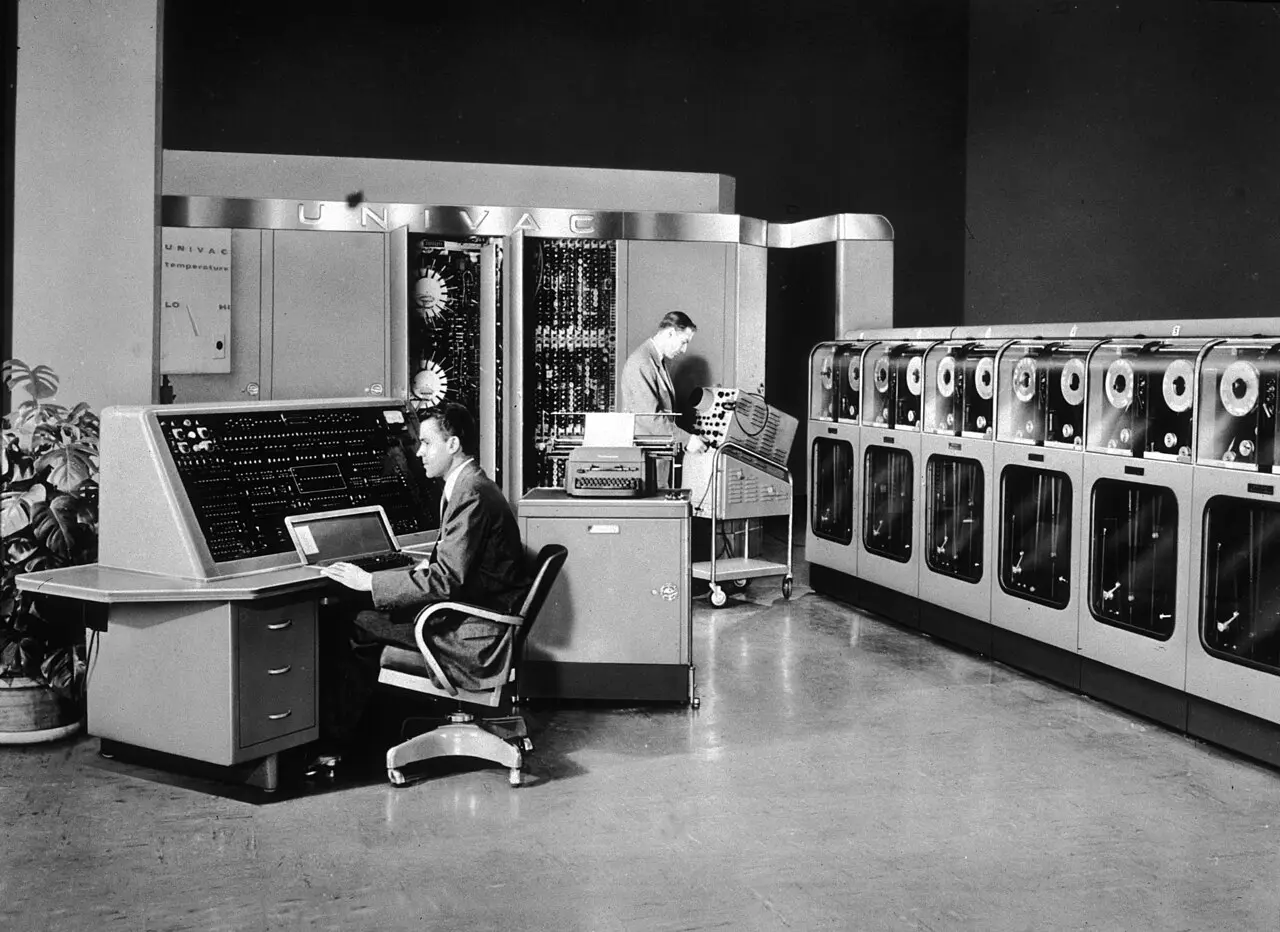
On 31 March 1951 the US Census Bureau accepted the first UNIVAC I. Until then an electronic computer had been a thing a university, an army or a laboratory built once, by hand, for itself. UNIVAC I had a model name, a sales brochure and a plan to sell the same machine to more than one customer. It is the point at which the computer stopped being an instrument and started being a product.
Accepted, dedicated, installed — three different dates
This is where accounts of UNIVAC I usually break, so it is worth pinning down first.
- 31 March 1951 — the Census Bureau accepts serial number 1
- 14 June 1951 — a dedication ceremony at the Eckert-Mauchly Laboratory in Philadelphia, attended by Census Bureau officials
- December 1952 — the machine is finally moved into a Census Bureau building
Twenty-one months separate acceptance from installation. In between, the computer sat on the factory floor in Philadelphia and did the Census Bureau's work from there — moving it was hard, and the manufacturer wanted a working machine on hand for demonstrations. The Census Bureau's own history records that UNIVAC I went on to tabulate part of the 1950 population census and all of the 1954 economic census, and that it was used throughout the 1950s for monthly economic surveys.
Who built it
It was designed by ENIAC's J. Presper Eckert and John Mauchly. They had founded the Eckert-Mauchly Computer Corporation in 1946, lost money on the BINAC contract for Northrop, badly underestimated development costs, and run out of cash. In February 1950 the company was sold to the office-equipment maker Remington Rand and became its Eckert-Mauchly Division. UNIVAC I therefore reached the market as the acquirer's product: the inventors lost the company before the first machine shipped.
The same company, in the same years, employed Grace Hopper, who ran her A-0 system on this machine.
The qualifier that has to go on "first"
Calling UNIVAC I the world's first commercial computer is simply wrong.
The Ferranti Mark 1 was delivered to the University of Manchester in February 1951, the month before. Manchester's Science and Industry Museum describes it as "the world's first commercially available general-purpose computer" and as "the first working computer to roll off a factory production line and into the hands of a customer". Ferranti built two Mark 1s and seven of the improved Mark 1*, nine machines in all.
Two qualifiers do hold for UNIVAC I: it was the first commercial electronic computer built in the United States, and the first computer received by a civilian US government agency. Both are narrow claims. Narrowing them is what makes the actual novelty visible.
Tape, not cards
The technically decisive choice was not arithmetic speed but input and output. UNIVAC I used UNISERVO magnetic tape rather than punched cards as its bulk medium. IEEE's account of the machine makes the point plainly: it could reach its own data instead of waiting for cards to be loaded, and that was where the speed advantage came from. A mercury delay-line store of 1,000 words and a 2.25 MHz clock are small numbers by any later standard, but for batch record-processing, tape was the right bet.
The night of 4 November 1952
What put UNIVAC into the general vocabulary was not census work. It was an election broadcast.
CBS arranged for a UNIVAC to forecast the presidential result from early returns. The console in the New York studio, however, was not a computer. According to the memoir of Remington Rand engineer Herman Lukoff, a supervisory control panel from another system was commandeered as a backdrop, and technicians wired incandescent bulbs to Christmas-tree light flashers so that it would blink rather than "sit there looking stupid". The machine doing the arithmetic was UNIVAC serial 5, still on the factory floor in Philadelphia.
Early in the evening UNIVAC produced a landslide: 438 electoral votes for Eisenhower against 93 for Stevenson. It was not broadcast. Late that night Arthur Draper of Remington Rand appeared on camera and explained: "When UNIVAC made its first prediction with only three million votes in, it gave five states for Stevenson, 43 for Eisenhower, 93 electoral votes for Stevenson, 438 for Eisenhower. We just plain didn't believe it." He went on: "we should have had nerve enough to believe the machine in the first place. It was right, we were wrong." The final result was 442 to 89.
Where the legend and the record diverge
The story has been retold until it is tidier than the evidence. Ira Chinoy's doctoral work at the University of Maryland, which reassembled the CBS broadcast footage alongside the company's internal reports and the next day's newspapers, unpicks several parts of it.
- The time is not settled. Remington Rand's post-mortem report, How UNIVAC Predicted the Election for CBS-TV, survives in two versions that are near-identical except for one detail: one dates the first forecast to 8:30 p.m., the other to 9:15. Tracking the running vote totals shown on air, the count did not pass three million until shortly before 9:15.
- CBS did not suppress it. The decision to hold the forecast back was taken by the Remington Rand people in Philadelphia. Lukoff records them conferring and saying "We can't let this go out. The risk is too great." Whether anyone at CBS took part in that decision cannot be established from the record.
- The machine was not alone in seeing it. Reporters working the returns by conventional means were already noting unexpected Eisenhower strength. An Associated Press correspondent wrote afterwards that by 8 p.m. they were filing copy saying Eisenhower had crashed into the lead.
Nor were the aired forecasts a single clean number. Around 10:30 p.m. UNIVAC gave Eisenhower 314 to 217; around 11:30 it swung to near-parity, odds of 8 to 7; then it came back to 100 to 1. A later company report revealed that the Massachusetts vote counts fed to the machine had been wrong all night.
Forty-six machines and a common noun
Commercially, Remington Rand did not hold the lead. Forty-six UNIVAC systems were eventually built, and IBM took the market back in the second half of the decade. But for a while the word UNIVAC worked in American English as a common noun for an electronic computer at all — when Grace Hopper opened her 1952 paper by asking the reader's permission to use UNIVAC as a synonym for the electronic digital computer, she was describing the air of the period exactly.
From this machine onward, computers were something you could buy.
Questions this page answers
- Was UNIVAC I the world's first commercial computer?
- No. Britain's Ferranti Mark 1 came first, in February 1951. UNIVAC I was the first commercial electronic computer built in the United States, and the first accepted by a civilian government agency.
Sources
TertiaryUNIVAC I — Wikipedia
Last updated: