Detailed · 15 events
A History of Databases
1950s
1960s
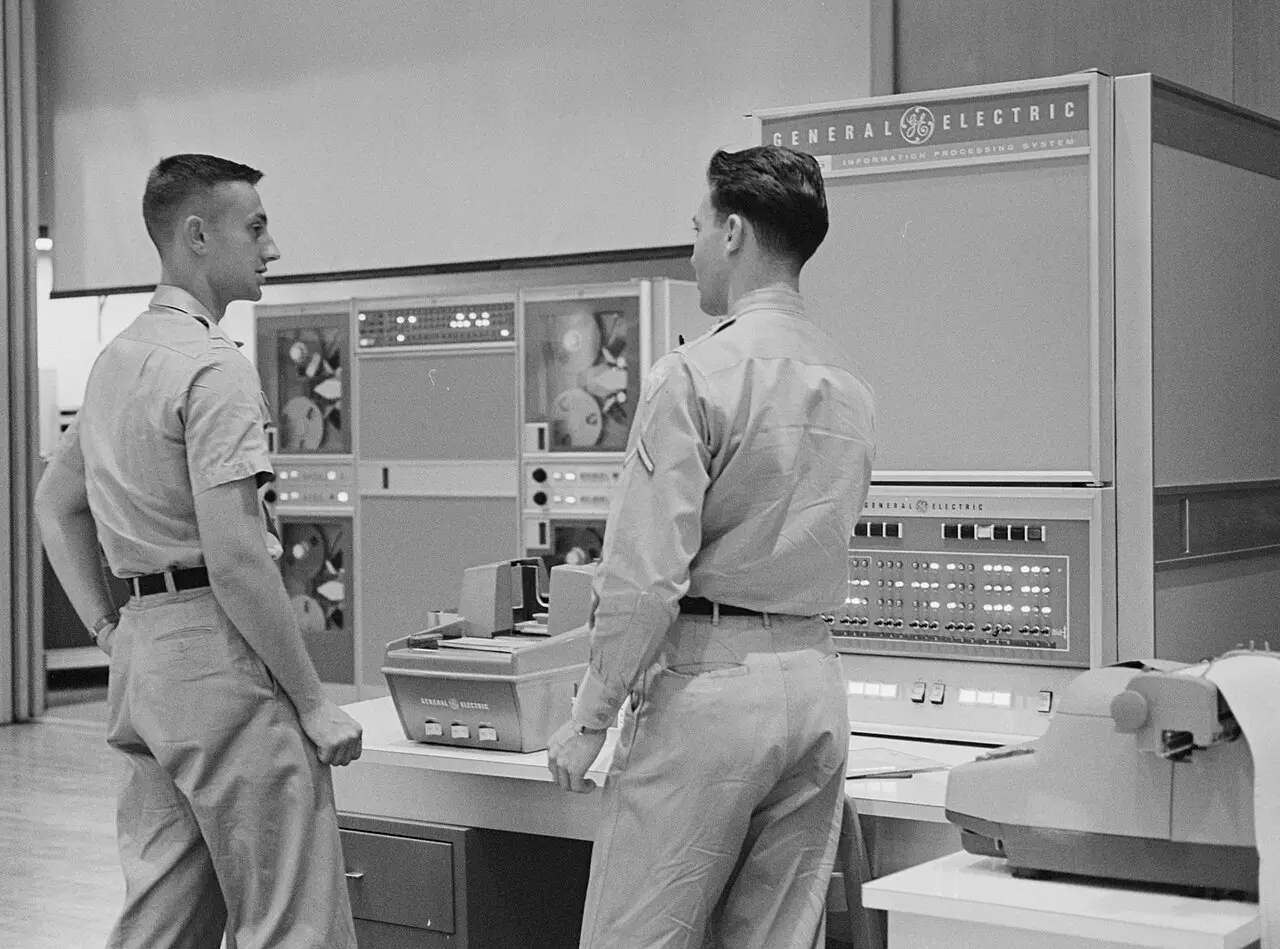
Warren K. Leffler, U.S. News & World Report Magazine Photograph Collection, Library of Congress (Wikimedia Commons) · Public domain · Commons ↗ At General Electric, Charles W. Bachman designed the Integrated Data Store (IDS) as the foundation of MIACS, a manufacturing control system for a GE factory. Functional specifications were complete by January 1962, a prototype was running in early 1963, and it was tested with real data that summer. Application programs no longer touched the shared disk files directly: every store, retrieve, modify and delete went through calls to IDS, which kept the record types and their relationships as separate metadata. The database historian Thomas Haigh judges that if any system deserves the title of first database management system, it is IDS. GE announced it as a supported package for its computer customers in October 1964. Its ideas were carried into the CODASYL Data Base Task Group and became the network data model, and Bachman received the ACM Turing Award in 1973.
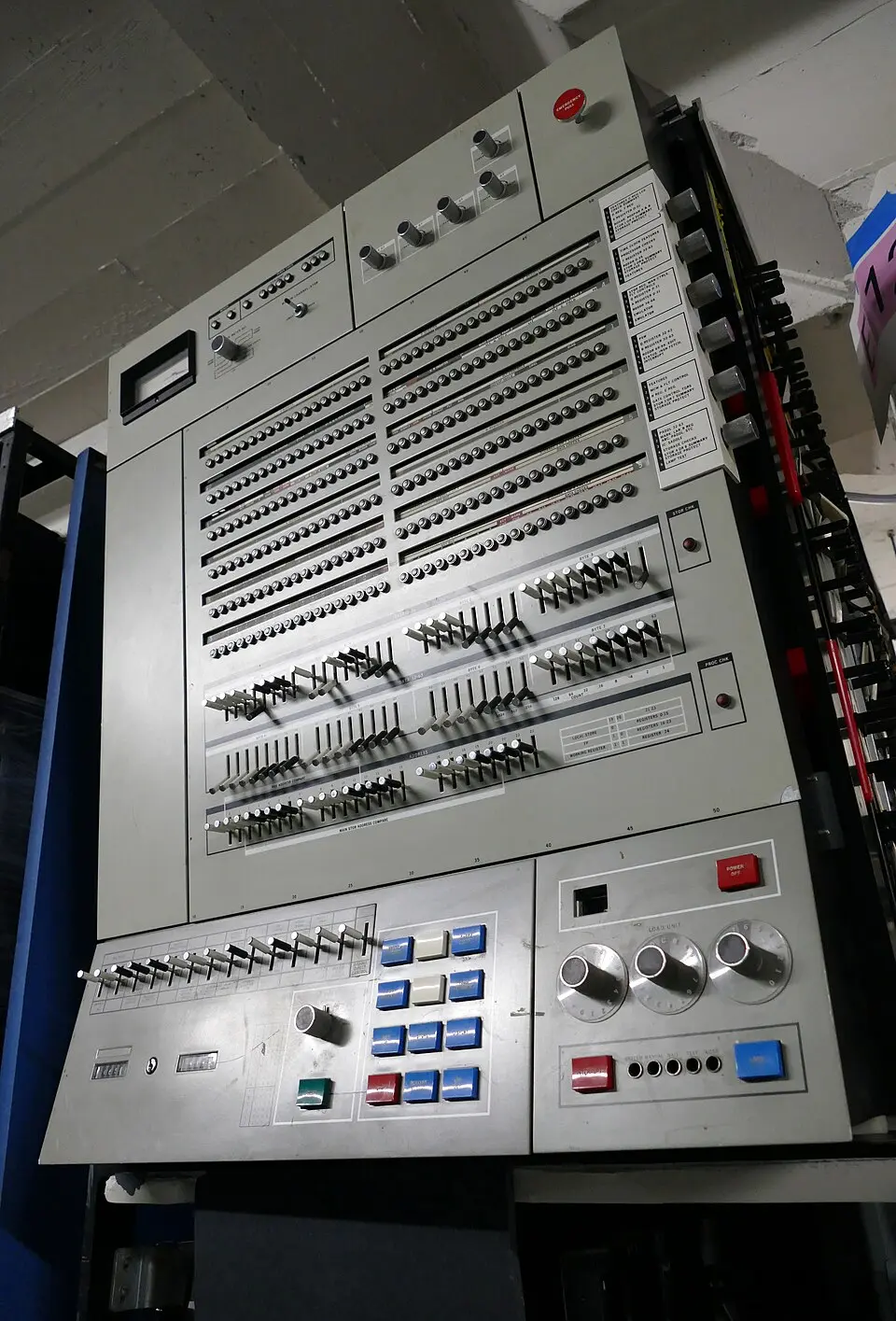
Living Computers: Museum+Labs (Wikimedia Commons) · CC BY-SA 4.0 · Commons ↗ On 14 August 1968 the first "IMS READY" message appeared on an IBM 2740 terminal at Rockwell's Space Division in Downey, California. It came from the Information Control System (ICS) and Data Language/I (DL/I), developed from 1966 by engineers from IBM, North American (North American Rockwell after a 1967 merger) and Caterpillar Tractor to manage the huge bills of material and engineering changes for the Apollo spacecraft. Its predecessor was DATE, which IBM's Uri Berman and colleagues put into service on an IBM 7010 in 1965, and which already separated stored data from the application programs using it. ICS was renamed Information Management System/360 (IMS/360) in 1969 and became an IBM product. Combining a hierarchical DBMS that holds records as parent-child trees with transaction processing, IMS spread through banking, insurance and manufacturing and has stayed in use for more than half a century.

1970s
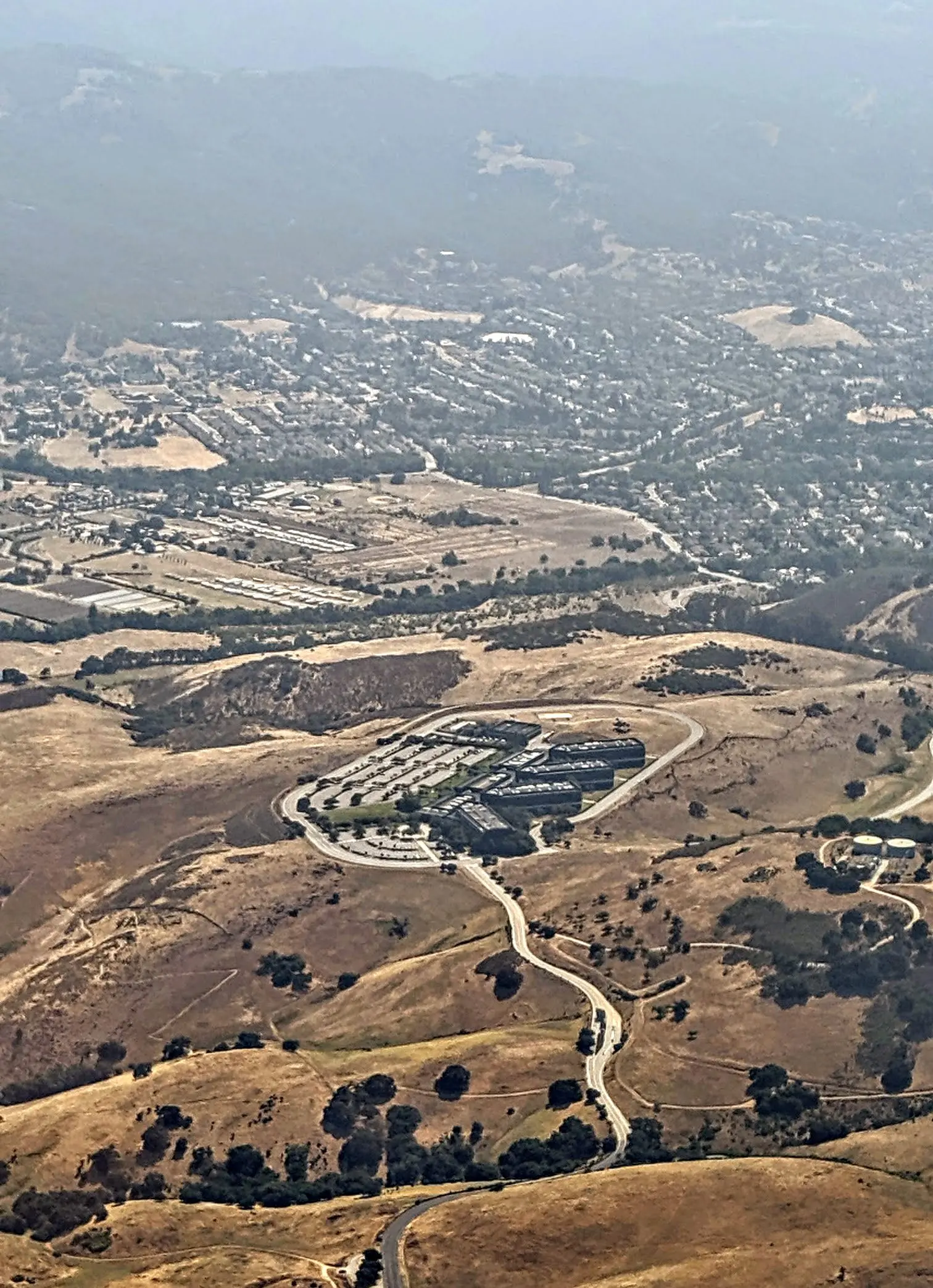
Dicklyon (Wikimedia Commons) · CC BY-SA 4.0 · Commons ↗ E. F. Codd of IBM's San Jose Research Lab published 'A Relational Model of Data for Large Shared Data Banks' in CACM 13(6), 377–387. Grounded in set theory and first-order predicate logic, it defined n-ary relations and five operations on them (permutation, projection, join, composition, restriction) and put 'data independence'—applications not depending on how data is physically stored—at the centre of the problem. As a fundamental challenge to the then-dominant hierarchical and network DBMS (IMS, IDS), it became the theoretical origin of every RDBMS that followed, from Oracle and DB2 through SQL Server, MySQL, and PostgreSQL. The terms 'relational algebra' and 'relational calculus' are not in this paper; they come from its 1972 sequel, Relational Completeness of Data Base Sublanguages. Codd received the ACM Turing Award in 1981.

Dicklyon (Wikimedia Commons) · CC BY-SA 4.0 · Commons ↗ In May 1974, at the ACM SIGFIDET workshop in Ann Arbor, Michigan, IBM San Jose researchers Donald Chamberlin and Raymond Boyce presented 'SEQUEL: A Structured English Query Language'. It let users query Codd's relational model through English-keyword SELECT-FROM-WHERE templates, with no quantifiers or bound variables, while claiming the power of first-order predicate calculus. System R's Phase Zero built a single-user prototype in 1974–75; a multiuser version followed in 1976–77 and was first installed, experimentally, in June 1977. In 1977 a trademark issue shortened the name from SEQUEL to SQL. Boyce died about a month after the Ann Arbor talk, aged 26.
1980s
On 16 October 1986 the American National Standards Institute approved 'Database Language SQL' as American National Standard X3.135-1986, drafted by Technical Committee X3H2 on Database under the X3 committee. It defined a schema definition language, a module language and a data manipulation language, split into a complete Level 2 and a subset Level 1, with annexes giving embedded syntax for COBOL, FORTRAN, Pascal and PL/I. Referential integrity was deferred to later addenda. The international edition, ISO 9075:1987, was published in June 1987; a second edition 'with integrity enhancement' followed in 1989 and a 587-page third edition in 1992.
1990s
Oracle Corporation (Wikimedia Commons, vectorised by Vulphere) · Public Domain (text logo, ineligible for copyright); MySQL is a trademark of Oracle · Commons ↗ Michael 'Monty' Widenius, David Axmark, and Allan Larsson founded MySQL AB in Sweden and put out the first, internal version of the MySQL RDBMS. Its licence was not the GPL but a house one—free to use, but paid for commercial use and for the Windows build; the GPL-plus-commercial dual licence arrived only in 2000. As the 'M' in the LAMP stack (Linux, Apache, MySQL, PHP/Perl/Python), MySQL powered the Web boom of the 2000s. Sun Microsystems acquired MySQL AB for about US$1 billion in 2008; when Oracle closed its purchase of Sun in January 2010, MySQL passed to Oracle. Widenius had already forked MariaDB in 2009 to keep an open successor line alive.

Daniel Lundin (Wikimedia Commons) · BSD · Commons ↗ On 9 July 1996 Marc Fournier committed 'Postgres95 1.01 Distribution - Virgin Sources' into a newly created repository—the moment the lineage of the UC Berkeley POSTGRES project (begun 1986 under Michael Stonebraker, wound down at Version 4.2) passed to a development community outside the university. Later that same year the project was renamed PostgreSQL and its version numbering was set to 6.0 to resume the Berkeley sequence; 6.0 itself shipped on 29 January 1997. Built around ACID compliance, MVCC, and extensibility, it spawned PostGIS, TimescaleDB, and pgvector—and in Stack Overflow's Developer Survey it took the most-used database slot from MySQL in 2023 and has since held first place for most-used, most-admired, and most-desired alike.
2000s

D. Richard Hipp; SVG conversion by Mwtoews (Wikimedia Commons) · Public domain · Commons ↗ On 17 August 2000 D. Richard Hipp released version 1.0 of SQLite, an SQL database engine that runs inside the application's own process. The starting point was software for a US Navy destroyer, where every time a separate Informix server went down the team's application showed a dialog reading 'Can't connect to database server'. An alpha had been made public on 29 May 2000, packaged at first as a Tcl extension. Version 1.0 stored data through GDBM; version 2.0, in September 2001, replaced it with SQLite's own B-tree and put the code in the public domain. sqlite.org now says SQLite is in every Android and iPhone device and that over one trillion SQLite databases are likely in active use.
MongoDB, Inc. (Wikimedia Commons) · Public Domain (ineligible for copyright); MongoDB is a trademark · Commons ↗ 10gen (later MongoDB Inc.), founded by Dwight Merriman, Kevin P. Ryan and Eliot Horowitz, made the first public release of MongoDB—a document-oriented NoSQL database that stored BSON-formatted JSON documents instead of rows and columns, with schemaless modelling and horizontal scalability. Version 1.0 shipped that August. It became the public face of the 'NoSQL movement', went public on NASDAQ in 2017, moved the Community Server from AGPLv3 to the SSPL in 2018, and reported US$2.46 billion of revenue in the fiscal year ended January 2026—establishing the document model as a durable choice in a DBMS market that had been dominated by relational systems.
2010s
AWS announced the limited preview of Amazon Redshift at the first-ever re:Invent (general availability followed in February 2013). Built on MPP and columnar technology licensed from ParAccel, the cloud-native analytical data warehouse was priced, with reserved instances, at under US$1,000 per terabyte per year—which the press release called one tenth the price of most data warehousing solutions then available. By overturning the assumption that a data warehouse meant buying dedicated hardware, Redshift—together with BigQuery, made publicly available in May 2012—established the 'cloud DWH' category, opening the path that Snowflake and Databricks would later disassemble and re-architect.

Snowflake (Wikimedia Commons) · Public domain · Commons ↗ Snowflake Computing—founded in 2012 by Benoit Dageville, Thierry Cruanes, and Marcin Żukowski, veterans of Oracle and Vectorwise—came out of stealth on 21 October 2014, announcing the Snowflake Elastic Data Warehouse and US$26 million in total funding. By separating storage (object stores such as S3) from compute (virtual warehouses), it built a cloud-native DWH where compute could be spun up only as needed. The product reached general availability on 23 June 2015. Its multi-cluster, shared-data architecture powered explosive growth: the NYSE listing on 16 September 2020 closed day one at $253.93 for a market value of roughly US$70.4 billion—the largest software IPO to that date. In FY2026 (year ended 31 January 2026) revenue was US$4.68 billion across 13,328 customers.
2020s
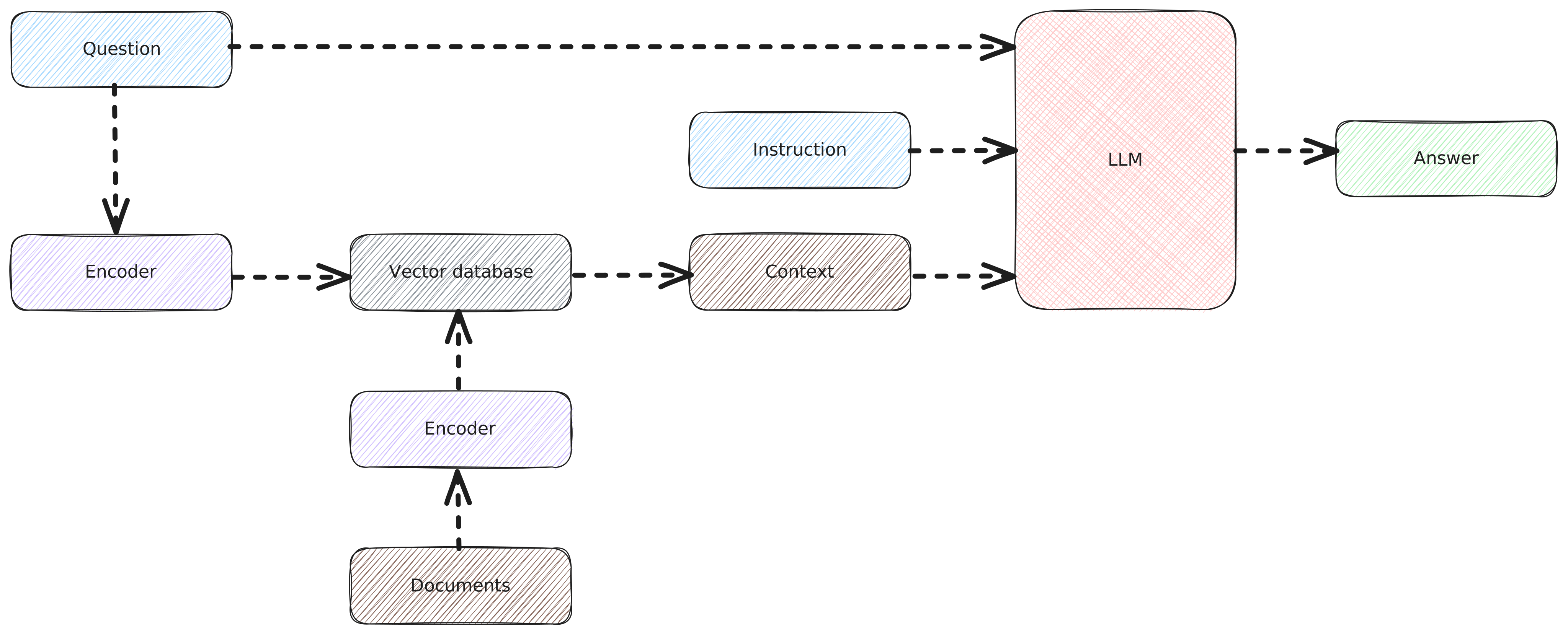
Gknor (Wikimedia Commons) · CC BY-SA 4.0 · Commons ↗ On 3 May 2023 AWS announced pgvector support in Amazon RDS for PostgreSQL (15.2 and later). Supabase had shipped it at Launch Week 7 in April; Google Cloud SQL and AlloyDB followed on 27 June and Amazon Aurora in July, and the major managed PostgreSQL services lined up behind the extension. pgvector stores embeddings—high-dimensional vector representations of text or images—in ordinary PostgreSQL tables and searches them by L2 distance, inner product, or cosine distance; it already shipped an IVFFlat index in v0.1.0 in April 2021. HNSW, the index the purpose-built vector databases standardised on, arrived in v0.5.0 on 28 August 2023. As RAG demand surged after ChatGPT's November 2022 release, pgvector's 'add an extension to your existing PostgreSQL' approach went head to head with purpose-built vector databases such as Pinecone, Weaviate, and Chroma.