PERSON
Tim Berners-Lee
Inventor of the World Wide Web. At CERN he submitted 'Information Management: A Proposal' in March 1989 and, by the end of 1990, had implemented HTTP, HTML, URLs, the first server and the first browser. He founded the W3C at MIT in 1994. ACM Turing Award, 2016. He now works on Solid, a decentralised-web specification, as CTO of its commercial spin-out Inrupt, on returning data sovereignty to individuals. His memoir This Is for Everyone appeared in 2025.
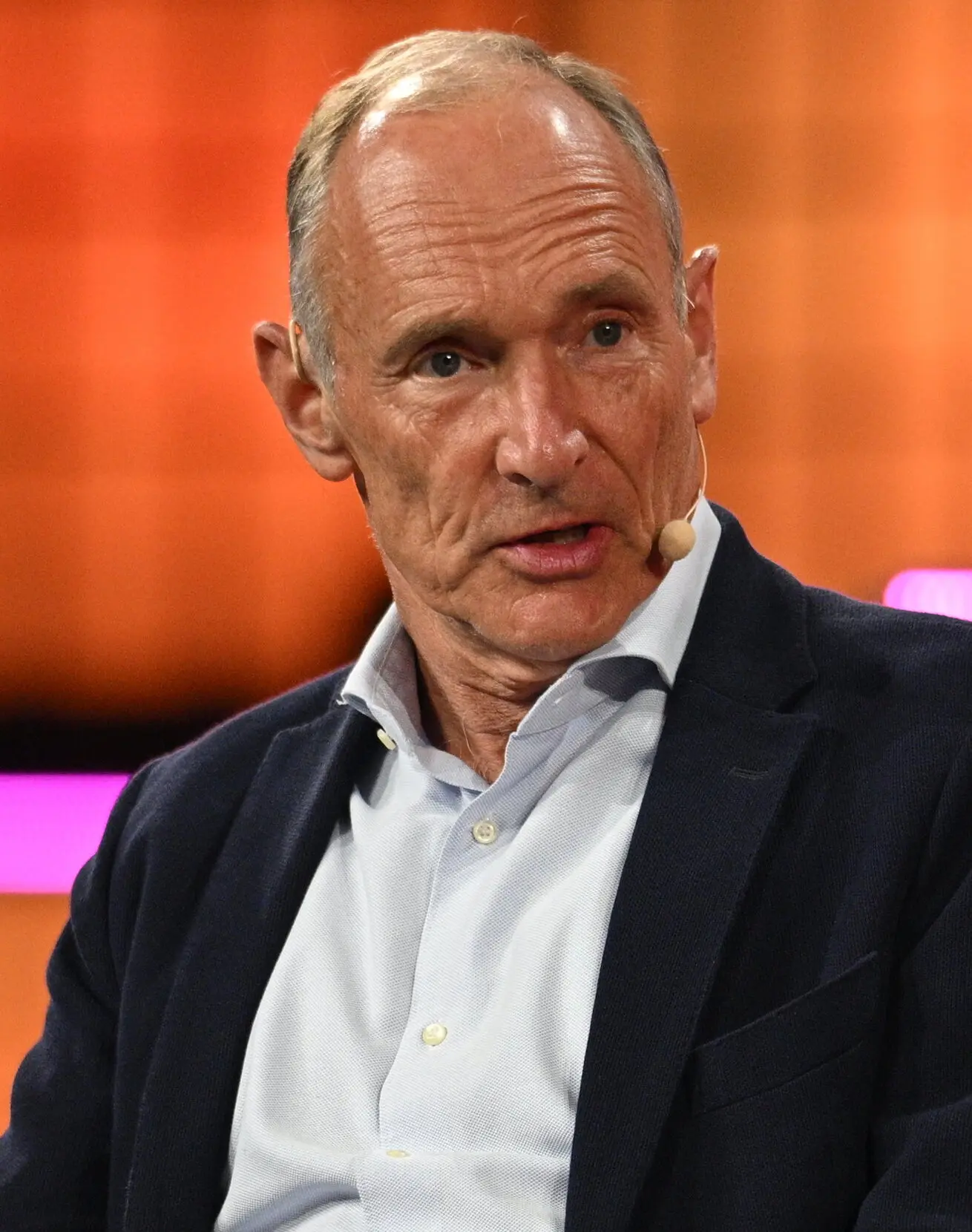
Profile
- Born
- 1955
- Status
- Living
- Span
- 1955–
- Appearances
- 03
- Name
- ENTim Berners-LeeJAティム・バーナーズ=リー
Sir Timothy John Berners-Lee (b. 8 June 1955) invented the World Wide Web. Between 1989 and 1991, while at CERN, he designed and wrote HTTP, HTML, the URL scheme, the first web server and the first browser. In 1994 he founded the World Wide Web Consortium (W3C) to keep web standards open and vendor-neutral. ACM Turing Award, 2016. In recent years he has worked through the Solid project and the spin-out Inrupt to return personal-data sovereignty to individual users.
Both parents worked on the Ferranti Mark 1
Berners-Lee was born on 8 June 1955 in south-west London. Both his parents — Conway Berners-Lee and Mary Lee Woods — were mathematicians who had worked on the Ferranti Mark 1, the first commercially available general-purpose electronic computer. He has said that his childhood dinner-table conversation routinely included Boolean algebra.
After Emanuel School he went up to The Queen's College, Oxford in 1973 to read physics, taking his degree in 1976. While at Oxford he built a homemade computer using a salvaged television set and a Motorola M6800 processor.
His route to CERN was not direct, and the intervening jobs are usually skipped:
| Years | Post |
|---|---|
| 1976-78 | Engineer, Plessey Telecommunications, Poole |
| 1978-80 | Programmer, D. G. Nash, Ferndown |
| Jun-Dec 1980 | Independent contractor, CERN — wrote ENQUIRE, a personal hypertext database of links between documents, the spiritual ancestor of the Web |
| 1981-84 | Technical manager, John Poole's Image Computer Systems Ltd, Bournemouth — real-time remote procedure call work |
| 1984-94 | Fellow, then technical staff, CERN |
| 1994- | MIT; founder and Director of the W3C |
A proposal in March 1989, and a note in the margin
Inventing the World Wide Web (1989-1991)
In March 1989 Berners-Lee submitted an internal proposal entitled Information Management: A Proposal to his manager, Mike Sendall. Sendall approved it and wrote in the margin the phrase that has outlived everything else on the page:
Vague, but exciting
There is no ellipsis in either of CERN's renderings, and no comma-free variant. Sendall then agreed to Berners-Lee acquiring one of the new NeXT machines from Steve Jobs's post-Apple company, and suggested he use it for the hypertext idea.
By the end of 1990 he had built HTTP, HTML, the URL scheme, the first web server (info.cern.ch, running on that NeXTcube) and the first browser, WorldWideWeb, which was also an editor. A more formal management proposal, WorldWideWeb: Proposal for a HyperText Project, followed on 12 November 1990 — that one written with Robert Cailliau, which is the qualification the phrase "single-handed" needs.
On 6 August 1991 he posted to the alt.hypertext newsgroup and the project became visible to the wider internet. On 30 April 1993 CERN released the source of the WorldWideWeb software royalty-free. The counter-example was immediate: the University of Minnesota had declared Gopher proprietary and subject to licence fees that same year. The event record has the full sequence.
Founding the W3C (1994)
In October 1994 Berners-Lee moved to MIT and established the W3C, headquartered at what was then LCS (now CSAIL). With Mosaic spreading and the browser war between Netscape and Microsoft in prospect, the explicit purpose was to keep web standards out of the hands of any single firm.
The W3C published HTML 4.0 (1997), XML (1998), CSS 2 (1998) and the HTML5 Recommendation (2014), and remains the home of specifications including WebAssembly, Web Components and WebRTC. Berners-Lee led it as Director from 1994; he is now its Emeritus Director, a founder and an honorary member of its board.
The Solid Project and Inrupt (2015-)
Solid (Social Linked Data), started at MIT, is a counter-proposal to the centralised data accumulation of the present web. Each person's data lives in a Pod (Personal Online Datastore) of their own choosing, and applications request read or write permission against that Pod. It is built from existing Semantic Web technologies — RDF, SPARQL, OAuth, WebID — recomposed for the purpose.
He announced Inrupt on 30 September 2018 to bring Solid to enterprise and government customers, and is its CTO. In a March 2025 Financial Times op-ed, quoted by Inrupt, he set out how he thinks AI agents should be arranged:
The next level is to make these data insights accessible to everyone via artificial intelligence agents. But in order not to repeat the worst mistakes of the social media era, we need to make sure these agents really work for you.
And, on what Inrupt is building: "I co-founded Inrupt to build a data wallet on top of Solid that can store everything from your driving license to photos to medical data."
Awards and honours
| Year | Honour |
|---|---|
| 1992 | ACM Software System Award |
| 2001 | Fellow of the Royal Society |
| 2002 | Japan Prize |
| 2004 | Knight Commander of the Order of the British Empire (KBE) |
| 2004 | Millennium Technology Prize — the inaugural award |
| 2007 | Order of Merit (OM), an honour restricted to twenty-four living members |
| 2007 | Charles Stark Draper Prize |
| 2012 | Appeared at the London Olympics opening ceremony at a NeXT machine, tweeting "This is for everyone" live in front of a stadium of about 80,000 |
| 2013 | Queen Elizabeth Prize for Engineering, with Vint Cerf, Bob Kahn, Louis Pouzin and Marc Andreessen |
| 2016 | ACM Turing Award — "For inventing the World Wide Web, the first web browser, and the fundamental protocols and algorithms allowing the Web to scale" |
| 2022 | Seoul Peace Prize |
Inrupt, the W3C, MIT and Oxford
Berners-Lee is CTO of Inrupt, Emeritus Director of the W3C, Emeritus 3Com Founders Professor of Engineering at MIT with a joint appointment at CSAIL, and a professor in the Department of Computer Science at the University of Oxford (since 2016), where he is also an Honorary Student of Christ Church. He divides his time between Massachusetts and the UK. He married Rosemary Leith in 2014.
In September 2025 he published a memoir, This Is for Everyone: The Unfinished Story of the World Wide Web, written with Stephen Witt (Farrar, Straus and Giroux) — the title taken from the 2012 tweet. His recurring public theme through the book and the interviews around it is that the Web is not broken but that parts of it have been optimised against their users: advertising-funded social platforms, algorithmic amplification of outrage, and the extraction of personal data. He treats these as a betrayal of the 1989 proposal's spirit, and Solid as the structural response. He is equally deliberate about distancing his work from the cryptocurrency-flavoured movement marketed as "Web3": his own agenda rests on Linked Data and decentralised authentication, not blockchain.
TCP/IP was a partnership; this was not
What Berners-Lee did between 1989 and 1991 has few parallels as a piece of individual invention. TCP/IP was a partnership between Vint Cerf and Bob Kahn; UNIX was Thompson and Ritchie together. The original HTTP, HTML and URL specifications were his alone, with Cailliau joining for the second, formal proposal and the advocacy that followed. Combined with CERN's 1993 decision to release the software royalty-free, the result is that the foundational infrastructure of the twenty-first-century information economy sits, even now, in the commons rather than behind patents or licence fees.
"This is for everyone" — the tweet he sent from a NeXT machine at the London Olympics in 2012 — was less opening-ceremony theatre than a one-line summary of that 1993 decision. The Solid and Inrupt work of the 2020s, and the memoir that borrowed the phrase for its title, are the same person's second response to the same problem.
Appearances
Sources
PrimarySolid — project home
TertiaryTim Berners-Lee — Wikipedia
Last updated: