PERSON
Dennis Ritchie
Designer of the C programming language (1971-1973) and, with Ken Thompson, co-creator of UNIX. He joined Bell Labs in 1967 and never changed jobs, retiring in 2007 as head of Lucent's System Software Research Department. ACM Turing Award 1983; US National Medal of Technology 1998 (presented 1999). He was found dead at home on 12 October 2011, a week after Steve Jobs; the news was largely overshadowed.
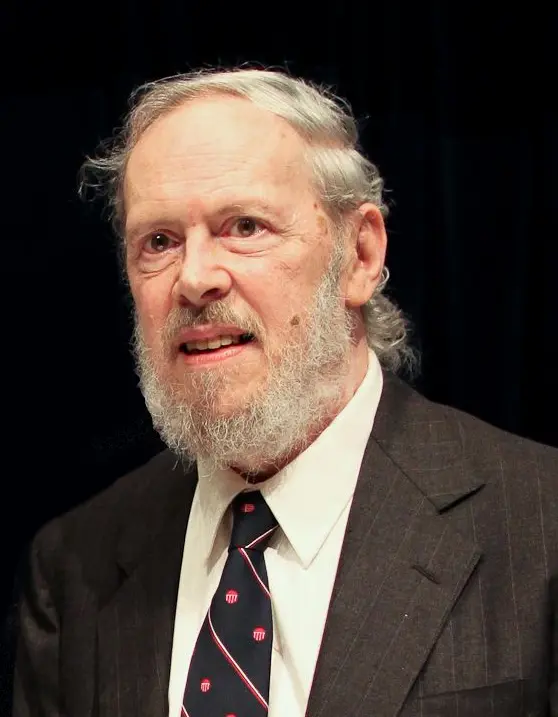
Profile
- Born
- 1941
- Died
- 2011
- Span
- 70 years
- Appearances
- 03
- Name
- ENDennis RitchieJAデニス・リッチー
Dennis MacAlistair Ritchie (1941-2011) designed the C programming language and, with Ken Thompson, co-created UNIX. He spent his entire working life at Bell Labs and its successor organisations, and shunned the spotlight, but the two artefacts he left behind — C and UNIX — still run, directly or by descent, inside very nearly every operating system, language runtime, network appliance and embedded device on Earth.
Background
Ritchie was born on 9 September 1941 in Bronxville, New York. His father, Alistair Ritchie, was a long-serving switching engineer at Bell Labs and a co-author of the standard textbook The Design of Switching Circuits (1951). Dennis grew up in New Jersey.
He read physics at Harvard, taking a bachelor's degree in 1963, then moved to applied mathematics for graduate work and completed a doctoral thesis, Program Structure and Computational Complexity, under Patrick C. Fischer in 1968. The committee approved it. The degree was never awarded. According to the Computer History Museum, which located the lost dissertation in 2020, Harvard's library required a bound copy for deposit and charged a binding fee that was, at the time, non-trivial — and Ritchie declined to pay it. Fischer's recollection of his attitude: if the library wants a bound copy to keep, the library should pay for the book. He was, as CHM put it, not merely "everything but thesis" but "everything but bound copy."
In 1967 Ritchie joined the Computing Sciences Research Center at Bell Labs in Murray Hill, New Jersey; as a graduate student he had worked on the Multics timesharing project at MIT's Project MAC. He became head of the Computing Techniques Research Department in 1990 and retired in 2007 as head of Lucent Technologies' System Software Research Department. The corporate name over the door changed with AT&T's break-ups; he never changed jobs.
Major contributions
UNIX (1969-)
In 1969, just after Bell pulled out of the MIT-GE-Bell joint Multics project, Ken Thompson found what Ritchie described as "a little-used PDP-7 computer with an excellent display processor" and set out to build a computing environment he liked. That became UNIX.
Ritchie was consistently modest about his own share. "His work soon attracted me," he wrote of Thompson; "I joined in the enterprise, though most of the ideas, and most of the work for that matter, were his." On the file system specifically: "Most of the design was Thompson's, as was the impulse to think about file systems at all, but I believe I contributed the idea of device files." The name Unix was proposed by Brian Kernighan, well into 1970.
What the first system had and did not have, and how pipes arrived, is the subject of the UNIX article.
The C Language (1971-1973)
The earliest UNIX was written in assembler. In 1971 Ritchie added a character type to Thompson's B and rewrote its compiler to emit PDP-11 machine instructions directly; the result, NB, became C. In the summer of 1973 the UNIX kernel itself was rewritten in it.
Portability was not the motive. Ritchie is explicit: "At the time we did not put much weight on portability; interest in this arose later." Writing an operating system in a high-level language was not new — Multics was largely PL/I — and what made C decisive was that it did so while its compiler still produced code small and fast enough to compete with assembly. Portability was the consequence, and the consequence is what mattered. The C article covers this in full.
In February 1978 Ritchie and Brian Kernighan published The C Programming Language (universally known as K&R). By Ritchie's own account Kernighan wrote almost all of the expository material, while Ritchie was responsible for the appendix containing the reference manual and the chapter on interfacing with the UNIX system. That appendix served as the de facto definition of the language until the ANSI standard of 1989.
A small correction to a common claim: "hello, world" did not first appear in print in K&R. Its first published outing was in Kernighan's 1972 A Tutorial Introduction to the Language B.
Plan 9 and Inferno
In the late 1980s Ritchie was, with Thompson, Rob Pike and others, a co-creator of Plan 9 from Bell Labs, a distributed operating system intended as UNIX's successor. Plan 9 was never a commercial success, but it was the first system to adopt UTF-8 and it seeded design ideas that resurfaced in the Go language. In 1995 Ritchie and colleagues began the Inferno distributed operating system and the Limbo language, aimed at devices such as set-top boxes and advanced telephones.
Awards and honours
- 1983 — ACM Turing Award, jointly with Ken Thompson. The citation reads: "With Ken Thompson, for their development of generic operating systems theory and specifically for the implementation of the UNIX operating system."
- 1983 — ACM Software System Award (with Thompson).
- 1988 — Elected to the National Academy of Engineering.
- 1990 — IEEE Richard W. Hamming Medal (with Thompson), "for the origination of the UNIX operating system and the C programming language."
- 1994 — IEEE Computer Pioneer Award (with Thompson).
- 1998 — US National Medal of Technology (with Thompson); presented by President Clinton on 21 April 1999.
- 2011 — Japan Prize for Information and Communications, jointly with Thompson.
Legacy
Ritchie never married. He was found dead at his home in Berkeley Heights, New Jersey, on 12 October 2011, aged 70. He had long been in poor health with prostate cancer and heart disease.
His passing was largely overshadowed by the wave of tributes for Steve Jobs, who had died a week earlier. The observation circulated widely on social media that Jobs built the iPhone but that it ran on what Ritchie had written — and it was substantially correct. The XNU kernel inside macOS and iOS is a hybrid of BSD and Mach, both of them UNIX descendants. Ritchie's work sat under Jobs's products as their literal foundation.
In his National Academy of Engineering memorial tribute, Brian Kernighan wrote: "Dennis was modest, kind, unassuming and generous, always giving credit to others while downplaying his own contributions." The tribute closes: "Dennis was a giant of computing. Most of the world's computers run Unix or Unix-like systems, and much of the world's software is written in C or in languages derived from it."
The claim that contemporary computer culture cannot be imagined without C and UNIX is not hyperbole. Ritchie built the kind of substrate that is invisible while it works and noticed only when it fails. He, too, was that sort of presence; and he left, very quietly, in much the same way.
Appearances
Sources
TertiaryDennis Ritchie — Wikipedia
Last updated: