PERSON
Vint Cerf
Co-author with Bob Kahn of the 1974 paper that set out how networks could be interconnected, and one of those known as a 'father of the internet'. What the 1974 design described was a single Transmission Control Program; the split into TCP and IP came in 1978. His career ran through IBM, UCLA, Stanford, DARPA, MCI and CNRI, and from 2005 to his retirement in July 2026 he was Vice President and Chief Internet Evangelist at Google. He shared the 2004 ACM Turing Award with Kahn.
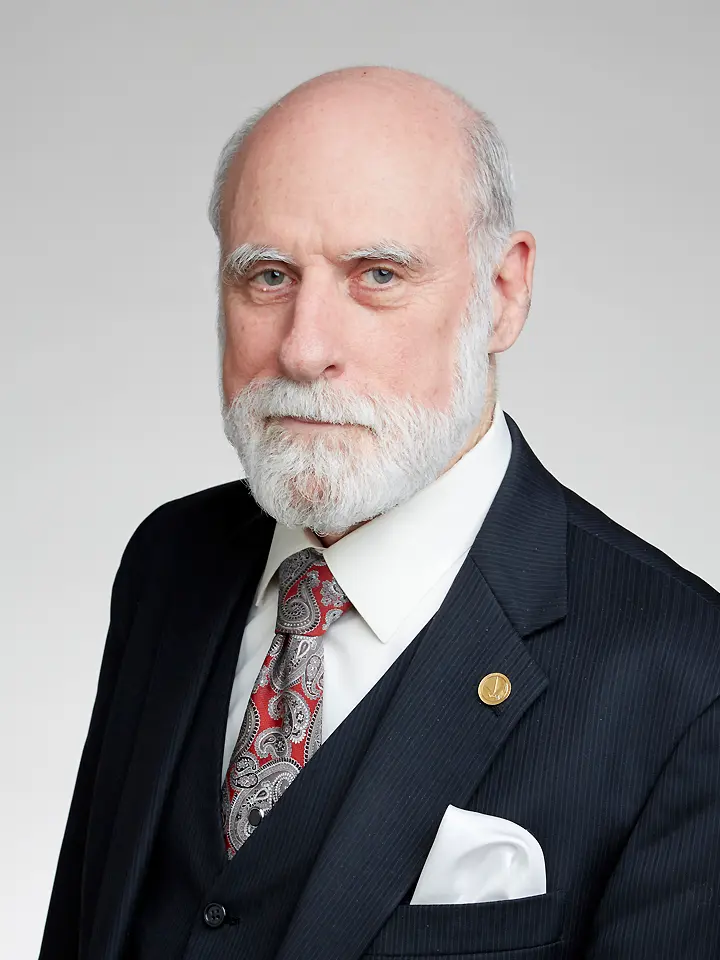
Profile
- Born
- 1943
- Status
- Living
- Span
- 1943–
- Appearances
- 01
- Name
- ENVint CerfJAヴィントン・サーフ
Vinton Gray Cerf (b. 23 June 1943) is the American computer scientist who, with Bob Kahn, published in 1974 the design for interconnecting packet networks, and who is widely recognised as one of the "fathers of the internet." His career ran through IBM, UCLA, Stanford, DARPA, MCI and CNRI, and from October 2005 until his retirement in July 2026 he was Vice President and Chief Internet Evangelist at Google. He shared the 2004 ACM Turing Award with Kahn. He was the founding president of the Internet Society, was involved in setting up ICANN, and from the late 1990s onwards has led, with NASA and JPL, the design of an "Interplanetary Internet."
Background
Cerf was born on 23 June 1943 in New Haven, Connecticut. He has been severely hearing-impaired since childhood, and by ACM's account he attributed part of his interest in computer networking to its promise as an alternative communications channel for the hearing impaired. The three-piece suits that became his trademark date from high school; asked about it at the Open Frontier conference in June 2026 he said, "It absolutely is true. I even had a vest, and for some reason I always wanted to stick out."
In 1965 he graduated from Stanford with a BS in mathematics. He spent 1965-67 at IBM in Los Angeles as a systems engineer working on QUIKTRAN, a FORTRAN-based time-sharing system. He entered the UCLA graduate programme in 1967 and joined Leonard Kleinrock's group, which held the performance-analysis contract for ARPANET; UCLA was given one of the first four nodes, and Cerf became deeply involved through the Network Working Group in the design of the host-to-host protocol, NCP. He took his MS in 1970 and his PhD in 1972, both in computer science.
He and Bob Kahn first met in 1969, when Kahn came to UCLA to help test the newly running ARPANET. From 1972 to 1976 Cerf was an assistant professor at Stanford, and it was during that period that the collaboration with Kahn — by then a programme manager at ARPA's Information Processing Techniques Office — began in earnest. He was himself a DARPA IPTO programme manager from 1976 to 1982, Vice President of Digital Information Services at MCI from 1982 to 1986, Vice President of the Corporation for National Research Initiatives (CNRI), which Kahn had founded, from 1986 to 1994, and Senior Vice President at MCI from 1994 to 2005.
Major contributions
Designing internetworking (1973-1978)
ARPANET had been operational since 1969, but by the early 1970s the problem of connecting it to other kinds of packet networks — the ground-radio PRNET and the satellite SATNET — had become acute. Each network had its own protocol, MTU and reliability model, and no consistent communication was possible across them.
In 1973 Cerf and Kahn designed an answer, published in May 1974 as "A Protocol for Packet Network Intercommunication" in the IEEE Transactions on Communications (22(5), 637–648). RFC 675, issued that December by Cerf, Yogen Dalal and Carl Sunshine, is titled "Specification of Internet Transmission Control Program" — and that is precisely what the design was at this stage: a single Transmission Control Program, not a two-part suite. The separation of the transport layer (TCP) from the internetwork layer (IP) came in 1978. The migration itself was planned in Jon Postel's RFC 801 of November 1981, and on 1 January 1983 ARPANET withdrew NCP and cut over to IP/TCP.
MCI and commercial email on the internet (1982-1994)
In 1982 Cerf left DARPA for MCI Communications as Vice President of Digital Information Services and led the MCI Mail service, launched in 1983. In 1989 MCI Mail was connected to the internet, opening one of the first gateways between the research-and-education network and a commercial email service. From 1986 to 1994 he worked with Kahn at CNRI, returning to MCI in 1994.
ISOC, the IETF and ICANN
In 1992 Cerf and Kahn founded the Internet Society (ISOC), and Cerf served as its first president. ISOC provides the organisational backbone for the IETF's standards work outside direct government funding. Cerf was also involved in the 1998 founding of ICANN — the body to which the US Department of Commerce transferred administration of the DNS root — and later chaired its board.
The Interplanetary Internet (1998-)
From 1998 Cerf, with NASA and JPL (Jet Propulsion Laboratory), began work on an "Interplanetary Internet": the protocol extensions required to network Mars probes, lunar bases, relay satellites and Earth into a single planetary-scale system.
Terrestrial TCP/IP is built on a round-trip-time assumption of tens to a few hundred milliseconds. Even at the speed of light, Earth-Mars one-way latency runs from roughly three to twenty-two minutes, and the line of sight is regularly interrupted by orbital geometry. The response is Delay-Tolerant Networking (DTN), specified through the Bundle Protocol (RFC 5050; version 7, the current one, is RFC 9171).
By Cerf's own account in an August 2025 Packet Pushers interview, the Bundle Protocol has been standardised both by the IETF and by the Consultative Committee for Space Data Systems, and "has been running on the International Space Station since 2009". NASA has made DTN the basis of the LunaNet Interoperability Specification, the networking layer intended to serve the Artemis programme.
Awards and honours
- 1991 — ACM Software System Award, with Kahn, for TCP/IP.
- 1995 — Silver Medal of the International Telecommunication Union.
- 1997 — US National Medal of Technology (with Kahn).
- 1998 — Marconi Award.
- 2001 — Charles Stark Draper Prize.
- 2004 — ACM Turing Award, with Kahn. The citation reads: "With Robert E. Kahn, for pioneering work on internetworking, including the design and implementation of the Internet's basic communications protocols, TCP/IP, and for inspired leadership in networking."
- 2005 — US Presidential Medal of Freedom (with Kahn).
- 2008 — Japan Prize (with Kahn).
- 2013 — Queen Elizabeth Prize for Engineering, one of five recipients alongside Tim Berners-Lee.
- 2023 — IEEE Medal of Honor.
Cerf was ACM President from 2012 to 2014. He is a member of the US National Academy of Engineering and of the American Academy of Arts and Sciences, and was elected a Foreign Member of the Royal Society in 2016.
The Google years, and retirement (2005-2026)
Cerf joined Google in October 2005 as Vice President and Chief Internet Evangelist and held the role for more than twenty years. His responsibilities spanned public argument about the long-run direction of internet technology, policy dialogue with governments and international bodies, and internal advisory work on next-generation networking, particularly IPv6 advocacy and DTN. His retirement was disclosed on 30 June 2026 at the Laude Institute's Open Frontier conference, and took effect on 7 July 2026. He was 83.
He never stopped complaining about the pace of IPv6 adoption, though his own numbers are estimates rather than measurements. In August 2025 he put it this way: "Today we're probably 40 percent penetrated in terms of who can use IPv6. We think most of the some maybe two thirds of all the traffic on the net is probably flowing on v6 because a lot of the streaming video is going over v6 carriage." The reason it took so long, in his telling: "The resistance there was necessity did not drive the uptake because there were alternatives and everybody was focused on the Web at the time."
By the end his attention had moved partly to machine-to-machine protocol design. At Open Frontier he argued that "the agentic model of AI, with multiple agents from multiple sources interacting with each other, is going to force composability," and that natural language is a poor substrate for it, because "precision for interagent interaction is going to be very, very important."
Legacy
The single most important element of the 1974 Cerf-Kahn design was not a technical detail but the end-to-end principle itself: the network's interior is dumb pipework that does not need to be trusted, and reliability, security, and application semantics are pushed out to the endpoints. That principle is what allowed ARPANET, a small research network, to scale into an enormous confederation of heterogeneous networks.
The same principle is also the structural axis of the major networking controversies of the present era: net neutrality (may providers throttle particular applications?), deep packet inspection by carriers, and state-imposed traffic censorship. Cerf himself has been a regular witness for net neutrality before Congress and in international fora since the 2010s.
A number of individuals have been called "father of the internet" — Kahn, Tim Berners-Lee, Leonard Kleinrock, Louis Pouzin, Jon Postel — but what marks Cerf out is that for more than half a century he sat at the centre of both the technical and the policy conversation. In 1969 he was a graduate student arguing about ARPANET host protocols; in 2025 he was arguing about interplanetary relays and agent interoperability. There are few comparable cases of sustained presence anywhere in computing.
Appearances
Sources
TertiaryVint Cerf — Wikipedia
Last updated: