PERSON
Grace Hopper
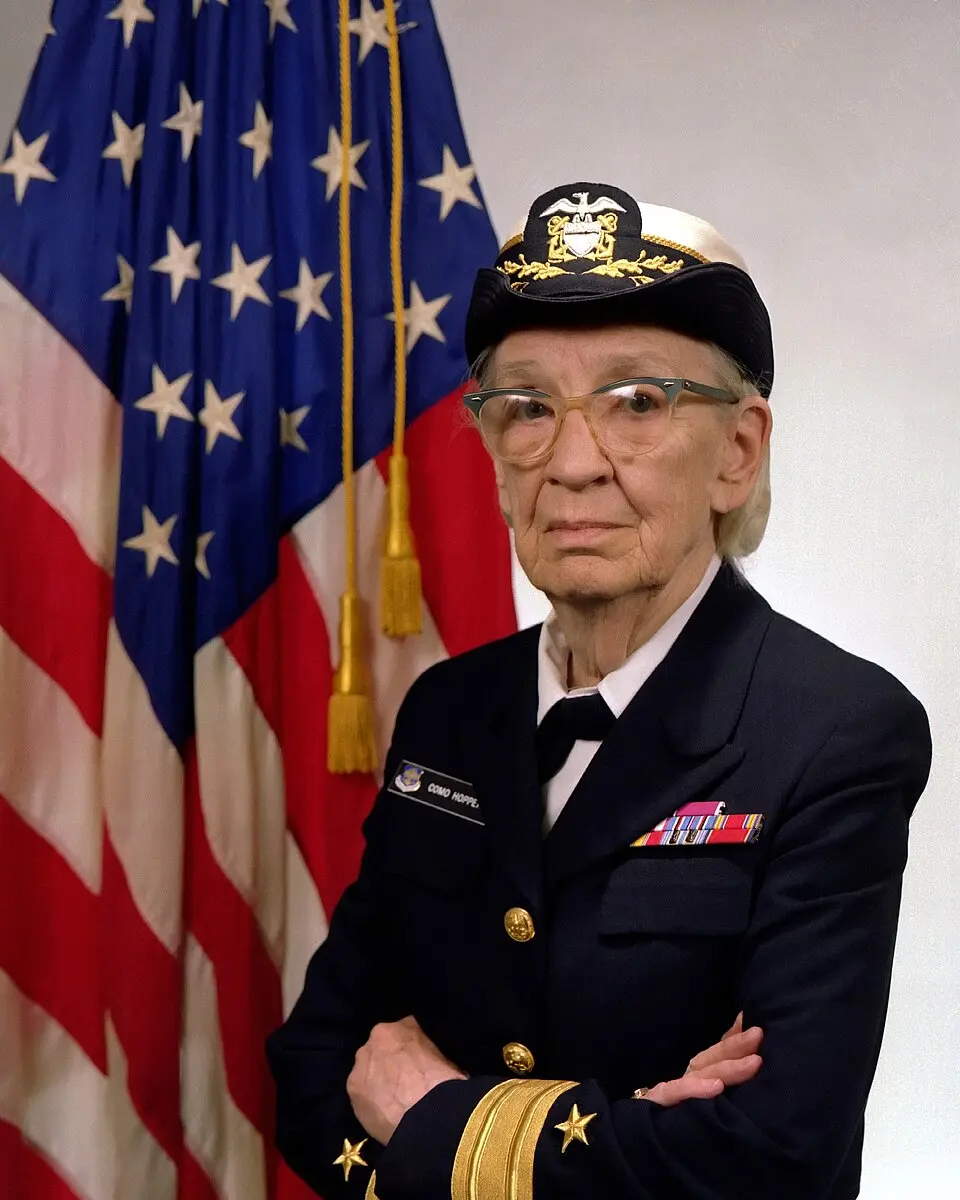
A Yale mathematics PhD who joined the Naval Reserve and became one of the earliest programmers of the Harvard Mark I. At Eckert-Mauchly and UNIVAC she led the automatic programming department and produced the A-0 system in 1952, then MATH-MATIC and FLOW-MATIC. FLOW-MATIC was one of the three sources of ideas the COBOL specification names; she herself was one of the two technical advisers to the CODASYL Executive Committee. When she retired in 1986 at seventy-nine she was the oldest commissioned officer on active duty in the US Navy. She was awarded the Presidential Medal of Freedom posthumously in 2016.
Profile
- Born
- 1906
- Died
- 1992
- Span
- 86 years
- Appearances
- 04
- Name
- ENGrace HopperJAグレース・ホッパー
Grace Brewster Murray Hopper (9 December 1906 — 1 January 1992) spent her career answering a piece of received wisdom — that computers can only do arithmetic — with a single counter-proposal: make the computer do the translating. She began as a mathematician and retired as a rear admiral. The forty-three years between were given to dragging the act of writing a program away from the machine and toward the person.
Background
Hopper was born in New York City. She graduated from Vassar College in 1928 in mathematics and physics, elected Phi Beta Kappa, took her master's at Yale in 1930 and her PhD in mathematics there in 1934, under Øystein Ore, with a thesis on irreducibility criteria. She then taught mathematics at Vassar, where she became an associate professor.
In December 1943 she entered the US Naval Reserve. After the WAVES midshipmen's school at Northampton, Massachusetts, she was commissioned a lieutenant (junior grade) and ordered to the Bureau of Ordnance Computation Project at Harvard University. There she became one of the first programmers of the Harvard Mark I, and went on to work on the Mark II and Mark III. She is credited with writing the Mark I's operating manual — which is to say that the genre of the computer manual begins with her.
Compilers
In 1949 Hopper joined the Eckert-Mauchly Computer Corporation, then building UNIVAC I, the first commercial electronic computer. As a senior programmer there she published, in the Navy's careful phrasing, the first paper on compilers, and by 1952 had the A-0 system running.
What A-0 was is worth stating precisely. In modern terms it was closer to a linker-loader; at the time, that was what the word "compiler" meant. The Presidential Medal of Freedom citation says flatly that "she created the first compiler, which translates source code from one language into another". The claim is defensible only with the period definition attached — which is the usual qualification any "first compiler" attribution needs.
In 1954 she was made the company's first director of automatic programming. Her department produced MATH-MATIC and FLOW-MATIC. The aim of FLOW-MATIC was unambiguous: a notation that a business data processor, who was not a mathematician, could read.
The relationship to COBOL
In 1959 CODASYL, convened under Department of Defense sponsorship, set out to define a common business language. The first COBOL specification names three sources of ideas: FLOW-MATIC, IBM's Commercial Translator, and AIMACO. Hopper was one of the two technical advisers to the CODASYL Executive Committee, and several of her staff sat on the Short Range Committee that defined the basic language design.
She did not write COBOL. The specification was written by the Short Range Committee, of which she was not a member. The nickname "the mother of COBOL" actually undersells what she did do — build the design philosophy COBOL inherited, and then spend a decade pushing the language into use.
The moth, and the nanosecond
In 1947 a moth lodged in a relay of the Mark II at Harvard and stopped the machine. The team taped the insect into the operations log and wrote beside it: "first actual case of bug being found." The logbook is now at the Smithsonian's National Museum of American History.
The Smithsonian's own catalogue record places the story correctly. Hopper did not coin "bug". Engineers had been calling small flaws in machines bugs for decades — Thomas Edison used the word in the 1870s — and the museum notes that the log book was probably not even hers. What the Smithsonian credits her with is not inventing the term but, with the rest of the Mark II team, popularising "bug" and "debug".
The other well-known demonstration was the nanosecond. Asked by generals and admirals why satellite communication took so long, she handed out lengths of wire just under a foot — about 30 cm, the distance light travels in a nanosecond. It was a way of putting an invisible quantity into somebody's hand.
Navy career and honours
Hopper retired from the Naval Reserve at the end of 1966, aged sixty, with the rank of commander. She was recalled the following year and never really left again. She was promoted to captain in 1973 and to commodore by presidential appointment in 1983; in November 1985 that grade was redesignated rear admiral (lower half), and her title changed with it. She retired finally on 14 August 1986, at seventy-nine, as the oldest commissioned officer on active duty in the United States Navy. The ceremony was held aboard USS Constitution, and she received the Defense Distinguished Service Medal.
- 1969 First recipient of the Data Processing Management Association's Man of the Year award
- 1971 ACM established the Grace Murray Hopper Award
- 1973 Elected to the National Academy of Engineering, and made a Distinguished Fellow of the British Computer Society — the first American, and the first woman of any nationality, to be so honoured
- 1991 National Medal of Technology
- 22 November 2016 Presidential Medal of Freedom, awarded posthumously
Legacy
The Arleigh Burke-class destroyer USS Hopper (DDG-70) carries her name, as does the annual Grace Hopper Celebration.
She argued one thing consistently: a programming language should be fitted not to the computer but to the occupation of the person using it. Business data processing has its own vocabulary — and from that argument came COBOL, still running core systems more than sixty-five years later. The more general idea, that a layer of translation belongs between the programmer and the hardware, has not been removed once in the seventy-odd years since A-0.
Appearances
Sources
One of the two technical advisers to the CODASYL Executive Committee; her staff on the Short Range Committee
TertiaryGrace Hopper — Wikipedia
Last updated: