T1#research
The Manchester Baby — A Program Runs Out of Memory
Metadata
- Date
- Decade
- 1940s
- Tier
- T1
- Sources
- 07
- Connections
- 02
- Tags
- #research
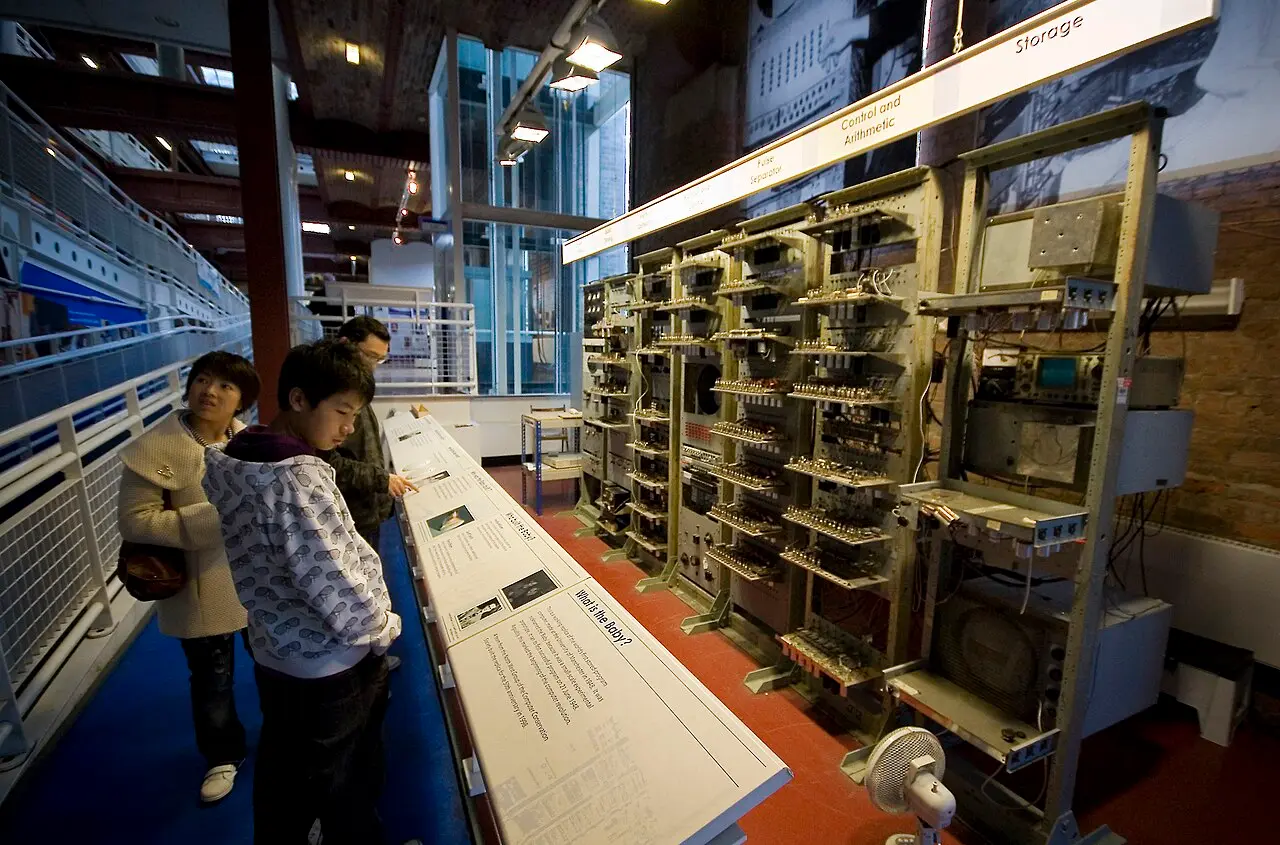
On 21 June 1948, in a room at the University of Manchester, a rack of equipment about the size of a wardrobe ran a program. The program was not in cables or on a switch panel; it was written as patches of electrical charge on the phosphor of a cathode-ray tube. The machine's formal name was the Small-Scale Experimental Machine. Everyone called it the Baby.
F. C. Williams later described that first successful run — quoted on the University of Manchester's fiftieth-anniversary pages — this way: "A program was laboriously inserted and the start switch pressed. Immediately the spots on the display tube entered a mad dance." In early trials it was "a dance of death leading to no useful result", with no clue as to what had gone wrong. "But one day it stopped, and there, shining brightly in the expected place, was the expected answer."
The memory came first; the computer was the test rig
The Baby was not built in order to be a computer. It was built in order to test a memory.
In July 1946, at the Telecommunications Research Establishment in Malvern, Williams began work on storing digits on a cathode-ray tube. Write charge onto the phosphor with the electron beam and you can distinguish a 0 from a 1 — but the phosphor is an insulator, and the charge leaks away in about a second. Williams arranged to read each spot and immediately rewrite it, continuously and at electronic speed, a process he called regeneration. A single-bit store worked in early October 1946, and he filed provisionally that December. The refresh cycle in every DRAM since is a direct descendant.
Williams moved to the chair of Electro-Technics at Manchester in December 1946, and Tom Kilburn, who had been in his group at TRE, was seconded to continue the work with him; Geoff Tootill joined from June 1947. By 1 December 1947 they were holding 2,048 bits on a single standard six-inch tube. An internal report Kilburn wrote at that point — introducing the "dot-dash" and "defocus-focus" methods of operating the tube, together with the design of a hypothetical computer around it — was circulated widely in Britain and the United States and drew considerable interest.
But storing 2,048 bits was not the same as using them. Individual bits could still only be set by hand. What needed proving was that any bit could be written and read at electronic speed and would hold its value indefinitely in between. So they built a small computer around the store as, in their own framing, the most effective and searching test they could devise — and made the machine take its instructions from that same store, which made the test harder still. The Baby is a stored-program computer for reasons that were as much about test coverage as about architecture.
Seven instructions, and no add
- 32-bit words, two's complement, serial binary arithmetic
- Main store of 32 words on one Williams-Kilburn tube, designed to extend to 8,192
- Two further tubes: one for the accumulator A, one holding the current instruction address CI and the present instruction PI. A fourth tube was display only
- Instruction format: a 3-bit function field, a 13-bit store address, and sixteen bits unused
- Seven instructions. There was no add — arithmetic was built from subtraction and negation
- About 1.2 milliseconds per instruction
Input was setting bits at chosen addresses on a simple keyboard. Output was reading the display tube. That was the entire interface.
The first program
Kilburn's program found the highest proper factor of a number a: try every integer b downward from a−1 until one divides a exactly. With no divider in the hardware, each division was done by repeated subtraction. Seventeen instructions in all.
The number they ran it on for the first time, on 21 June, was small. The famous fifty-two-minute run was not that first attempt. Within a few days they had built up to 2^18 — 262,144 — testing around 130,000 candidates, executing about 2.1 million instructions and about three and a half million store accesses, and reaching the correct answer, 131,072, in a fifty-two minute run.
The original program was lost. What survives, and is generally described as the oldest documented program for a stored-program computer, is the version in Tootill's notebook, a revision carrying two extra instructions that made the program easier to rerun. Three demonstration programs are known to have been run on the Baby; one of them, a long-division routine, was written by Alan Turing.
How the "first" has to be qualified
The IEEE Milestone dedicated in 2022 phrases its claim with unusual care: at that site, on 21 June 1948, the Baby "became the first computer to execute a program stored in addressable read-write electronic memory."
Every clause in that sentence is doing work, because each one excludes a neighbour.
- The EDVAC draft of 1945 described the stored-program design, but EDVAC itself did not run until 1951
- ENIAC was converted in 1948 to interpret an order code, but those orders sat in read-only function tables set by hand, not in writable memory
- Colossus (1943) was electronic but special-purpose, and held no program internally
What the Baby demonstrated was two things at once: that the Williams-Kilburn tube was a usable random-access memory, and that a machine could be driven from instructions held in it. The first of those spread fastest — Williams-Kilburn tubes were adopted by sixteen other early computer projects before ferrite cores displaced them.
Into the Mark 1, then Ferranti
Work on a practical machine started immediately, with more people. Built in stages between late 1948 and late 1949, the Manchester Mark 1 was the result, and it pioneered index registers. Its commercial derivative, the Ferranti Mark 1, was delivered to a customer in February 1951 — the first electronic computer marketed as a standard product.
The Baby itself was never preserved; its parts went into the Mark 1. A working replica was built for the fiftieth anniversary in 1998 and now stands in the Science and Industry Museum in Manchester.
Sources
TertiaryManchester Baby — Wikipedia
Last updated: