T1#launch#consumer#market#military
Starlink — SpaceX's Internet From Thousands of Low-Orbit Satellites
Metadata
- Date
- Decade
- 2010s
- Tier
- T1
- Sources
- 12
- Connections
- 01
- Tags
- #launch#consumer#market#military#japan
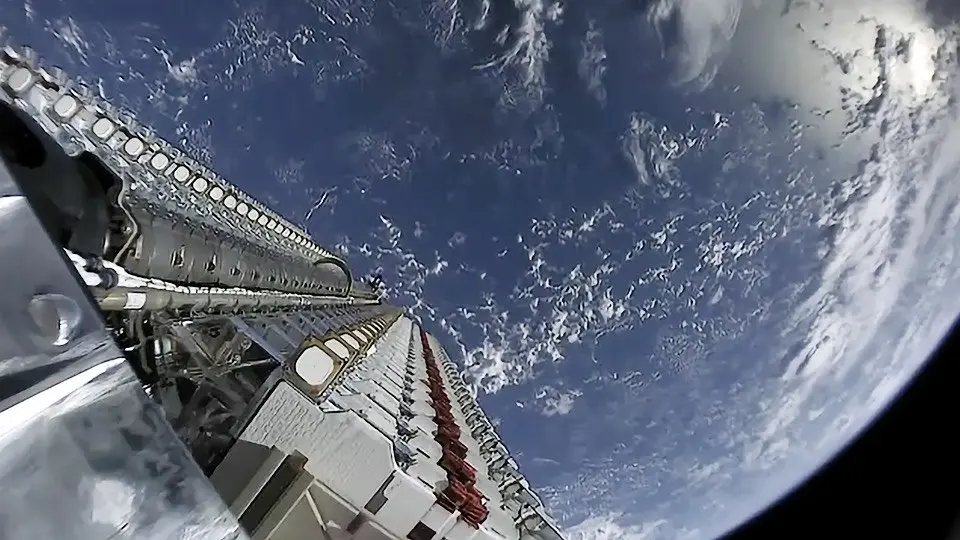
Starlink is SpaceX's satellite internet service. Thousands of small satellites in low orbit, around 550 km up, connect any site with a Starlink dish to the internet. The first 60 operational satellites were launched on a Falcon 9 on the night of 23 May 2019 US Eastern time (24 May in UTC and in Japan). Paid service for the public began in the United States in October 2020, and on 11 October 2022 SpaceX announced the start of service for individuals in Japan.
By October 2026 Starlink had become one of the main businesses of a listed SpaceX. In its third-quarter results of 20 October 2026, SpaceX reported 13.6 million consumer subscribers as of 30 September, about 11,100 satellites in orbit, and coverage in 174 countries.
Before the first launch
According to Wikipedia, Starlink was made public in January 2015, when SpaceX opened a satellite development facility in Redmond, Washington. Two test satellites, Tintin A and B, flew in February 2018, and the first full batch of 60 went up in May 2019.
SpaceNews reported the 60 as the first satellites of an internet constellation that could ultimately number 12,000. In a 2020 statement Japan's National Astronomical Observatory (NAOJ) dated the start of launches to 24 May 2019 and cited an estimate that, with nearly 12,000 satellites in place, about 200 would be visible in the sky at any time.
"Better Than Nothing Beta"
According to CNBC, on Monday 26 October 2020 SpaceX emailed people who had registered interest and opened a public beta. It was called the "Better Than Nothing Beta", priced at US$99 a month plus US$499 for the Starlink Kit of dish, tripod and Wi-Fi router. For the previous few months it had run a private beta for employees. SpaceX's app description said initial service was targeted for the US and Canada in 2020, expanding to near-global coverage of the populated world by 2021. At that point SpaceX had launched nearly 900 Starlink satellites.
Japan and KDDI
In Japan, KDDI was an early partner. According to a BUSINESS NETWORK report of 19 October 2022, KDDI agreed with SpaceX in September 2021 to use Starlink as backhaul for au base stations, and as Japan's only authorised Starlink integrator would also supply businesses and local governments. SpaceX had announced service for individuals in Japan on 11 October 2022, which the report describes as the first in Asia.
Next came direct links between satellites and phones. On 10 April 2025 KDDI and Okinawa Cellular launched au Starlink Direct, connecting au smartphones directly to Starlink satellites, and called it Japan's first direct-to-cell satellite service. According to the announcement, au covers more than 99.9% of the population but only about 60% of the land area because of Japan's terrain, and the service fills in the remaining 40% or so.
Ukraine
In February 2022 Starlink became a wartime lifeline in Ukraine after the Russian invasion. According to CNBC, on Saturday 26 February Mykhailo Fedorov, Ukraine's vice prime minister and minister of digital transformation, asked Musk for Starlink stations, and late that day Musk replied on Twitter: "Starlink service is now active in Ukraine. More terminals en route."
According to Wikipedia, Starlink went on to carry communications for Ukraine's government and military and was used to connect drones and coordinate artillery fire. SpaceX expressed reservations about offensive use beyond military communications and placed technical restrictions on it. Musk said the service was costing US$20 million a month, and in June 2023 the US Department of Defense signed a contract with SpaceX to pay for Starlink use in Ukraine.
Astronomers' concerns
The constellation also changed the night sky. On 3 June 2019 the International Astronomical Union (IAU) issued a statement of concern that large constellations like Starlink could impair astronomical observations. NAOJ followed with its own statement on 9 July 2019 (in English on 13 March 2020): satellites reflect sunlight and appear to optical telescopes as "artificial stars", and radio links between satellites and the ground can interfere with radio astronomy. At Lowell Observatory in Arizona, an image of galaxies had already been crossed by trails of light reflected from Starlink satellites.
SpaceX for its part reported that as of 31 March 2026 its Starlink satellites accounted for about 75% of all active manoeuvrable satellites in orbit.
Starlink in numbers
In SpaceX's filings a subscriber is a unique service line directly assigned to a Starlink.com account; managed enterprise and government customers with negotiated contracts are excluded. From the third quarter of 2026 the measure was renamed "consumer subscribers".
| As of | Subscribers | Satellites | Source |
|---|---|---|---|
| 31 December 2023 | 2.3 million | — | S-1 |
| 31 December 2024 | 4.4 million | — | S-1 |
| 31 December 2025 | 8.9 million | — | S-1 |
| 31 March 2026 | 10.3 million | about 9,600 (broadband and mobile) | S-1 |
| 30 June 2026 | 12.0 million | — | Q2 quarterly report |
| 30 September 2026 | 13.6 million | about 11,100 (including those approved for de-orbit) | Q3 results release |
The third-quarter release notes a change in how satellites are counted: the new definition includes satellites approved for de-orbit, and the old one would have given about 400 fewer. It also says SpaceX has hundreds of thousands of enterprise subscribers on top of the consumer figure.
In revenue, the Connectivity segment, led by Starlink, earned US$11,387 million in 2025 and US$5,248 million in the third quarter of 2026 alone. Average monthly revenue per subscriber (ARPU) fell from US$99 in 2023 to US$81 in 2025, which the S-1 attributes mainly to international expansion and the addition of lower-priced plans.
Inside a listed SpaceX
SpaceX priced its initial public offering at US$135 a share on 11 June 2026, and trading began on Nasdaq the next day under the ticker SPCX. On 2 February it had acquired xAI, which brought X (formerly Twitter) under its roof as well (see X Corp. (formerly Twitter)).
The satellites themselves are changing generation. According to the third-quarter release, Starship Flight 14, the first Starship flight to reach orbit, delivered 26 next-generation Starlink V3 satellites, which SpaceX described as about ten times the downlink capacity added by a Falcon 9 Starlink launch. A separate constellation for mobile phones, about 650 satellites as of 31 March 2026 according to the S-1, is expanding through partnerships with carriers in many countries, KDDI among them.
For the history of the internet's layers see the internet and web timeline; for the man who runs SpaceX, see Elon Musk.
Questions this page answers
- When did Starlink start?
- The first 60 operational satellites were launched on the night of 23 May 2019 US Eastern time (24 May UTC). Paid service for the public began in October 2020 with the Better Than Nothing Beta in the United States.
- When did Starlink come to Japan?
- SpaceX announced service for individuals in Japan on 11 October 2022, reported as the first in Asia. KDDI agreed in September 2021 to use Starlink for au base-station backhaul, and on 10 April 2025 launched au Starlink Direct, linking smartphones directly to the satellites.
- How many subscribers and satellites does Starlink have?
- SpaceX's third-quarter 2026 results reported 13.6 million consumer subscribers and about 11,100 satellites in orbit, including those approved for de-orbit, as of 30 September, plus hundreds of thousands of enterprise subscribers.
- Does Starlink affect astronomy?
- The International Astronomical Union voiced concern on 3 June 2019, and Japan's national observatory noted that satellites appear to telescopes as artificial stars and that their radio links can interfere with radio astronomy.
Sources
Subscribers at the end of 2023 to 2025 and on 31 March 2026, about 9,600 satellites, 164 markets, the subscriber definition, reasons for falling ARPU, about 75%, about 650 mobile satellites, partner carriers including KDDI
PrimarySpaceX Reports Third Quarter 2026 Results — Exhibit 99.1 to Form 8-K, October 20, 2026 — SEC EDGAR
13.6 million subscribers, about 11,100 satellites and the change of definition, 174 countries, Connectivity revenue, Starship Flight 14 and 26 V3 satellites
Launches from 24 May 2019, about 12,000 satellites and about 200 visible, the Lowell Observatory image, the IAU statement of 3 June 2019
Secondary「スマホの衛星通信元年だ」KDDIがStarlinkを法人向けに全国で提供 — BUSINESS NETWORK、2022年10月19日
Service for individuals in Japan from 11 October 2022 (first in Asia), KDDI's September 2021 agreement, the authorised integrator role, about 550 km altitude
TertiaryStarlink — Wikipedia
The January 2015 announcement, the February 2018 test satellites, military use and costs in Ukraine, the June 2023 Defense Department contract
Last updated: