T1#consumer
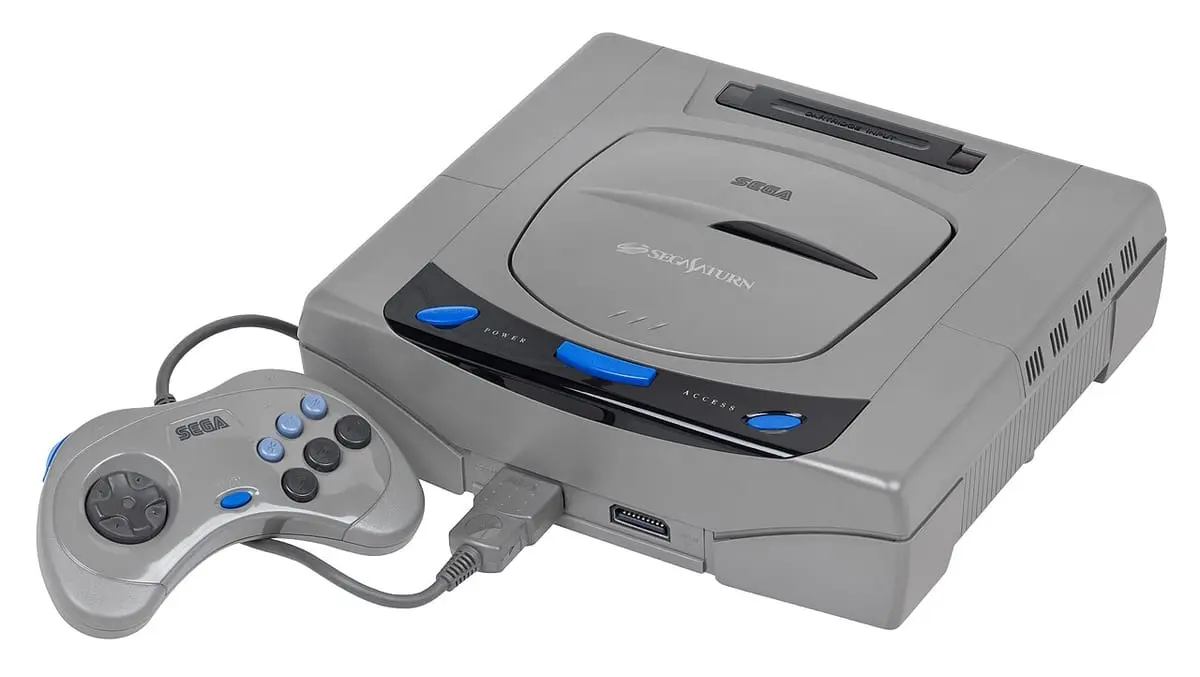
Sega Saturn — Twin SH2s and a Surprise Launch
Metadata
- Date
- Decade
- 1990s
- Tier
- T1
- Sources
- 05
- Connections
- 00
- Tags
- #consumer
The Sega Saturn went on sale in North America on 11 May 1995, at $399 with Virtua Fighter in the box. Japan had it first, on 22 November 1994, at ¥44,800, and Europe followed on 8 July 1995. The North American date was not the one Sega had announced: it was revealed on the day, at a trade show, with the consoles already in some stores.
| Region | Release date | Launch price | Source |
|---|---|---|---|
| Japan | 22 November 1994 | ¥44,800 | Sega's official hardware history |
| North America | 11 May 1995 | $399 (with Virtua Fighter) | Retronauts; heise online |
| Europe | 8 July 1995 | £399.99 | English Wikipedia |
In Japan, Sony's PlayStation followed eleven days later, on 3 December. Sega's own history calls the contest among 32-bit machines the "next-generation console war": Panasonic's 3DO REAL in March 1994, the Saturn in November, the PlayStation and NEC's PC-FX in December, and the Nintendo 64 in June 1996.
A planet's name and two SH2s
According to Sega's official hardware history, the Saturn was developed as Sega's sixth home console and so was named after the sixth planet of the solar system. The same page gives this specification:
| Item | Detail |
|---|---|
| Model number | HST-3210 |
| Main CPU | Two SH2s (28.6 MHz, 25 MIPS) |
| Sound CPU | 68EC000 (11.3 MHz) |
| Memory | 16 Mbit work RAM, 12 Mbit video RAM, 4 Mbit sound RAM |
| Graphics | 320×224 and other modes, 16.77 million colours, dedicated polygon hardware |
| Sound | PCM or FM, 32 channels |
| Drive | Double-speed CD-ROM |
| Power draw | About 15 W |
The page says the pair of 32-bit SH2 processors made possible both polygon-based 3D games and much richer 2D games. In arcades, Sega introduced ST-V, a board compatible with the Saturn, so popular titles could be brought home quickly.
Famitsu's 2020 retrospective notes that the Saturn's 2D drawing matched or exceeded arcade boards, and that fans would sometimes sum up the generation as "2D for the Saturn, 3D for the PlayStation."
Japan: a million in six months
According to Famitsu, Japanese shipments of the Saturn passed one million within six months of launch. Virtua Fighter at launch was followed by arcade conversions such as Daytona USA, Virtua Cop, Virtua Fighter 2 and Sega Rally Championship. Sega itself describes the Saturn as its biggest-selling console in Japan.
Sega was not the only maker. According to Sega's history, Victor (JVC) sold the V-Saturn, and Hitachi sold the Hi-Saturn (1 April 1995, ¥64,800), which added Video CD and Photo CD playback; Hitachi later built a car-navigation version (6 December 1995, ¥150,000). Sega's own redesigned, cheaper model, known as the white Saturn, went on sale on 22 March 1996 at ¥20,000—less than half the launch price, sixteen months on.
North America: four months early
North America went differently. According to Retronauts, Sega of America had announced a launch on 2 September 1995. Then, on 11 May 1995, at its keynote at the first E3 in Los Angeles, CEO Tom Kalinske revealed that 30,000 Saturns, bundled with Virtua Fighter, were already in stores across the country at $399.
English Wikipedia says Sega of Japan had pushed for the early launch to give the Saturn an advantage over the PlayStation.
According to heise online's 2025 retrospective, Sony announced the PlayStation's American price a few hours later at the same show. Steve Race stepped to the microphone, said "299" and left the stage to cheers. At the same event Sony announced a launch on 9 September 1995 in more than 12,000 stores. The Saturn reached North American shelves four months before the PlayStation, but at a price $100 higher.
The early start had a cost. Retronauts says retailers such as Best Buy and Walmart, which received none of the 30,000 consoles, were annoyed, and that only a handful of games were available for months. It concludes that the move gave Sega barely any advantage over Sony.
In Europe too, according to English Wikipedia, the Saturn arrived ahead of the original North American date, on 8 July 1995, at £399.99.
Totals
| Region | Units sold | Source |
|---|---|---|
| Worldwide | 9.26 million | English Wikipedia |
| Japan | 5.75 million | English Wikipedia |
| United States | 1.8 million | English Wikipedia |
These totals could not be confirmed on Sega's own site; all three come from English Wikipedia, which puts Europe at one million. On those figures, Japan accounted for about 60 percent of the total, and the machine never took hold in North America or Europe.
Its successor, the Dreamcast, launched in Japan on 27 November 1998. For the wider story, see the game consoles timeline.
Questions this page answers
- When was the Sega Saturn released?
- In North America it went on sale on 11 May 1995 at $399, after Japan (22 November 1994, ¥44,800). Europe followed on 8 July 1995.
- Why did the Saturn launch early in North America?
- Sega of America had announced 2 September 1995, but at its keynote at the first E3 on 11 May 1995 it said 30,000 consoles were already on sale at selected retailers. English Wikipedia says Sega of Japan had pushed for an early launch to get ahead of the PlayStation. Retailers left out of the shipment were angered.
- How many Sega Saturns were sold?
- English Wikipedia gives 9.26 million worldwide, including 5.75 million in Japan and 1.8 million in the United States. According to Famitsu, Japanese shipments passed one million within six months of launch.
- Where does the name Saturn come from?
- According to Sega's official hardware history, it was Sega's sixth home console, so it was named after the sixth planet of the solar system.
Sources
Primaryセガサターン ── セガハード大百科(セガ公式)
Japanese date and price, the twin-SH2 specification, the origin of the name, Victor's V-Saturn and Hitachi's Hi-Saturn, the 1996 low-cost model
Secondaryセガサターンが発売された日 ── ファミ通.com、2020年11月22日
One million shipped in Japan within six months
Secondary"It's out there..." 22 years since the American launch of the Sega Saturn — Retronauts, May 11, 2017
The 30,000 units at $399 revealed at E3, the original 2 September date, and the retailer backlash
Secondary30 years of "299" - how Sony turned the console market upside down — heise online, May 11, 2025
The PlayStation's $299 announcement at the same E3
TertiarySega Saturn — Wikipedia
European date and price; sales by region
Last updated: