T1#regulation#labor#japan
Japan's Level 4 Law — Driverless "Specified Automated Operation" Legalised
Metadata
- Date
- Decade
- 2020s
- Tier
- T1
- Timelines
- A History of Artificial Intelligence · AI and Society: A History · A History of Self-Driving Cars
- Sources
- 12
- Connections
- 00
- Tags
- #regulation#labor#japan
Level 4 automated driving (high driving automation) is the stage at which the system does all of the driving within set conditions and, when the conditions are about to run out or something fails, brings the vehicle to a safe stop itself instead of handing over to a driver; so no driver is needed. In Japan, the automated-driving provisions of an amended Road Traffic Act (Act No. 32 of 2022), passed in April 2022, took effect on 1 April 2023. They made driverless operation equivalent to Level 4, called "specified automated operation", legal on public roads under permits issued by prefectural public safety commissions. The first permit was issued on 11 May 2023 by the Fukui Prefectural Public Safety Commission for a mobility service in the town of Eiheiji, Fukui, which began running on 21 May. According to Japan's transport ministry (MLIT), by June 2026 Level 4 buses and similar vehicles had been put into service at 11 locations, largely through subsidy programmes, and 12 permits for specified automated operation had been issued.
The definitions of the levels are on the SAE J3016 page, and the 2019 amendments that allowed Level 3 on the Honda Legend page.
The permit system for specified automated operation
According to the National Police Agency, the system works as follows.
| Item | Provision |
|---|---|
| Permit | Anyone conducting driverless automated driving equivalent to Level 4 (specified automated operation) needs a permit from the prefectural public safety commission |
| Application | A specified automated operation plan describing how the operator will meet its obligations and respond to incidents |
| Local voice | Before granting a permit, the commission hears the views of the mayors of the municipalities on the route; it also consults the transport minister on matters such as the operating conditions |
| Remote monitoring | A remote monitoring system staffed by a "chief operator" (unless the chief operator rides on board) |
| Accidents | Duties to call the fire service, send staff to the scene and report to the police |
| Sanctions | Instructions or revocation for violations; after an accident, a police station chief can provisionally suspend the permit |
One of the criteria is that the service carries people or goods and is found to improve the convenience or welfare of local residents.
The vehicle standards differ too. According to MLIT, the Level 3 safety standard requires the system, when automated operation becomes difficult (a malfunction, a sudden change in weather and so on), to warn the driver to take over, so a driver is needed. The Level 4 standard requires it to stop safely in the same situation, so no driver is needed. A Level 4 service needs approval under the Road Transport Vehicle Act and a permit under the Road Traffic Act, and, if it carries passengers, a licence or registration under the Road Transportation Act as well.
Eiheiji: the first Level 4
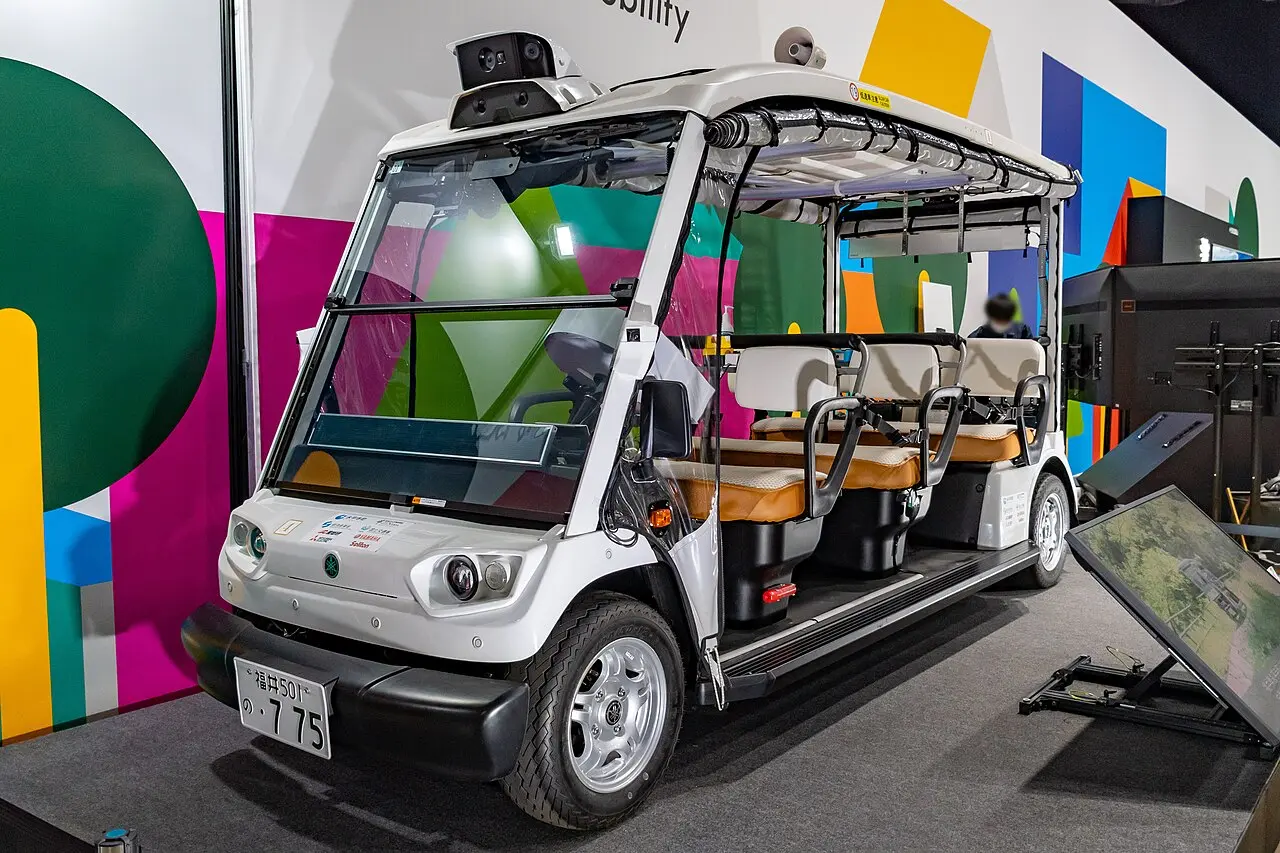
The first case was a small cart running on part of the Eiheiji Mairo-do, a promenade in the town of Eiheiji, the product of trials run by MLIT and the Ministry of Economy, Trade and Industry.
| Date | Step |
|---|---|
| 30 March 2023 | MLIT's Chubu District Transport Bureau approves a vehicle from the National Institute of Advanced Industrial Science and Technology (AIST) as Japan's first Level 4 automated vehicle under the Road Transport Vehicle Act |
| 1 April 2023 | Automated-driving provisions of the amended Road Traffic Act take effect |
| 2 May 2023 | The Fukui Transport Branch registers the paid passenger service run by ZEN Connect, a local development company |
| 11 May 2023 | The Fukui Prefectural Public Safety Commission issues Japan's first Level 4 permit under the Road Traffic Act |
| 21 May 2023 | The driverless Level 4 service begins |
The vehicle is a Yamaha electric cart modified by AIST that follows an electromagnetic induction wire laid in the road at 12 km/h over about 2 km. There is no driver either on board or at a remote site.
On 29 October that year the vehicle hit a parked, unoccupied bicycle. According to the town's investigation as reported by Jidounten Lab, the cart was moving at about 4 km/h and no one was hurt. Radar and other sensors had detected the bicycle, but at that spot the cart braked automatically only when the camera's image recognition agreed, a setting meant to avoid false alarms from oncoming vehicles, and the camera failed to recognise the unoccupied bicycle. Insufficient training data for unoccupied bicycles was among the causes cited; the town adopted measures including additional training and aimed to resume service in March 2024, after the winter break.
Spreading out, 2024–2026
An MLIT document of 8 June 2026 lists the 11 places where Level 4 had been put into service: Eiheiji (Fukui), Kamishihoro (Hokkaido), Kesennuma (Miyagi), Osaka (the Osaka-Kansai Expo), Matsuyama (Ehime), Hitachi (Ibaraki), Ota ward in Tokyo (Haneda), Shiojiri (Nagano), Taki (Mie), Kashiwa (Chiba) and Hitachiota (Ibaraki). Because Shiojiri received a second permit, the permit count is 12.
On 18 December 2024 Ibaraki Kotsu received a permit from the Ibaraki Prefectural Public Safety Commission for specified automated operation on the Hitachi BRT in Hitachi, which the company announced as Japan's first such permit for a commercial vehicle. From 3 February 2025 it began commercial Level 4 service over about 6.1 km of dedicated busway, which it described as the longest Level 4 route in Japan at the time and the first commercial Level 4 service using an ordinary medium-sized bus.
In the Kashiwanoha district of Kashiwa, Chiba, Tobu Bus Central received a permit from the Chiba Prefectural Public Safety Commission on 12 November 2025, and from 13 January 2026 began specified automated operation on some runs of the shuttle between Kashiwanoha-campus station and the University of Tokyo's Kashiwa campus. It uses a medium-sized bus on public roads shared with cars, pedestrians and cyclists; the consortium led by the University of Tokyo describes it as the first Level 4 service on public roads in the Tokyo metropolitan area.
For taxis in Tokyo, Waymo, GO and Nihon Kotsu have announced that they aim to run fully driverless service during 2027; that story is on the Waymo page.
Who is it for? Driver shortages and the economics
In its Digital Garden City Nation strategy (approved by the Cabinet in December 2022) the government set a target of automated mobility services at about 50 locations by around fiscal 2025 and more than 100 by fiscal 2027, and MLIT called 2023 the "first year of automated-driving deployment". The target is written as a number of "automated mobility services", so it is not necessarily the same measure as the 11 Level 4 locations MLIT reported in June 2026. According to an analysis by SOMPO Institute Plus, most of the projects subsidised in fiscal 2024 ran at Level 2, with safety staff on board.
Behind the push is a shortage of people to run local transport. An estimate that the Nihon Bus Association submitted to a government council in October 2023 found that maintaining 2022 service levels while meeting new caps on overtime (the so-called "2024 problem") would require about 129,000 bus drivers in 2030, against a projected 93,000, a shortfall of about 36,000 (28%). The association warned that without enough drivers, route buses would be cut back or abandoned. Driverless Level 4 is expected first of all to fill that gap.
The economics, though, are hard. In an April 2025 analysis, Mai Shinzoe of SOMPO Institute Plus noted that introducing a single automated vehicle is said to cost from tens of millions of yen to over ¥100 million, and that the national subsidy rate was falling from 100% to 80%. She wrote that supporting automated services from fare revenue is extremely difficult, and suggested that Japan's step-by-step approach, starting in low-risk restricted spaces, helps explain the gap with the United States, where driverless taxis run in city centres.
| Aspect | Hopes | Concerns |
|---|---|---|
| Local transport | Keeping routes running despite the driver shortage (as the Nihon Bus Association's estimate implies) | Costs said to run from tens of millions of yen to over ¥100 million per vehicle, and shrinking subsidies (SOMPO Institute Plus) |
| Safety | The system is responsible all the way to a stop; remote monitoring and accident duties are set in law | As the Eiheiji contact showed, recognising unexpected objects remains a problem |
| Reach | From a 12 km/h cart to medium-sized buses on ordinary roads | Level 4 had reached only 11 locations by June 2026 |
In Japan, Level 4 has been framed less as taking drivers' jobs than as making up for drivers who will not be there. Whether that framing holds depends on whether driverless operation can pay its way. More on AI and society is in the AI and society timeline.
Questions this page answers
- What is Level 4 automated driving?
- It is the stage at which the system does all of the driving within set conditions and, when they are about to run out or something fails, stops the vehicle safely by itself instead of handing over to a driver, so it can run with no driver. Japanese law calls it specified automated operation.
- When did Japan legalise Level 4?
- The automated-driving provisions of the amended Road Traffic Act, passed in April 2022, took effect on 1 April 2023. Since then driverless automated driving has been allowed with a permit from a prefectural public safety commission.
- Where was Japan's first Level 4 service?
- Eiheiji in Fukui Prefecture. The vehicle was approved as Level 4 on 30 March 2023, the Fukui Prefectural Public Safety Commission issued Japan's first permit on 11 May, and a driverless service began on 21 May. It is an electric cart that follows an induction wire at 12 km/h over about 2 km.
- Where does Level 4 run in Japan today?
- According to an MLIT document of 8 June 2026, Level 4 was in service at 11 locations: Eiheiji, Kamishihoro, Kesennuma, Osaka (the Expo), Matsuyama, Hitachi, Ota ward in Tokyo (Haneda), Shiojiri, Taki, Kashiwa and Hitachiota, with 12 permits issued.
Sources
Primary自動運転 — 警察庁
Act No. 32 of 2022, passed in April 2022, with the automated-driving provisions in force from April 2023; creation of the permit system
Primary特定自動運行に係る許可制度の創設について — 警察庁
The permit, the operating plan, consultation with mayors and the transport minister, the chief operator, accident duties, permit criteria and sanctions
Primary国内初!運転者を必要としない自動運転車(レベル4)の認可について — 国土交通省, 2023年3月31日
Approval by the Chubu District Transport Bureau on 30 March 2023, the vehicle and route, the difference between the Level 3 and Level 4 standards, and the 'first year of deployment'
Primary国内初!運転者を配置しないレベル4での自動運転移動サービスの開始について — 国土交通省, 2023年5月12日
Registration on 2 May, the Fukui permit on 11 May, service from 21 May; 12 km/h, about 2 km, timetable and fares
Primary自動運転の普及に伴う社会変容への対応について(参考資料)— 国土交通省, 2026年6月8日
The list of 11 Level 4 locations, and 12 permits including Shiojiri's second
Primary今後の取り組み方針(資料3)— 国土交通省
The government target of about 50 locations by around fiscal 2025 and over 100 by fiscal 2027 (Digital Garden City Nation strategy, December 2022)
Primary国内最長距離&国内初の中型バスでのレベル4自動運転の営業運行 — 茨城交通ほか(日本総合研究所), 2025年1月24日
The Ibaraki permit of 18 December 2024, commercial service from 3 February 2025, about 6.1 km of busway
Primary東京都市圏の公道で初!柏の葉地区で特定自動運行(自動運転レベル4)の運行開始 — 東京大学ほか, 2026年1月13日
The Chiba permit of 12 November 2025, service from 13 January 2026, and the claim of a first for the Tokyo metropolitan area
Primary国土幹線道路部会 ヒアリング資料 — 公益社団法人日本バス協会, 2023年10月5日
The 2030 bus-driver estimate (129,000 needed, 93,000 available, 36,000 short, 28%) and the warning of cuts
Secondary日本の自動運転レベル4は、どこまで進んだか(1)~マイルストーンの2025年、国交省は補助金の減額で自治体の自立を促す~ — SOMPOインスティチュート・プラス, 2025年4月18日
Costs said to run from tens of millions of yen to over ¥100 million, the subsidy rate cut from 100% to 80%, the difficulty of fare revenue, and most fiscal-2024 projects at Level 2
Secondary日本初レベル4の自動運転事故、「追加学習」で来年3月再開へ — 自動運転ラボ, 2023年11月15日
The 29 October 2023 contact, causes and measures from the town's investigation, and the March 2024 restart goal
Last updated: