T1#regulation#consumer#japan
Honda Legend — A Type-Designated Level 3 Car Goes on Sale
Metadata
- Date
- Decade
- 2020s
- Tier
- T1
- Sources
- 11
- Connections
- 00
- Tags
- #regulation#consumer#japan
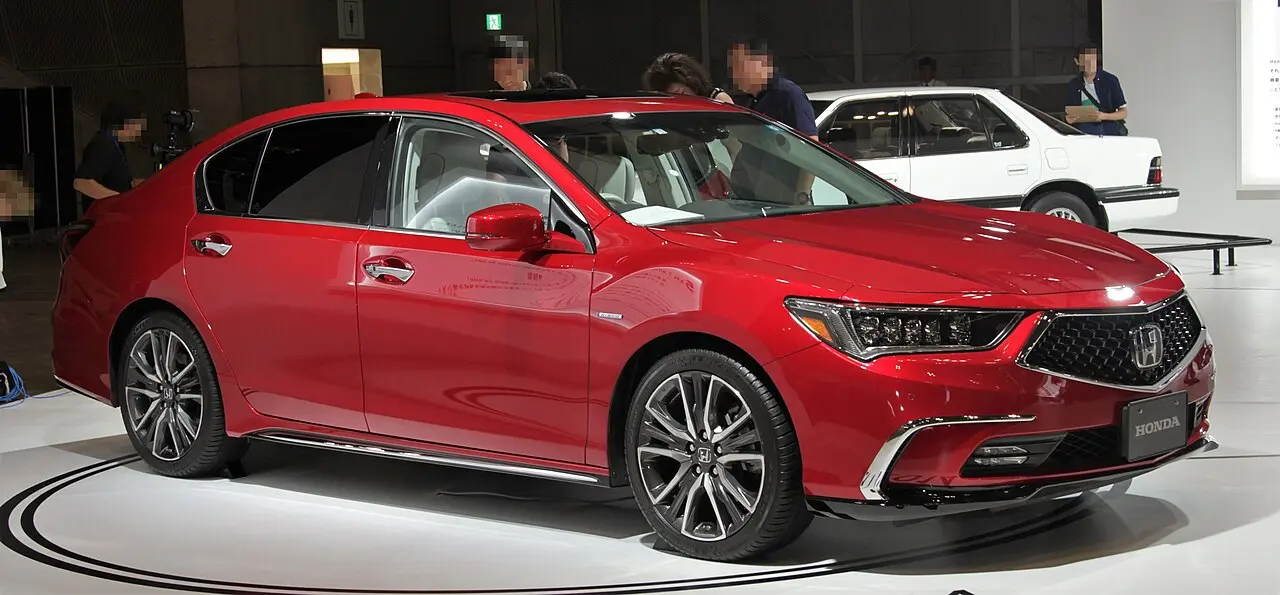
Level 3 automated driving (conditional driving automation) is the stage at which the system does the driving within limited conditions, such as congested expressway traffic, and the driver takes back control when the system asks, for instance as those conditions are about to end. The first production car to offer it in Japan was the Legend Hybrid EX・Honda SENSING Elite, which Honda put on sale on 5 March 2021. It was announced the day before, on 4 March; it was offered only by lease and only in Japan, with a planned run of 100 cars at a suggested retail price of ¥11,000,000 including consumption tax. Its congestion function, Traffic Jam Pilot, had received type designation as an automated operation device from Japan's Ministry of Land, Infrastructure, Transport and Tourism (MLIT) on 11 November 2020, which the ministry announced as the world's first type designation for a vehicle equipped with an automated operation device.
The definitions of the levels are on the SAE J3016 page. This page covers the legal changes that made Level 3 usable on Japanese roads, and what the Legend actually did.
The 2019 amendments that made Level 3 possible
Selling a Level 3 car required changing both the vehicle safety standards and the rules for drivers. Amendments to the Road Transport Vehicle Act and the Road Traffic Act were both passed by the Diet in May 2019, and their automated-driving provisions took effect in April 2020.
| Law | Main provisions |
|---|---|
| Amended Road Transport Vehicle Act (Act No. 14 of 2019) | Adds the "automated operation device" to the devices covered by the safety standards. Requires that it not operate outside its operating conditions; that it warn the driver to take over before leaving them and, if no one takes over, stop safely; driver monitoring; cybersecurity measures; and a data recorder (six months or 2,500 events) |
| Amended Road Traffic Act (Act No. 20 of 2019) | Defines operating a car with an automated operation device as "driving". Prohibits its use when the conditions set by the transport minister are not met. Lifts the ban on using mobile phones and similar only when, among other things, the driver is ready to deal properly and immediately with leaving the conditions. Requires the operating data to be recorded and kept |
The National Police Agency explains that, together with the vehicle-law amendment, these provisions allowed SAE Level 3 vehicles to travel safely on the road. Internationally, the UN's World Forum for Harmonization of Vehicle Regulations (WP29) adopted an international standard for automated operation devices in June 2020; MLIT says Japan led the discussion in its expert groups.
The Legend's Traffic Jam Pilot
These were the main operating conditions MLIT published with the type designation.
| Item | Condition |
|---|---|
| Roads | National expressways, urban expressways and motorways connected to them (some sections excluded) |
| Excluded | Sections without a median or other structure separating oncoming traffic, sharp curves, service and parking areas, toll gates and so on |
| Weather | No heavy rain, snow, dense fog or strong backlight that would prevent the system recognising vehicles and the roadway |
| Traffic | The lane is congested or nearly so, with the vehicles ahead and behind travelling near the centre of the lane |
| Speed | Below about 30 km/h before activation, about 50 km/h or less after |
| Other | High-definition map and satellite positioning (GNSS) data available; driver seated correctly with seat belt fastened |
According to Honda, when the car meets congestion, Traffic Jam Pilot operates the accelerator, brakes and steering while monitoring the surroundings, keeping to the lane and following, stopping and restarting with the car ahead. Meanwhile the driver may watch TV or a DVD on the navigation screen or search for a destination. When the conditions end, indicator lights and sounds ask the driver to take over; if the driver keeps failing to respond, the car slows and stops while warning others with its hazard lights and horn, moving towards the left lane if there is a shoulder.
Honda said development involved some 10 million simulated scenarios and about 1.3 million km of expressway testing with test vehicles; these are Honda's own figures. The car carried blue accessory lamps to signal that it had an automated operation device, and MLIT asked manufacturers to put a sticker identifying automated vehicles on the rear.
How far "world's first" goes
MLIT's wording is a bounded one: the world's first type designation for a vehicle equipped with an automated operation device. Germany had opened its Road Traffic Act to Level 3 in 2017, but Mercedes-Benz received system approval from the German authority under the UN regulation UN-R157 only in December 2021, and began taking orders in Germany in May 2022 (see the DRIVE PILOT page). The Legend came earlier, but as a 100-car lease offer in Japan only.
| Date | Event |
|---|---|
| May 2019 | Amended Road Transport Vehicle Act and Road Traffic Act passed |
| 1 April 2020 | Amended vehicle act and the safety standard for automated operation devices take effect (the traffic-act provisions also took effect that month) |
| 11 November 2020 | MLIT grants type designation to the Legend as a vehicle with an automated operation device |
| 4 March 2021 | Honda announces the car |
| 5 March 2021 | Lease sales begin in Japan (100 cars) |
Afterwards: end of production, and a robotaxi plan
The Legend did not stay in production for long. According to Car Watch in June 2021, Honda decided, with the closure of its Sayama vehicle plant, to end production of three models including the Legend within 2021, and had notified dealers at the end of March. Consolidating the plants was a policy it had announced in 2017.
Honda then turned from Level 3 in private cars to driverless mobility services. On 19 October 2023 it announced a memorandum of understanding with GM and GM's Cruise aimed at forming a joint venture to start a driverless ride-hailing service in central Tokyo in early 2026. The plan was to start with dozens of Cruise Origin vehicles, which have no driver's seat or steering wheel, and expand to 500. On 10 December 2024, however, GM announced that it would no longer fund Cruise's robotaxi development; that story is on the Cruise suspension page. In Tokyo, a different group is now aiming for driverless taxis during 2027 (see the Waymo page).
Impact on society
In announcing the type designation, MLIT wrote that automated vehicles are expected to help solve social problems such as reducing traffic accidents, securing mobility for older people and raising productivity in logistics. What the Legend showed was a step short of that: in one narrow situation, a congested expressway, it freed the driver from watching the road and reduced fatigue and stress.
Level 3 does not release the driver from driving altogether. The National Police Agency warns that when the conditions of use stop being met the driver is required to take over immediately and reliably, and urges drivers to understand each device's conditions and performance correctly. MLIT's own announcement stated that drivers must not overtrust the system and must always remain able to drive. On compensation after a crash, an MLIT study group concluded in 2018 that operator liability under the Automobile Liability Security Act should be kept during the transition up to Level 4 (see the SAE J3016 page).
At 100 cars, the Legend could not visibly change accidents or the burden of driving across society. Its significance is that it put on public roads a production car in which watching TV while the system drives was, within conditions, legally allowed, with type designation, safety standards and traffic rules all in place. The next step in the rules was the 2023 amendment to the Road Traffic Act that put driverless Level 4 under a permit system.
Questions this page answers
- What is Level 3 automated driving?
- It is the stage at which the system does the driving within limited conditions, such as congested expressway traffic, and the driver takes over when the system requests it, for example as the conditions end. SAE J3016 calls it conditional driving automation. The driver need not monitor the road but must stay ready to take over.
- When did Honda's Level 3 Legend go on sale?
- It was announced on 4 March 2021 and went on sale in Japan on 5 March, by lease only, with 100 cars planned at a suggested retail price of ¥11,000,000 including tax. MLIT's type designation came on 11 November 2020.
- Under what conditions could the Legend's Level 3 be used?
- On national and urban expressways and connected motorways, with the lane congested or nearly so, below about 30 km/h before activation and about 50 km/h or less after, no bad weather, high-definition map and satellite positioning available, and the driver wearing a seat belt, among other conditions.
- Was the Legend really the world's first Level 3 car?
- MLIT's wording is the world's first type designation for a vehicle equipped with an automated operation device. Sales were limited to 100 leased cars in Japan. Mercedes-Benz received approval in Germany under the UN regulation UN-R157 in December 2021 and began taking orders in May 2022.
Sources
Primary世界初! 自動運転車(レベル3)の型式指定を行いました — 国土交通省, 2020年11月11日
MLIT's world's-first wording, review by the National Traffic Safety and Environment Laboratory, the social goals, and the warning against overtrust
Primary【別紙3】自動運行装置の概要 — 国土交通省, 2020年11月11日
Traffic Jam Pilot's operating conditions (roads, exclusions, weather, congestion, speed, map and GNSS, driver state)
Primary【別紙2】自動運行装置の保安基準の概要 — 国土交通省, 2020年11月11日
Passage (May 2019) and entry into force (April 2020) of the law, the safety standard, the data recorder, and the June 2020 international standard
PrimaryHonda SENSING Elite 搭載 新型「LEGEND」を発売 — Honda, 2021年3月4日
On sale 5 March, 100 cars, lease only, ¥11 million, how Traffic Jam Pilot works, TV and DVD viewing, emergency stop assist, about 10 million simulations and 1.3 million km of testing
Primary自動運転レベル3 型式指定を国土交通省から取得 — Honda, 2020年11月11日
The amended Road Transport Vehicle Act (Act No. 14 of 2019) in force from 1 April 2020, and the main points of the safety standard
Primary自動運転 — 警察庁
Act No. 20 of 2019, passed in May 2019 and in force from April 2020; the explanation that it provided for SAE Level 3; the warning to drivers
Primary道路交通法の一部を改正する法律(令和元年法律第20号)概要 — 警察庁
Definition of the automated operation device, prohibition outside the conditions of use, the exemption from the mobile-phone ban, and the data recorder
Last updated: