Standard · 12 events
A History of Cloud Computing
1990s

Christopher Michel (Flickr, via Wikimedia Commons) · CC BY 2.0 · Commons ↗ Marc Benioff, a former Oracle executive, incorporated salesforce.com on 8 March 1999 with Parker Harris, Frank Dominguez and Dave Moellenhoff. Their base was a rented one-bedroom apartment at 1449 Montgomery Street on San Francisco's Telegraph Hill. The company delivered customer relationship management (CRM) as a service used through a web browser, with nothing to install, and campaigned under a 'No Software' logo and the theme of its official launch on 7 February 2000, 'The End of Software'. Salesforce did not invent hosted software, but it put the model of using enterprise software as a service, rather than installing it on your own servers — later called SaaS — at the front of its pitch. It went public on the NYSE on 23 June 2004, then grew from an application into a platform with AppExchange in 2005 and Force.com in 2008.
2000s

Amazon.com Inc. (Wikimedia Commons) · Apache License 2.0 · Commons ↗ On 14 March 2006 Amazon Web Services launched Amazon S3, object storage that any developer could rent over the web: no upfront cost, no minimum fee, $0.15 per GB stored per month and $0.20 per GB transferred. Objects ran from 1 byte to 5 GB, were stored and retrieved over REST and SOAP, and the service was designed for 99.99% availability. The AWS name dated from a July 2002 product-catalogue API, and SQS had been in beta since November 2004, but S3 was the first time Amazon sold its infrastructure itself, metered, to outsiders. EC2, renting compute by the hour, entered limited beta on 25 August 2006. Storage in Europe followed on 6 November 2007, and a Tokyo Region on 2 March 2011.
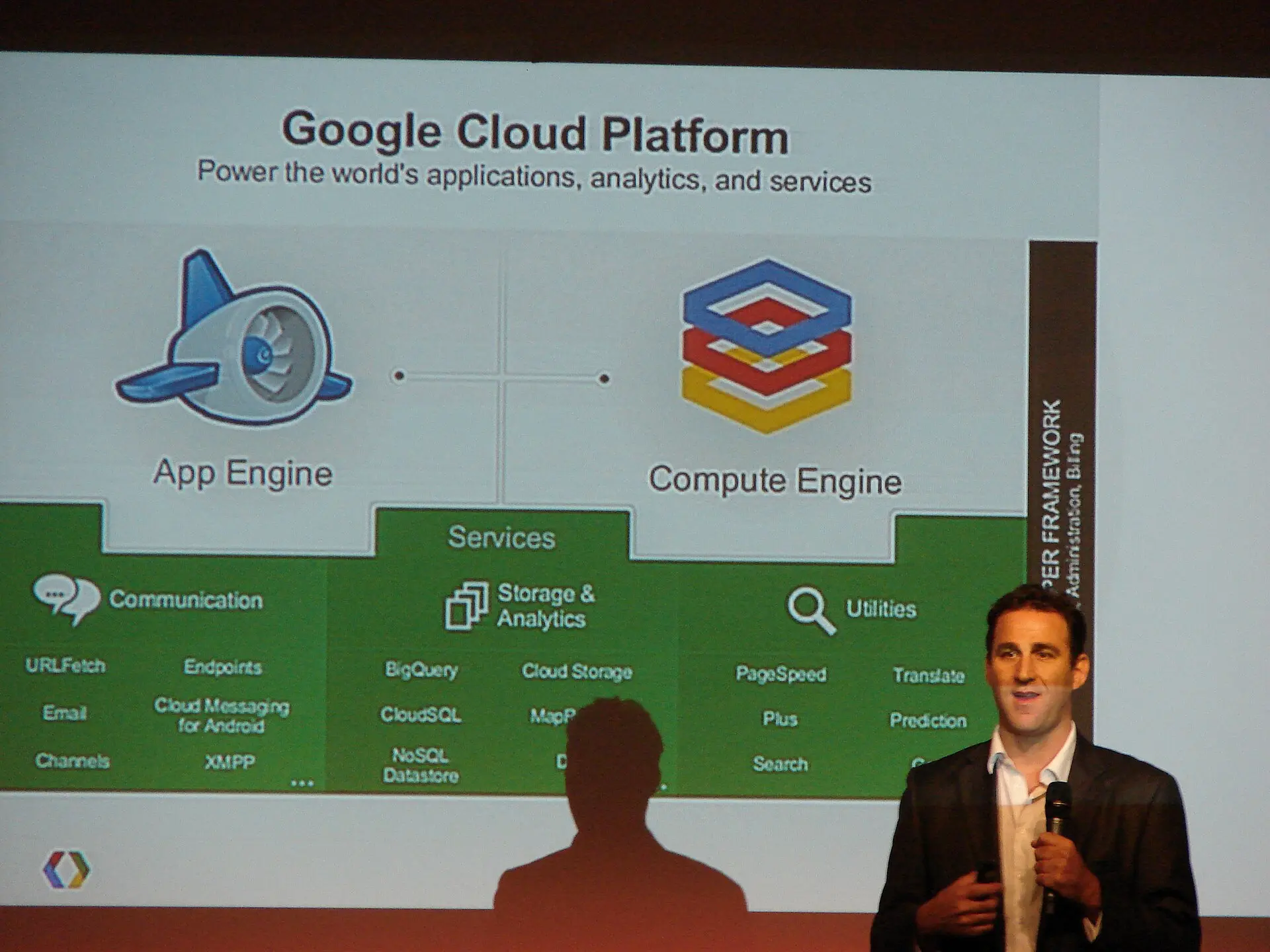
Copyleft (Wikimedia Commons) · CC0 1.0 Public Domain Dedication · Commons ↗ Google launched App Engine as a preview at its Campfire One developer event on the evening of 7 April 2008. Developers wrote a web application and Google's infrastructure ran it, handling scaling and storage — an early, prominent example of what is now called platform-as-a-service. The preview was limited to the first 10,000 developers, with free quotas of 500 MB of storage, 200 million CPU megacycles a day and 10 GB of bandwidth a day, and data lived in a store built on Bigtable and GFS. Python was the only language; Java arrived as an early look on 7 April 2009, and App Engine left preview to become a fully supported product with release 1.6.0 on 7 November 2011, which also introduced a 99.95% SLA for paid applications.
- EVT.004T1Go Released as Open Source — GoogleA History of Programming LanguagesRead more →
2010s

Microsoft Corporation · Public domain (PD-textlogo; trademarked) · Commons ↗ On 27 October 2008, at PDC in Los Angeles, Ray Ozzie unveiled Windows Azure and the Azure Services Platform and opened a limited preview. Microsoft announced pricing in July 2009 ($0.12 per compute hour, $0.15 per GB of storage a month and more), gave customers a free January 2010, and on 1 February 2010 Windows Azure and SQL Azure became generally available in 21 countries with full SLAs, and billing began. Japan East and Japan West were announced as generally available on 25 February 2014, and the service was renamed Microsoft Azure on 3 April 2014. By Synergy Research Group's estimate, Microsoft held about 20% of the cloud infrastructure services market in the fourth quarter of 2020, second to Amazon.
dotCloud, Inc. (Wikimedia Commons) · Apache License 2.0 · Commons ↗ On 15 March 2013, Solomon Hykes of the PaaS company dotCloud showed Docker in public for the first time, in a five-minute lightning talk at PyCon US 2013 in Santa Clara titled 'The future of Linux Containers'. Docker did not invent containers. cgroups, which enforce resource limits, were begun at Google in 2006 by Paul Menage and Rohit Seth as 'process containers' and merged in Linux 2.6.24 in January 2008; namespaces, which provide isolation, had been added step by step since 2.4.19 in 2002. Early Docker used them through LXC and only made its own libcontainer the default in version 0.9 on 10 March 2014. Docker's contribution was to put that machinery within reach of ordinary developers through image building, image distribution and an easy CLI. v0.1.0 was tagged on 26 March 2013, dotCloud became Docker, Inc. on 29 October 2013, and 1.0 shipped on 9 June 2014.


2020s

Amazon.com Inc. (Wikimedia Commons) · Apache License 2.0 (trademark applies) · Commons ↗ Amazon Web Services unveiled Amazon Bedrock—a unified API providing access to multiple foundation models (Anthropic's Claude, AI21 Jurassic, Stability's Stable Diffusion, Amazon Titan, and others). Customers could invoke foundation models serverlessly without removing their data from AWS. As a counter to the Microsoft–Azure–OpenAI exclusivity, Bedrock was AWS's strategic statement of a 'many models, one platform' approach. Combined with the up-to-US$4-billion investment in Anthropic in September 2023, Bedrock became the flagship of the multi-model camp.
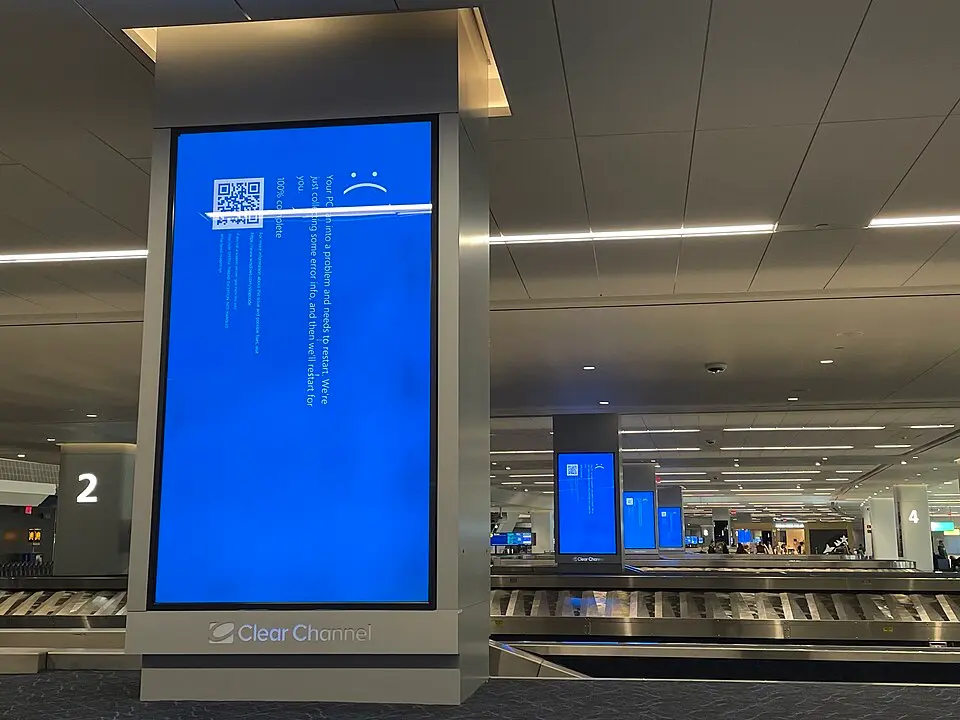
Smishra1 (Wikimedia Commons) · CC BY-SA 4.0 · Commons ↗ At 04:09 UTC on 19 July, a faulty content update (Channel File 291) that CrowdStrike shipped to its Falcon Sensor put Windows machines worldwide into blue screens and bootloops. What failed was not a kernel driver update but a data file the driver reads to define detection logic — that distinction is the heart of the incident. The figure of 8.5 million affected devices is Microsoft's estimate, which it put at less than one percent of all Windows machines. Aviation, hospitals, bank ATMs, emergency call handling and broadcast went down together; Delta Air Lines cancelled around 7,000 flights over five days and put its own losses at more than US$500 million. On economic damage, Parametrix estimated US$5.4 billion in direct losses to Fortune 500 companies excluding Microsoft; no authoritative global total exists. Recovery meant manual Safe Mode work on each machine, plus BitLocker recovery keys where drives were encrypted. The incident pushed the design question of EDR kernel privilege onto the public agenda.
- EVT.011T1The Three Mile Island Unit 1 Restart Deal — Data Centres Call a Reactor BackA History of Artificial IntelligenceA General History of Information TechnologyAI and Society: A HistoryRead more →
- EVT.012T1The Trump AI Pivot — Biden's Order Rescinded, Stargate's $500 Billion PledgeA History of Artificial IntelligenceA General History of Information TechnologyRead more →