PERSON
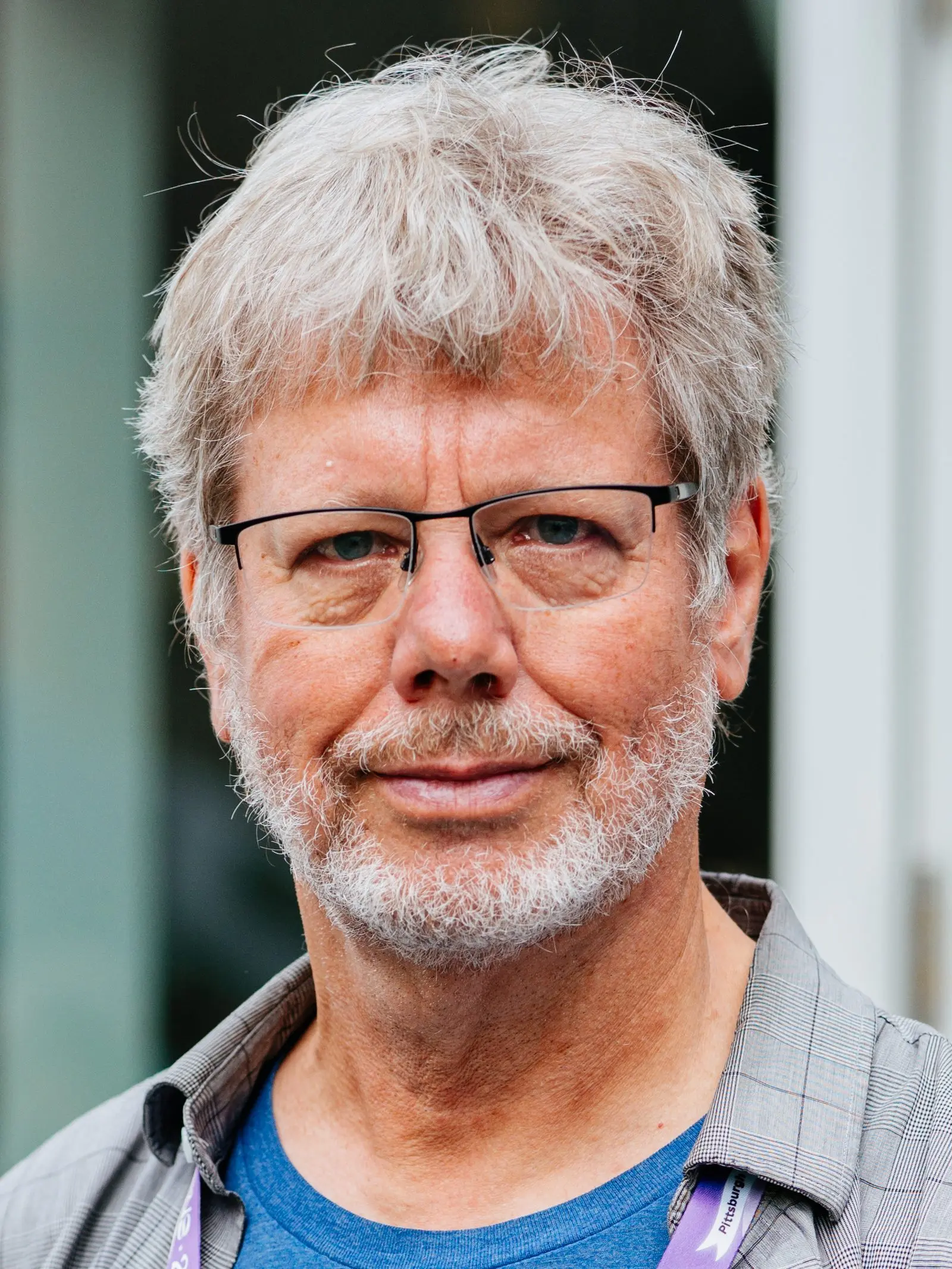
Guido van Rossum
Creator of Python. He began writing it at CWI in the Netherlands in December 1989 and posted 0.9.0 to alt.sources on 20 February 1991. After CWI came CNRI, BeOpen.com, Zope, Elemental Security, Google, Dropbox and Microsoft; he left Microsoft in May 2026 and is retired. He long held the title 'Benevolent Dictator For Life' of the Python community, stepping down in July 2018; the first Steering Council was elected in February 2019 and took over governance.
Profile
- Born
- 1956
- Status
- Living
- Span
- 1956–
- Appearances
- 02
- Name
- ENGuido van RossumJAグイド・ヴァンロッサム
Guido van Rossum (b. 31 January 1956) is the creator of the Python programming language. What he began over the Christmas holiday of 1989 as a "hobby" project at CWI (Centrum voor Wiskunde en Informatica) in Amsterdam has, in thirty-odd years, become one of the most widely used general-purpose languages in the world. Within the Python community he long styled himself the "Benevolent Dictator For Life" — BDFL — until he stepped down from that role in 2018.
Background
Van Rossum was born in The Hague on 31 January 1956 and grew up in Haarlem. His younger brother, Just van Rossum, is a type designer and programmer who drew the typeface used in the "Python Powered" logo. He took a bronze medal at the 1974 International Mathematical Olympiad, and read mathematics and computer science at the University of Amsterdam, taking his master's degree in 1982.
By his own record he worked part-time for SARA from 1977 to 1982, then joined the ABC group at CWI from 1982 to 1986 — ABC being the language and environment for non-expert programmers led by Lambert Meertens and Steven Pemberton. From 1986 to 1991 he was on Sape Mullender's Amoeba distributed operating system project, and from 1991 to 1995 in Dick Bulterman's multimedia group.
Python is a by-product of the Amoeba years. In his own account he was, in December 1989, "looking for a 'hobby' programming project that would keep me occupied during the week around Christmas", and began writing an interpreter for "a descendant of ABC that would appeal to Unix/C hackers". The name is not the snake: he chose it "being in a slightly irreverent mood (and a big fan of Monty Python's Flying Circus)". No account of his mentions a television rebroadcast. Python 0.9.0 was posted to the Usenet group alt.sources on 20 February 1991.
Major contributions
Python (1991-)
Python's design choices have been debated for longer than most languages have existed. The use of indentation rather than braces produced complaint at first but is now usually treated as the discipline that enforces readability. Dynamic typing, "first-class everything" (functions, classes and modules are all objects), and the "batteries-included" standard library combined to blur the line between scripting language and general-purpose language.
In 1995 van Rossum moved to the United States to continue Python work at CNRI in Reston, Virginia — formally as a NIST guest researcher stationed at CNRI until February 1998, and as a CNRI employee from March 1998. In this period he wrote the DARPA-funded proposal "Computer Programming for Everybody" and built Grail, the first web browser written in Python. The Python 2.0 release in 2000 — and the licence questions surrounding it — led directly to the founding of the Python Software Foundation in 2001.
Python 3.0 shipped in 2008. It deliberately broke backwards compatibility — strings became Unicode by default, print became a function, integer division changed behaviour. The transition from Python 2 generated extraordinary friction and took more than a decade; Python 2.7 was finally end-of-lifed on 1 January 2020.
The language's dominance in machine learning and data science (NumPy, pandas, PyTorch, TensorFlow) has since made it the de facto "language of data". It first reached number one in the TIOBE index in October 2021; on GitHub's annual Octoverse count it overtook JavaScript as the most used language only in 2024 — the two indices are three years apart on when Python arrived at the top.
Career
The dates below are from his own resume.
- April 1995 – February 1998 — NIST guest researcher, stationed at CNRI, Reston, Virginia.
- March 1998 – May 2000 — employee of CNRI.
- May – October 2000 — Director of PythonLabs at BeOpen.com.
- October 2000 – July 2003 — Director of PythonLabs at Zope Corporation.
- July 2003 – December 2005 — Senior Language Architect at Elemental Security, where he wrote the Python version of pgen that became
lib2to3/pgen2/in the standard library. - December 2005 – December 2012 — Google, Senior Staff Engineer; half his time on Python, plus the Mondrian and Rietveld code review tools and App Engine's NDB.
- January 2013 – October 2019 — Dropbox, Principal Engineer; mypy, and the migration of over five million lines of server-side code from Python 2 to Python 3.
- October 2019 – October 2020 — retired (first attempt).
- November 2020 – May 2026 — Microsoft, Distinguished Engineer, first in the Developer Division and later in the Office of the CTO.
- May 2026 — retired again. His own site now says: "I am permanently retired."
Stepping Down as BDFL (2018)
On 12 July 2018, van Rossum posted a brief note titled "Transfer of Power" to the python-committers list, saying he wanted "to remove myself entirely from the decision process". The trigger was the bitter debate over PEP 572, which proposed the walrus operator (:=). The post opens: "Now that PEP 572 is done, I don't ever want to have to fight so hard for a PEP and find that so many people despise my decisions."
The most-quoted passage follows his refusal to name a successor:
I am not going to appoint a successor.
So what are you all going to do? Create a democracy? Anarchy? A dictatorship? A federation?
And the last line: "I'm tired, and need a very long break." PEP 572 itself was accepted. The BDFL post was never refilled; governance passed to the five-member Steering Council elected in February 2019 — on which van Rossum himself served through 2019, withdrawing from the 2020 election.
Awards and honours
- May 1999 — Dr. Dobb's Journal Excellence in Programming Award.
- 2001 — FSF Award for the Advancement of Free Software (presented at FOSDEM in 2002).
- May 2003 — NLUUG Award.
- 2006 — ACM Distinguished Engineer.
- 2018 — Fellow of the Computer History Museum.
- 2019 — Dijkstra Fellow, CWI.
- 2023 — NEC C&C Prize.
He has not received the ACM Turing Award.
Faster CPython, and its end
At Microsoft, van Rossum led the formation of the Faster CPython team — an effort founded on Mark Shannon's proposal to make Python five times faster in four years (the "Shannon Plan") that delivered steady gains from CPython 3.11 (2022) onwards; 3.14 is reckoned roughly 20–40% faster than the 3.10 the project started from. The most ambitious threads were the experimental Tier-2 JIT and the removal of the Global Interpreter Lock (PEP 703 "free-threading", experimentally available since 3.13).
In May 2025 Microsoft ended its sponsorship as part of a broad redundancy round and most of the team was laid off; the core developers affected included Mark Shannon, Eric Snow and Irit Katriel. Within days a "Community Stewardship of Faster CPython" discussion opened on discuss.python.org, moving benchmarking infrastructure to the Python Software Foundation and reconstituting the work as a fortnightly, volunteer-led effort. The arrangement in which one corporate team owned the performance of a language runtime ended there.
Legacy
What van Rossum embodied was a clear departure from the conventional language aesthetics of his day — the dense expressivity of Perl, the structural austerity of C++, the symbolic elegance of the Lisps — in favour of an almost moral insistence on readability. "Explicit is better than implicit" and "Readability counts", from Tim Peters's Zen of Python, are in effect a retrospective verbalisation of his design choices.
Python is the working language of practically every part of the 2020s AI surge. PyTorch, NumPy, pandas, Hugging Face's transformers library and much of the serving code behind the major LLM products are Python. He did not set out to design a language for AI; the starting point was dissatisfaction with ABC and a want of a high-level language that Unix/C hackers could actually use. That incidental fit reorganised the computer culture of the early twenty-first century around Python.
The BDFL title — and its voluntary surrender — also marks an important moment in the cultural history of open source. The contrast with Linus Torvalds, who is still the final merger of the Linux kernel after thirty-five years, is sharp: van Rossum performed an alternative stance, that there is a point at which a single individual should hand a project over to an institution rather than carry it alone.
Appearances
Sources
TertiaryGuido van Rossum — Wikipedia
Last updated: