T1#research
Fugaku — The First Arm Supercomputer at No. 1
Metadata
- Date
- Decade
- 2020s
- Tier
- T1
- Sources
- 10
- Connections
- 02
- Tags
- #research
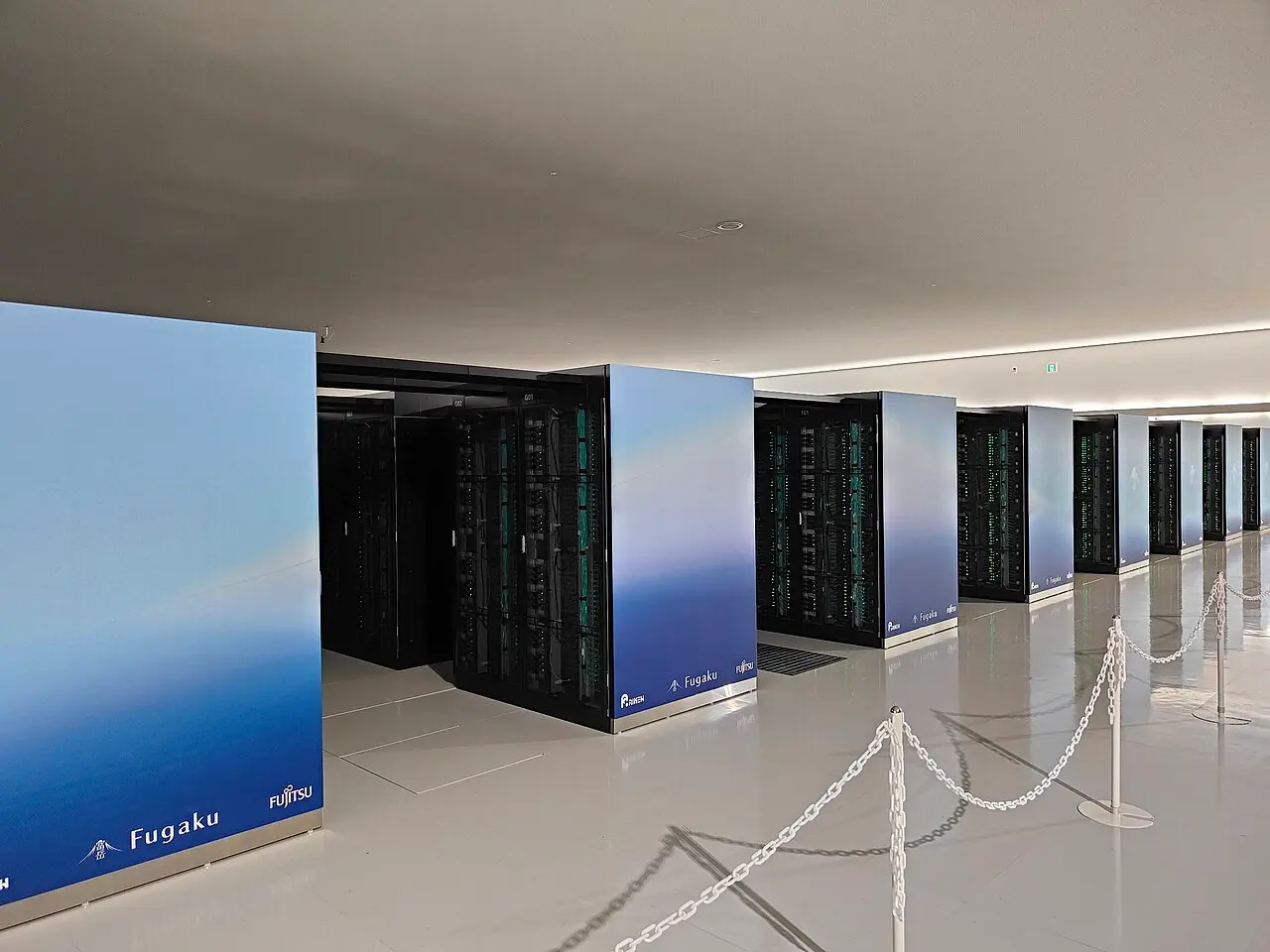
Fugaku (富岳) is a supercomputer that RIKEN and Fujitsu developed from 2014 as the successor to the K computer. On 22 June 2020 (Japan time), world rankings were announced at the online ISC2020 conference, and Fugaku took first place in all four of them: TOP500, HPCG, HPL-AI and Graph500. Its TOP500 LINPACK score was 415.5 petaflops, 2.8 times that of the second-place Summit in the United States.
At that point Fugaku was not finished and not yet open to users. It was completed and opened for shared use on 9 March 2021. The nine months between the day it became the world's fastest and the day it became available is the first thing to get straight if you are looking up dates.
The four rankings
The TOP500 ranks systems by their speed on LINPACK, which solves a large dense system of linear equations. The other three, HPCG (High Performance Conjugate Gradient), HPL-AI and Graph500, each measure performance on a different kind of computation. RIKEN presented first place in all four as evidence of Fugaku's all-round performance.
| Item | June 2020 |
|---|---|
| TOP500 (LINPACK) | 415.5 petaflops, No. 1 (Summit second at 148.8 petaflops) |
| Theoretical peak | 513.85 petaflops |
| Cores | 7,299,072 |
| Processor | Fujitsu A64FX (48 cores, 2.2 GHz) |
| Interconnect | Tofu interconnect D |
| Power | 28,335 kW |
| Four rankings | No. 1 in TOP500, HPCG, HPL-AI and Graph500 |
RIKEN said that taking first place in TOP500, HPCG and Graph500 at the same time was a world first; that is RIKEN's own claim. TOP500 noted that in single or further-reduced precision, often used in machine learning and AI, Fugaku's peak performance exceeded 1,000 petaflops (1 exaflops).
The first No. 1 on Arm
According to TOP500, Fugaku was the first No. 1 system powered by Arm processors. The K computer had used Fujitsu's SPARC64 VIIIfx; for Fugaku, Fujitsu moved to the Arm instruction set and designed its own 48-core A64FX. Arm is the architecture that came to dominate smartphones (see Arm architecture and ARM vs x86), and this was the first time it reached the top of the supercomputer rankings.
At the start of shared use, RIKEN President Hiroshi Matsumoto said he wanted to use Fugaku's world-leading performance and the versatility of the Arm architecture to widen the range of its work. Like the K computer, which took first place without GPUs or other accelerators, Fugaku reached No. 1 on CPUs alone.
COVID-19 work before completion
The last of Fugaku's racks were delivered in May 2020, and from April 2020, before completion, RIKEN offered its computing resources on a trial basis for COVID-19 countermeasures and other work. The best known was a project on predicting and countering droplet infection in indoor environments, led by Makoto Tsubokura, a team leader at the RIKEN Center for Computational Science and professor at Kobe University.
According to PC Watch's August 2020 report, the team used CUBE, a thermal-fluid analysis code implemented on Fugaku, to simulate how droplets and aerosols from coughing and speaking spread.
- A commercial non-woven mask completely blocked droplets larger than 50 microns; a polyester-like cloth mask blocked more than 90% and a cotton-like one about 80%
- Even with gaps at the cheeks and nose, a mask was reported to block 80% of droplets by volume
- Office partitions 1.2 m high were not enough to stop droplets, while partitions 1.4 m or higher tended to create poorly ventilated pockets
The results were released as videos and fed into public discussion of masks and ventilation. In its March 2021 announcement RIKEN wrote that this and related research were prompting changes in how people live.
Completion, shared use, and losing first place
| Date | Event |
|---|---|
| 2014 | RIKEN and Fujitsu begin development (the post-K project) |
| 30 August 2019 | The K computer is shut down |
| April 2020 | Trial use begins, including COVID-19 research |
| May 2020 | All racks delivered |
| 22 June 2020 | No. 1 in four rankings |
| November 2020 | No. 1 in all four rankings again |
| 9 March 2021 | Completed; shared use begins |
| November 2021 | Fourth consecutive TOP500 lead (442 petaflops) |
| June 2022 | The US Frontier takes No. 1 at 1.102 exaflops |
| 22 August 2025 | Development team for FugakuNEXT announced |
When shared use began, RIKEN put Fugaku's application performance at up to 100 times that of the K computer and expected it to be used in drug discovery, weather, earthquakes and tsunamis, materials and more. Fugaku held the TOP500 lead for four lists in a row, through November 2021, and in June 2022 gave it up to Frontier at Oak Ridge National Laboratory in the US, which TOP500 called the first true exascale machine. In the June 2026 list, Fugaku is ninth at 442.01 petaflops.
The successor: FugakuNEXT
On 22 August 2025 RIKEN announced that it would design and develop FugakuNEXT (a development code name) with Fujitsu and NVIDIA. It will be the first Japanese flagship system to use GPUs as accelerators: NVIDIA leads the GPU platform design and Fujitsu the overall system and CPU design. RIKEN aims for operation around 2030 and more than five times Fugaku's hardware performance.
In the same announcement RIKEN looked back on the step from K to Fugaku: about 40 times more hardware performance and about three times more from improving the applications, which together exceeded the 100-fold target for some applications. It also noted that gains from semiconductor scaling are slowing, so large improvements from hardware alone are getting harder. The generation after Fugaku, which reached No. 1 on CPUs alone, will add GPUs to meet the demands of AI.
Other computing milestones of the era are on the hardware timeline.
Questions this page answers
- When did Fugaku become the world's No. 1?
- In the rankings announced at ISC2020 on 22 June 2020 (Japan time). It placed first in TOP500, HPCG, HPL-AI and Graph500, with 415.5 petaflops on LINPACK. It was not yet in shared use; it was completed on 9 March 2021.
- How long was Fugaku No. 1?
- It led four consecutive TOP500 lists: June 2020, November 2020, June 2021 and November 2021. In June 2022 Frontier at Oak Ridge National Laboratory in the US took first place with 1.102 exaflops. In the June 2026 list Fugaku was ninth.
- What processor does Fugaku use?
- Fujitsu's 48-core Arm processor, the A64FX, at 2.2 GHz, with nodes linked by Fujitsu's Tofu interconnect D. TOP500 called it the first No. 1 system powered by Arm processors. Its predecessor, the K computer, used Fujitsu's SPARC64 VIIIfx.
- Is there a successor to Fugaku?
- On 22 August 2025 RIKEN announced it would design and develop FugakuNEXT (a development code name) with Fujitsu and NVIDIA. It will be the first Japanese flagship system to use GPUs as accelerators, and aims for operation around 2030 with more than five times Fugaku's hardware performance.
Sources
Primaryスーパーコンピュータ「富岳」TOP500、HPCG、HPL-AI、Graph500において世界第1位を獲得 — 理化学研究所, 2020年6月23日
First place in four rankings; announced at ISC2020 dated 22 June (22 June Japan time); RIKEN's statement that simultaneous first place in TOP500, HPCG and Graph500 was a world first
PrimaryJune 2020 — TOP500
415.5 petaflops, 2.8 times Summit, 48-core A64FX, first No. 1 powered by Arm, 7,299,072 cores, 28,335 kW
PrimaryNovember 2021 — TOP500
Still No. 1 since June 2020, at 442 petaflops
PrimaryJune 2022 — TOP500
PrimaryJune 2026 — TOP500
Fugaku ninth at 442.01 petaflops with 7,630,848 cores
Primaryスーパーコンピュータ「富岳」完成、共用開始 — 理化学研究所・高度情報科学技術研究機構・富士通, 2021年3月9日
Development from 2014; all racks delivered May 2020; trial use from April 2020; four titles twice; completion and shared use on 9 March 2021; up to 100 times K's application performance
Secondary理研、スパコン富岳で不織布や手作りマスクの飛沫の差を解析 — PC Watch, 2020年8月25日
Makoto Tsubokura's team on predicting and countering droplet infection indoors; the CUBE software; differences by mask material; partition height
Primary理化学研究所、富士通およびNVIDIAとの国際連携による「富岳NEXT」開発体制を始動 — 理化学研究所, 2025年8月22日
GPU adoption, operation around 2030, more than five times Fugaku's hardware performance; K to Fugaku was about 40 times in hardware and about 3 times in applications
Last updated: