PERSON
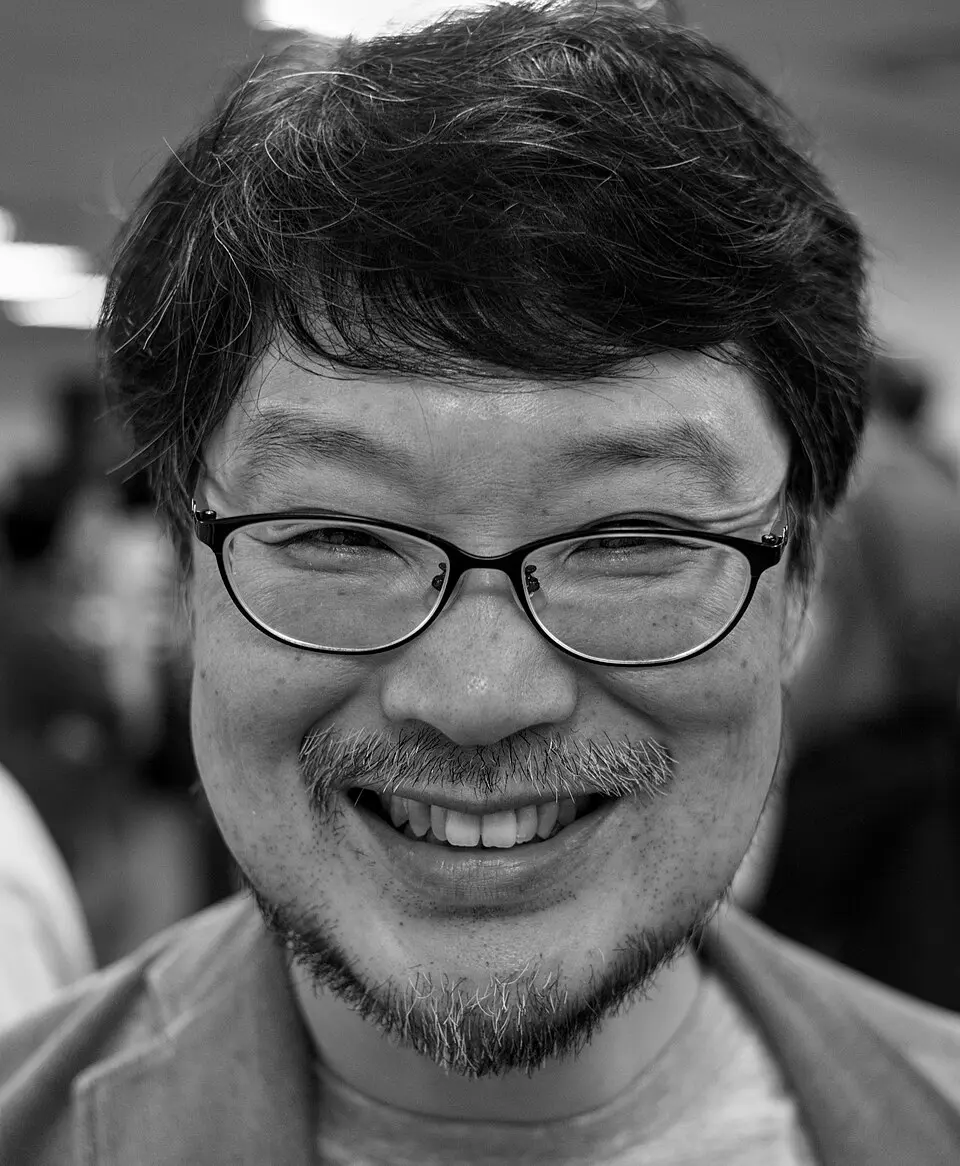
Yukihiro Matsumoto
Designer of the Ruby programming language. Born in 1965. By his own account in the official FAQ, Ruby was born on 24 February 1993; the first public release was version 0.95 in December 1995. He joined Network Applied Communication Laboratory (NaCl) in Matsue, Shimane, in August 1997 and has worked from there since. He has chaired the Ruby Association since its founding in 2007, was made an honorary citizen of Matsue in 2009, and received the FSF's Award for the Advancement of Free Software in March 2012.
Profile
- Born
- 1965
- Status
- Living
- Span
- 1965–
- Appearances
- 01
- Name
- ENYukihiro MatsumotoJAまつもとゆきひろ
Yukihiro Matsumoto — "Matz" — born 14 April 1965, is the designer of the Ruby programming language. He was born in Osaka Prefecture, raised in Tottori from the age of four, and studied information science at the University of Tsukuba. Since joining Network Applied Communication Laboratory (NaCl) in Matsue, Shimane, in August 1997, he has designed and implemented the language from that provincial city for nearly thirty years. Among the general-purpose languages in daily use worldwide, there are very few whose designer stayed in Japan while the language grew.
The birth of Ruby
The official FAQ preserves his own account: "Well, Ruby was born on February 24, 1993. I was talking with my colleague about the possibility of an object-oriented scripting language." The conversation came before the code. The name is a jewel name in the manner of Perl, taken from a colleague's birthstone; the FAQ adds that he later realised Ruby comes right after Perl in several situations.
The first public release was version 0.95, posted to Japanese domestic newsgroups in December 1995. The influences the official site names are Perl, Smalltalk, Eiffel, Ada and Lisp, and the property inherited from Smalltalk is stated as "everything in Ruby is an object." The official formulation is that phrase — not the slogan "pure object-oriented."
Design philosophy
Ruby's philosophy survives best in Matsumoto's own words, above all in the interview Bill Venners conducted with him at the JAOO conference in Aarhus, Denmark on 24 September 2003.
The famous line about programmer happiness is one Venners quoted back to him from Matsumoto's own introductory article: "For me the purpose of life is partly to have joy. Programmers often feel joy when they can concentrate on the creative side of programming, So Ruby is designed to make programmers happy." Matsumoto restated it in his own terms: "By using Ruby, I want to concentrate the things I do, not the magical rules of the language" — attention on the problem, not the ceremony.
The "principle of least surprise," routinely presented as Ruby's founding rule, he flatly disowns: "Actually, I didn't make the claim that Ruby follows the principle of least surprise. Someone felt the design of Ruby follows that philosophy, so they started saying that." His gloss is sharper still — "The principle of least surprise means principle of least my surprise," with the weight on my. Surprise was never an objective metric for all users; the yardstick was the designer's own reaction.
He is similarly wary of orthogonality: "The orthogonal features, when combined, can explode into complexity," and consistency and orthogonality are "tools of design, not the primary goal in design." The willingness to allow several ways of doing a thing he traces directly to Larry Wall, "who is my hero actually." He also rejects the premise of a perfect language: "I tried to make Ruby perfect for me, but maybe it's not perfect for you. The perfect language for Guido van Rossum is probably Python."
A language designed in Japan
Ruby grew first on Japanese bulletin boards and mailing lists and only reached the wider world after Ruby on Rails in 2004. The institutional record follows the same path. The language was established as the Japanese Industrial Standard JIS X 3017 on 22 March 2011 (revised 20 December 2013), corresponding to the international standard ISO/IEC 30170:2012. The body that drafted the JIS was the Ruby Association, which Matsumoto chairs.
That association was founded in July 2007, and he has chaired it from the beginning. On 18 November 2009 the city of Matsue named him an honorary citizen, describing him simply as the developer of the Ruby programming language. Remaining a language designer while remaining in a regional city is, in this case, the reason a regional city acquired a software industry.
Awards
- March 2007 — Ruby received the grand prize of the Nikkei BP Technology Award
- 25 March 2012 — The Free Software Foundation's Award for the Advancement of Free Software, presented at LibrePlanet 2012 at the University of Massachusetts Boston. The FSF's news item titles it the 2011 award; its list of recipients places him in 2012
- 18 November 2009 — Honorary citizen of Matsue
Current activities
His own GitHub profile, as of August 2026, gives his affiliations as Ruby Association and NaCl and his location as Matsue, Japan. He is again a keynote speaker at RubyKaigi 2026.
The language's own milestones continue. Ruby 3.0, released 25 December 2020, delivered the "Ruby 3 will be three times faster than Ruby 2" goal — Ruby3x3 — that had driven development since 2015. The release announcement carries his signed comment: "When I first declared 'Ruby3x3' in the conference keynote, many including members of the core team felt 'Matz is a boaster'. In fact, I felt so too. But we did." Ruby 4.0 followed on 25 December 2025, introducing Ruby Box, an experimental isolation mechanism for definitions, and ZJIT, a new just-in-time compiler written as YJIT's successor. Thirty years on, performance and concurrency remain the language's central work.
Legacy
The core of Matsumoto's argument is that language design is a human problem rather than a machine problem. "Most of our tasks are related to humans after all," he says; computers do not care how much effort communication costs, and people do. Against a tradition that ranked efficiency and expressive power above all, Ruby treated the writer's experience as a first-class design input.
The clearest consequence was cultural, in web development: after Rails, Ruby became the tool that set a startup's initial velocity; that lineage is set out on the event entry. For Japan the implication runs elsewhere. One engineer, working from a regional city in western Japan, spent thirty years demonstrating that designing a programming language is not the exclusive property of English-speaking research institutions and large corporations.
Appearances
Sources
PrimaryOfficial Ruby FAQ, Part 1 — ruby-lang.org
The birthday of 24 February 1993, where the name came from, and the release of 0.95
PrimaryAbout Ruby — ruby-lang.org
The design influences, "everything is an object", and "natural, not simple"
PrimaryRuby 3.0.0 Released — ruby-lang.org, 25 Dec 2020
Ruby3x3, and Matz's own comment
PrimaryRuby 4.0.0 Released — ruby-lang.org, 25 Dec 2025
Ruby Box and ZJIT
Primary会社概要・沿革 — 株式会社ネットワーク応用通信研究所
Yukihiro Matsumoto joined in August 1997
PrimaryRuby Association とは — 一般財団法人 Rubyアソシエーション
Yukihiro Matsumoto as chairman
Primary名誉市民 — 松江市
Yukihiro Matsumoto, 18 November 2009
PrimaryJIS X 3017:2013 プログラム言語Ruby — 日本規格協会
Established 22 March 2011, revised 20 December 2013; the corresponding international standard is ISO/IEC 30170:2012
PrimarySpeakers — RubyKaigi 2026
Lists Yukihiro "Matz" Matsumoto as a keynote speaker
Primarymatz (Yukihiro "Matz" Matsumoto) — GitHub
The affiliation shown as of August 2026
TertiaryYukihiro Matsumoto — Wikipedia
Date and place of birth
Last updated: